Crypto–Fintech Convergence Explained for Travelers

TL;DR:
- Crypto–fintech convergence combines blockchain infrastructure with user-friendly payment platforms to enable seamless crypto payments and settlement for travelers. This shift, driven by stablecoin adoption, institutional investment, and platform integration, reduces friction and offers instant, anonymous, cross-border eSIM purchases. However, tax considerations and provider reliability remain important factors for users to consider before buying.
Crypto–fintech convergence is the fusion of blockchain infrastructure (stablecoins, self-custodial wallets, tokenized assets) with the user-facing products of traditional financial technology, so that a single app or checkout can handle payments, FX conversion, and settlement without the user touching multiple platforms. For travelers, the practical outcome is direct: you can pay for an eSIM data plan using Bitcoin, Ethereum, USDC, or hundreds of other tokens through a wallet like MetaMask, and the merchant’s backend handles the rest. Cryptoesim.io is a working example of this, letting you buy a data plan for 190+ countries with crypto and receive an activation QR code instantly, no bank account or physical SIM required.
What this means in practice:
- Stablecoins like USDC absorb FX volatility at settlement, so the price you see is the price you pay.
- Self-custodial wallets (MetaMask, for example) give you direct control without a custodian in the middle.
- Unified checkout interfaces hide the blockchain complexity, making the experience feel like any other online purchase.
The bottom line: crypto–fintech convergence turns what used to be a technically demanding process into a fast, low-friction checkout for travelers who want connectivity the moment they land.
Table of Contents
- What does crypto–fintech convergence actually mean?
- Why is this convergence happening right now?
- How does this affect you when buying an eSIM with crypto?
- How to buy an eSIM with crypto safely (a U.S. traveler’s checklist)
- Where does adoption stand, and what should you expect next?
- What Cryptoesim.io offers travelers right now
- Key Takeaways
- Why convergence is a net positive, with one honest caveat
- Try Cryptoesim.io before your next trip
- Useful sources and further reading
What does crypto–fintech convergence actually mean?
Think of it this way: your banking app shows your balance, lets you pay bills, and handles currency exchange. Now imagine that same app also holds Bitcoin and Ethereum, settles international transfers in USDC instead of routing through SWIFT, and lets you pay a merchant in Tokyo or Nairobi in seconds. That single-interface experience is convergence in action.
The technical foundation is blockchain in financial services: stablecoins act as the settlement layer, tokenization represents real-world assets on-chain, and smart contracts automate compliance steps that used to require manual reconciliation. Fintech companies layer consumer-friendly UX on top of those rails, so the user never sees the underlying mechanics.
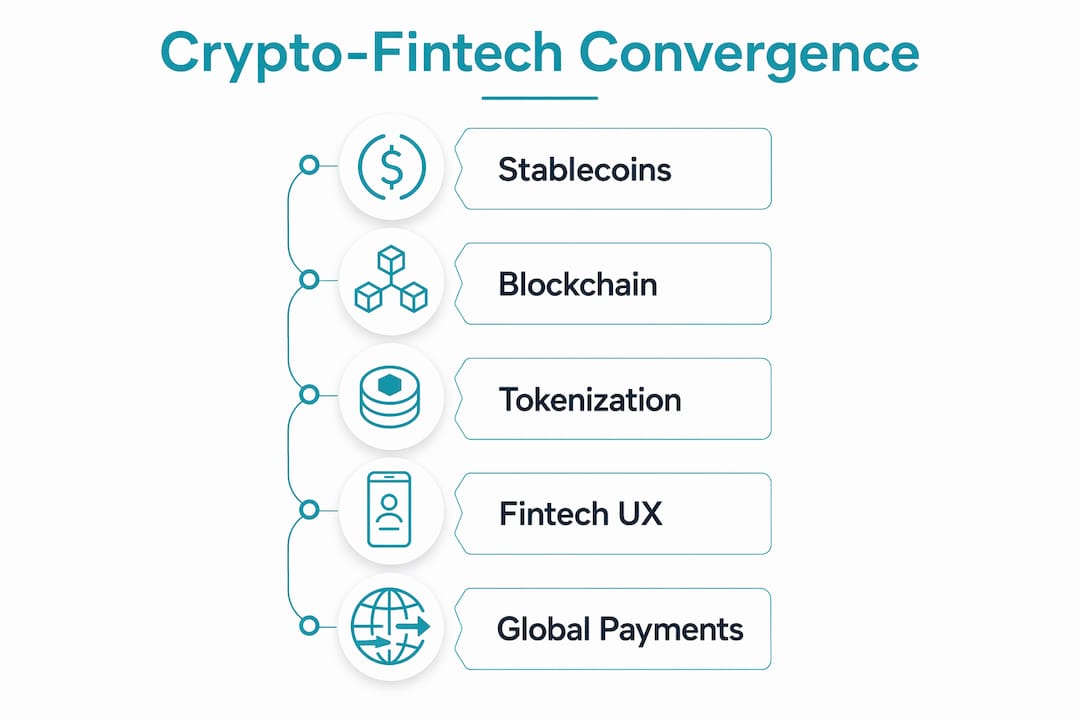
For a traveler at checkout, this shows up as a payment screen that accepts Bitcoin, Ethereum, USDC, and dozens of other tokens simultaneously. MetaMask connects your wallet, you confirm the transaction, and the merchant’s system converts whatever token you sent into a stable settlement asset on the backend. You get your eSIM QR code. The blockchain work happened invisibly.
Why is this convergence happening right now?
The short answer is that the infrastructure finally caught up with the ambition. Three forces are pushing it forward simultaneously.

Stablecoins became real plumbing. a16z describes stablecoins as the foundational layer for a new global finance stack, enabling on-chain payments, FX, and credit primitives that simply did not exist at scale five years ago. When a traveler pays for an eSIM with Ethereum and the merchant settles in USDC, that is stablecoin infrastructure doing exactly what a16z describes.
Institutions stopped experimenting and started building. According to Elliptic’s analysis, blockchain strategies have shifted from optional experiments to business imperatives, with institutions now investing in talent and compliance frameworks to stay competitive. A Broadridge survey found that 84% of financial institutions now consider tokenization a strategic priority.
Fintechs are rebundling. After a decade of unbundling banking into specialized apps, the most successful platforms are now combining payments, treasury, and stablecoin rails into unified products. For a traveler, that means fewer apps, fewer accounts, and a checkout that just works.
How does this affect you when buying an eSIM with crypto?
The benefits are real, but so are a few friction points worth knowing before you pay.
What works in your favor:
- Checkout systems often accept multiple tokens and convert them to a stable asset on the backend, so you do not need to hold a specific coin to complete a purchase.
- USDC-settled transactions reduce the volatility risk that comes with paying in Bitcoin or Ethereum directly.
- Providers like Cryptoesim.io allow anonymous purchases with no account required, which matters if you prefer not to share personal data for a prepaid data plan.
- Cross-border payments settle faster than traditional wire transfers, often in seconds rather than days.
Where friction still exists:
- U.S. travelers should note that the IRS treats cryptocurrency as property, meaning a crypto payment can be a taxable event. Keep your transaction receipts.
- KYC/AML requirements vary by provider. Some platforms require identity verification; others, like Cryptoesim.io, do not for standard prepaid plans.
- Refunds on crypto transactions work differently than credit card chargebacks. If a plan does not activate, the resolution path depends on the merchant’s policy, not your card issuer.
- Blockchain scalability and legacy system interoperability remain unresolved at the institutional level, which can occasionally affect settlement timing.
Pro Tip: Pay with USDC when the option exists. You lock in a dollar-equivalent price at checkout and avoid the scenario where Bitcoin’s price moves between the moment you initiate and the moment the transaction confirms.
How to buy an eSIM with crypto safely (a U.S. traveler’s checklist)
Before you hit “confirm” on any crypto eSIM purchase, run through this sequence.
- Confirm your device is eSIM-compatible. Check your phone’s settings or the manufacturer’s spec page. Most iPhones from XS onward and many Android flagships support eSIM. The global eSIM coverage guide for digital nomads has a quick compatibility reference.
- Check which tokens the provider accepts. Cryptoesim.io supports Bitcoin, Ethereum, USDC, and 300+ other tokens. If you hold a less common token, verify it is on the accepted list before initiating.
- Connect your wallet. MetaMask works for Ethereum and ERC-20 tokens including USDC. For Bitcoin, use a wallet that supports the payment protocol the merchant specifies.
- Review the settlement currency. Understand whether the merchant settles in the token you send or converts to a stablecoin. This affects your cost basis for U.S. tax purposes.
- Read the refund policy before paying. Crypto payments are not reversible the way credit card charges are. Know the merchant’s process for failed activations.
- Complete the purchase and save everything. Download the QR code immediately. Save the on-chain transaction ID, the merchant receipt, and the confirmation email. You will need these for any dispute or tax record.
- Activate the eSIM before you need it. Scan the QR code in your phone’s cellular settings while you still have Wi-Fi. The international eSIM travel setup guide walks through the activation steps for major device types.
Pro Tip: Start with a short-duration plan (1–3 days) on your first crypto eSIM purchase. It limits your exposure if something goes wrong with activation, and you can top up once you confirm the plan works on your device.
Where does adoption stand, and what should you expect next?
The market is past the pilot stage for consumer-facing crypto payments. Institutional infrastructure is the part still catching up.
| Milestone | Status |
|---|---|
| Stablecoin rails in consumer checkout | Production (multiple providers) |
| Bank tokenization initiatives | Integration phase (2026) |
| Qivalis (37-bank Euro stablecoin consortium) | Active in 2026 |
| DTCC tokenization pilots | 50+ banks collaborating |
| Unified fiat/stablecoin checkout for eSIMs | Available now at Cryptoesim.io |
Guidehouse’s Q2 2026 analysis confirms that institutional projects, including the Qivalis consortium of 37 European banks and DTCC tokenization collaborations involving more than 50 banks, have moved from pilot to active integration. That institutional momentum matters to travelers because it means the settlement rails underlying your eSIM purchase are becoming more reliable, not less.
A February 2026 Arizent Research and American Banker survey found that 79% of U.S. banks and credit unions consider a unified platform for traditional and tokenized payments important. That is the infrastructure layer that will eventually make crypto checkout as routine as Apple Pay.
Expect incremental improvement through 2026: wider stablecoin settlement options, faster confirmation times, and more providers accepting crypto without requiring account creation.
What Cryptoesim.io offers travelers right now
Cryptoesim.io is a direct example of crypto–fintech convergence applied to travel connectivity. The platform’s crypto-integrated eSIM checkout covers the features that matter most for a traveler paying with digital assets.
- 190+ countries covered with instant digital activation via QR code.
- Bitcoin, Ethereum, USDC, and 300+ tokens accepted at checkout, no single-token requirement.
- No account required. Purchase anonymously with crypto and receive your activation code by email.
- Plans from 1 day to 1 year, so you can match the plan length to your trip without overpaying.
- 24/7 support for activation issues, which matters when you land at 2 AM and need data immediately.
A practical scenario: a remote worker flying into Southeast Asia buys a 30-day regional plan with USDC via MetaMask before boarding. The QR code arrives by email. On arrival, they scan it in their phone’s cellular settings over airport Wi-Fi and have data before leaving the terminal. No SIM card hunt, no currency exchange desk, no carrier contract.
Pro Tip: Save your on-chain transaction ID alongside the Cryptoesim.io order confirmation. If you ever need to dispute a charge or document the expense for tax purposes, having both the merchant receipt and the blockchain record makes the process straightforward.
Key Takeaways
Crypto–fintech convergence is already delivering practical benefits for travelers: faster checkout, stable pricing via USDC, and anonymous eSIM purchases across 190+ countries with no account required.
| Point | Details |
|---|---|
| Convergence definition | Blockchain rails plus fintech UX create a single checkout that handles payments, FX, and settlement. |
| Stablecoin advantage | Paying with USDC locks in a dollar-equivalent price and removes volatility risk at checkout. |
| U.S. tax note | Crypto payments are taxable events; save your transaction ID and merchant receipt every time. |
| Adoption momentum | 84% of financial institutions now treat tokenization as a strategic priority, per Broadridge. |
| Cryptoesim.io | Supports Bitcoin, Ethereum, USDC, and 300+ tokens for instant eSIM activation in 190+ countries, no account needed. |
Why convergence is a net positive, with one honest caveat
The conventional take on crypto payments for everyday purchases is that they are too volatile, too complicated, and too risky for the average traveler. That framing is about three years out of date. Stablecoin settlement has solved the volatility problem at the point of sale. Wallet interfaces like MetaMask have solved most of the complexity. What remains is the tax and record-keeping discipline that U.S. travelers genuinely need to maintain.
The bigger risk is not the technology. It is buying from a provider that has not thought through the refund flow or does not offer real support when activation fails at midnight in a foreign airport. The checklist in this article addresses that directly. Platforms that combine institutional-grade compliance with a consumer-grade checkout experience are the ones worth using. Cryptoesim.io sits in that category: anonymous purchase, instant QR delivery, and 24/7 support are not marketing language when you are standing in an airport with no data.
Try Cryptoesim.io before your next trip
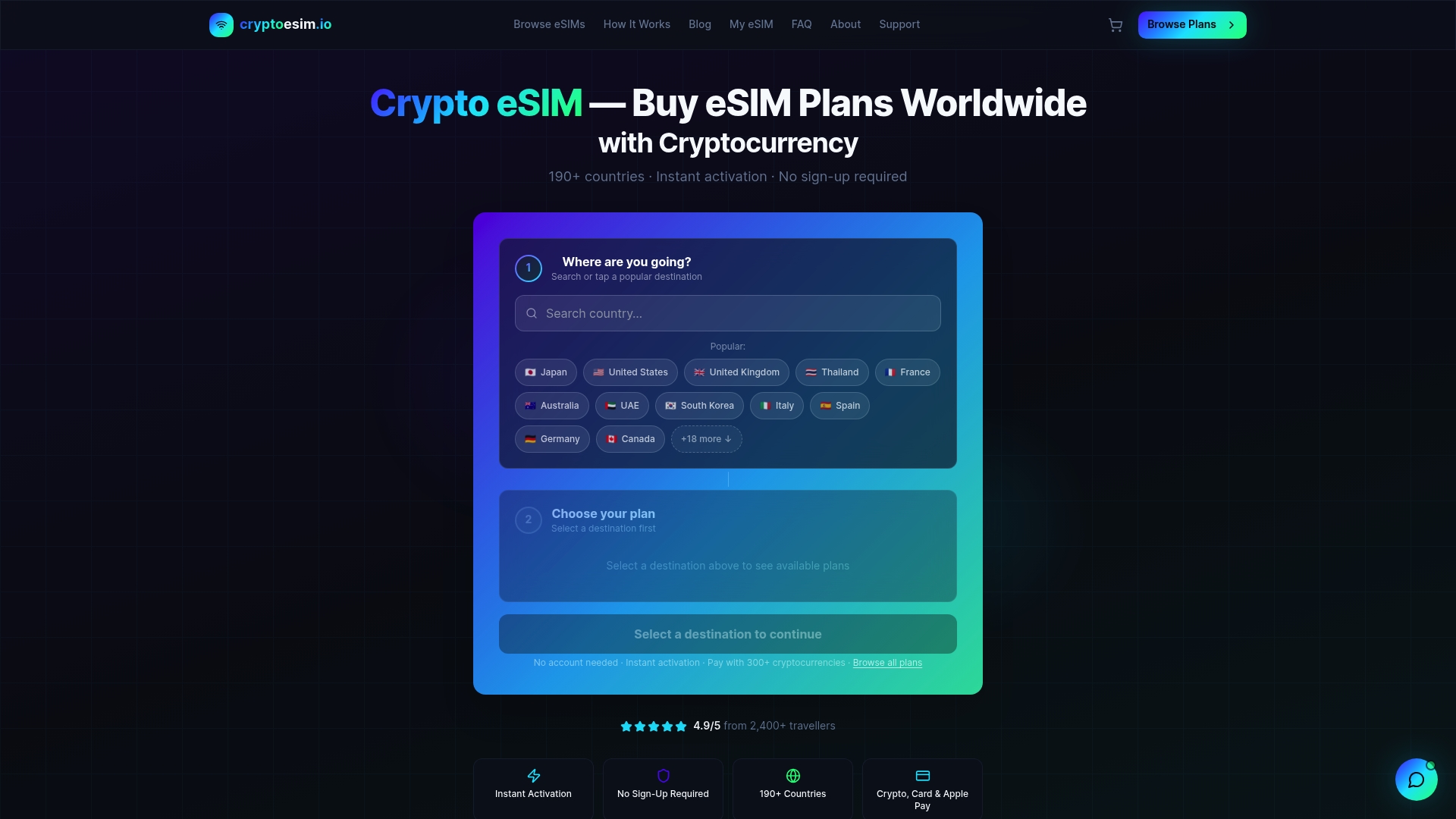
Cryptoesim.io gives travelers a faster alternative to airport SIM kiosks and carrier roaming plans: pay with Bitcoin, Ethereum, USDC, or 300+ other tokens, receive your eSIM activation QR code instantly, and get connected in 190+ countries with no account, no contract, and no physical SIM. Before you check out, run three quick verifications: confirm your device supports eSIM, check that your preferred token is accepted, and read the refund policy for failed activations. When you are ready, browse available eSIM plans and complete your purchase in under two minutes.
Useful sources and further reading
- The new stack for global finance: Stablecoins edition — a16z crypto. Explains how stablecoins function as settlement infrastructure for cross-border payments and new financial primitives. Essential background for understanding why eSIM crypto checkout works the way it does.
- Q2 2026 digital asset insights: Embedded, integrated, and connected — Guidehouse. Tracks institutional adoption milestones including the Qivalis consortium and DTCC tokenization pilots. Useful for understanding the infrastructure timeline behind consumer crypto payments.
- Cryptoasset and TradFi convergence set to accelerate in 2026 — Elliptic. Covers compliance frameworks and the shift from experimental to mandatory blockchain strategies at major institutions. Relevant for U.S. travelers tracking regulatory direction.
- How Digital Asset Infrastructure Is Rebundling Finance — FintechFilter. Explains the rebundling trend and why unified platforms benefit consumers. Good context for why a single checkout can now handle multiple tokens and stablecoin settlement.
- Tokenization has become a strategic priority for 84% of financial firms — CoinDesk / Broadridge. The Broadridge survey data on institutional tokenization adoption and hybrid market expectations.
- Cryptoesim.io — CryptoeSIM.io. The platform for purchasing eSIM data plans with crypto across 190+ countries, with instant QR code delivery and no account required.