Crypto Spending Power: Buy eSIMs With Crypto in 2026

Crypto spending power is your ability to pay for goods and services directly from a crypto balance, where any conversion to fiat happens at the moment of checkout, not before. For travelers buying international eSIM data plans, this distinction is the whole game. Use stablecoins like USDC or a crypto-enabled virtual card, and your eSIM activates almost immediately. Sell to fiat first, and you are looking at trading fees, bank delays, and a taxable event before you have even picked a data plan.
The Payments Innovation Tracker (2026) calls spendability the next real test for digital assets, noting that the main obstacle is infrastructure rather than demand. eSIMs and mobile data top-ups are already on the right side of that infrastructure gap. According to the Genghis Crypto Livability Index, connectivity, airtime, and eSIMs are the most widely available crypto spending rails globally, often the first or only reliably purchasable category in many markets.
| Takeaway | What it means for you |
|---|---|
| Conversion at checkout = spending power | Selling to fiat first does not count and adds fees |
| Stablecoins reduce volatility risk | USDC or USDT pegged spend limits price-swing exposure |
| eSIMs are a top-tier crypto rail | Near-instant activation when the merchant accepts crypto natively |
| Cryptoesim accepts hundreds of tokens | No account required; QR code delivered after payment confirms |
Table of Contents
- What crypto spending power actually means (and what it doesn’t)
- How the payment rails actually move your crypto to a merchant
- Why buying an international eSIM is one of the best uses of crypto spending power
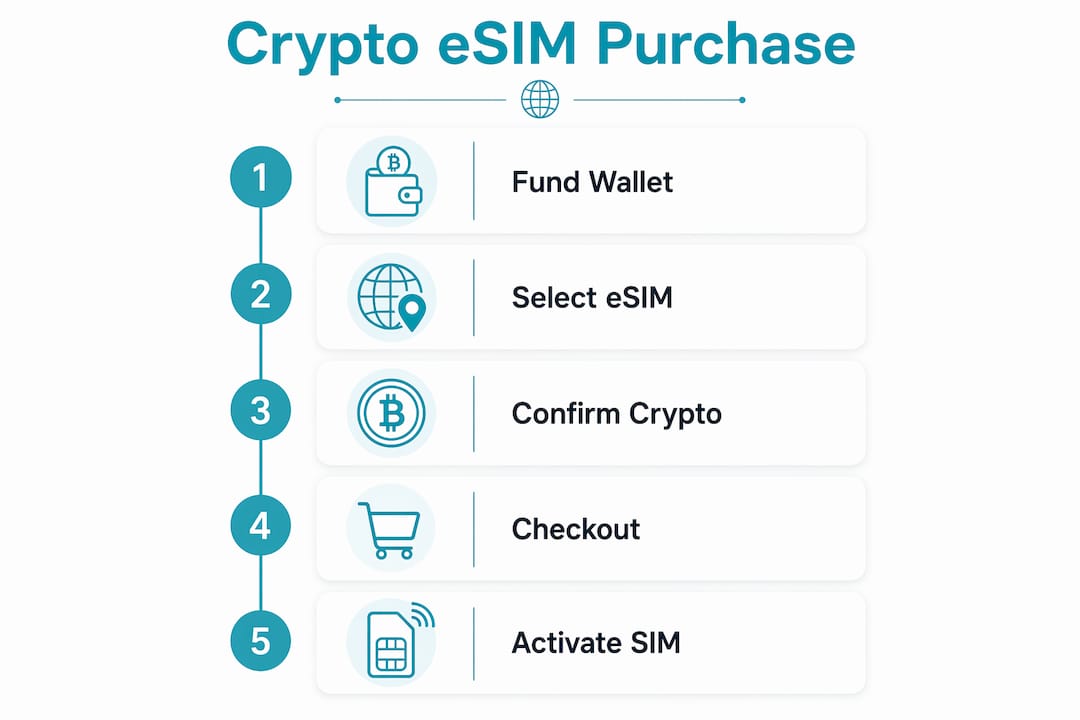
- Step-by-step: how to complete a crypto checkout for an eSIM
- Fees and timing to expect in the United States
- Security, privacy, and U.S. tax considerations
- Quick checklist before you hit Buy on a crypto eSIM checkout
- Key Takeaways
- What I’ve seen travelers get wrong at crypto checkout
- Cryptoesim makes crypto eSIM checkout straightforward
- Useful sources
What crypto spending power actually means (and what it doesn’t)
The Genghis Crypto Livability Index draws a hard line: conversion at the point of payment counts as living on crypto; selling to fiat and then paying does not. That boundary matters because every pre-sale to fiat is a potential taxable disposal event in the U.S., plus trading fees and withdrawal delays that can stretch days.
Stablecoins like USDC sit right on that boundary in the most useful way. Because they are pegged to the dollar, spending them triggers a disposal event with near-zero gain or loss, which dramatically reduces the reporting burden compared with spending volatile tokens. Regulated bridges, such as the virtual card Uphold introduced with its Visa Signature card, let customers pledge crypto holdings to unlock spending without selling the underlying asset. As Uphold CEO Simon McLoughlin framed it, the goal is to preserve crypto exposure while unlocking spending power, not force a choice between the two.
- Conversion at POS via a bridge or card = spending power preserved
- Pre-sale to a bank account = spending power lost, fees and taxes triggered
- Stablecoin spend = disposal event with minimal gain/loss impact
- Volatile token spend = full capital gains calculation required per transaction
Pro Tip: Keep a small, dedicated USDC balance on a low-fee network like Polygon specifically for purchases. It acts as a spending account that does not touch your core holdings and keeps each transaction’s tax footprint close to zero.
How the payment rails actually move your crypto to a merchant
Three architectures dominate right now, explained clearly in how AI detects spending patterns: a clear guide for crypto payment processors. Card bridges convert crypto to fiat at swipe, routing through Visa or Mastercard rails so any merchant that takes a card takes your crypto. Regulated stablecoin bridges route USDC or similar tokens through compliant processors that settle to the merchant in fiat invisibly. Direct on-chain settlement skips conversion entirely when the merchant accepts tokens natively, which is increasingly common for digital goods like eSIMs.

The Payments Innovation Tracker frames invisible rails as the practical goal: crypto payments that feel indistinguishable from fiat to both buyer and seller. That is exactly what a well-built eSIM checkout delivers. A self-custody USDC wallet paired with a virtual card can pay any Visa-accepting merchant while leaving your Bitcoin or ETH holdings untouched.
| Rail type | Preserves crypto exposure | Typical speed | Typical fee shape |
|---|---|---|---|
| Card bridge (custodial) | No, converts at swipe | Instant | 1–3% conversion spread |
| Stablecoin bridge (regulated) | Partial (stablecoin held) | Seconds to minutes | Small processor fee |
| Direct on-chain (native token) | Yes | 1–5 min (chain-dependent) | Network gas only |
| Crypto-collateral card | Yes (holdings pledged) | Instant | Interest or fee on credit line |
Custodial flows require KYC and hand your data to the processor. Non-custodial flows, where you sign from your own wallet, keep your holdings private but require you to manage gas. For micro-purchases like an eSIM plan, Polygon gas fees for stablecoin transfers typically run $0.0005–$0.01 per transaction, making on-chain spend genuinely practical.
Why buying an international eSIM is one of the best uses of crypto spending power
eSIMs and mobile top-ups sit at the top of the Genghis spending-rails index because global aggregators accept crypto broadly, with near-universal operator coverage. Unlike rent or utility bills, which still hit jurisdictional banking cliffs in most countries, a crypto eSIM checkout is a digital-to-digital transaction with no physical fulfillment delay.
- Instant provisioning: when the merchant settles on-chain or via stablecoin, the QR code arrives within minutes of payment confirmation
- No shipping, no physical SIM, no carrier store: the entire flow is software
- Stablecoin-funded virtual cards work at any eSIM seller that accepts standard card payments
- Direct crypto checkout at sellers like Cryptoesim skips the card layer entirely
Buying a 7-day global data plan with USDC on a crypto-native eSIM platform is the clearest example of crypto spending power working as intended: you hold USDC, you pay USDC, the merchant receives settlement, and your QR code arrives before you finish your coffee. No bank, no exchange, no waiting.
The crypto payments guide for travelers on Cryptoesim’s blog walks through exactly this flow, including what to expect at each confirmation step.
Step-by-step: how to complete a crypto checkout for an eSIM
- Choose your spending account. Load USDC onto a low-fee network (Polygon is practical for small amounts) or fund a vetted virtual card from your self-custody wallet. Avoid sending volatile tokens directly unless the seller locks the rate at checkout.
- Select your plan and open checkout. Pick the data plan, select crypto payment, and confirm which network and token the seller accepts. Mismatched networks are the single most common cause of failed transactions.
- Check the rate and fees. Note the processor’s conversion rate or spread before confirming. Some sellers lock the rate for 10–15 minutes; others reprice at confirmation.
- Confirm KYC requirements. Virtual card flows and some processors require identity verification. Direct on-chain checkouts at platforms like Cryptoesim typically do not require an account or KYC.
- Send the transaction. Confirm the wallet address or scan the QR code, set an appropriate gas fee for your network, and submit.
- Wait for confirmation and activation. On-chain confirmations take 1–5 minutes depending on the network. The eSIM QR code should arrive by email or on-screen immediately after the seller’s processor confirms receipt.
- Troubleshoot if needed. If the QR code does not arrive within 10 minutes, locate your transaction hash in your wallet and send it to the seller’s support. That hash is proof of payment and speeds resolution significantly.
Pro Tip: Fund exactly what you need for the purchase into a dedicated spending wallet before you start checkout. It limits your tax exposure to one small transaction and prevents accidentally sending from a long-held position with a large embedded gain.
Understanding how to use crypto for eSIMs in detail can save you from the most common checkout mistakes before you hit the airport.
Fees and timing to expect in the United States
Selling crypto through an exchange before spending adds trading fees, withdrawal fees, and days of settlement. On-chain and stablecoin flows cut that down sharply.
| Fee item | Typical range | When it applies |
|---|---|---|
| Polygon USDC gas | $0.0005–$0.01 | Every on-chain send |
| Processor conversion spread | 0.0005–1% | Card bridge or regulated bridge |
| Merchant convenience fee | 0–2% | Seller-specific; check at checkout |
| On-chain confirmation time | 1–5 minutes | Polygon, most L2s |
| eSIM provisioning window | Instant to 10 minutes | After seller confirms receipt |
- U.S. buyers face no federal restriction on using crypto for purchases, but every spend of a non-stablecoin token is a reportable disposal event with the IRS
- Stablecoin spend (USDC at $1.00 peg) typically produces near-zero gain or loss, reducing reporting complexity
- Card bridge fees are higher but offer the widest merchant compatibility
Security, privacy, and U.S. tax considerations
The IRS treats cryptocurrency as property. Every time you spend a non-stablecoin token, you realize a capital gain or loss equal to the difference between your cost basis and the token’s value at the moment of the transaction. That applies to crypto used in a transaction regardless of the purchase amount. Stablecoin spend at a stable peg minimizes this, but it does not eliminate the reporting requirement entirely.
According to the Stablecoin Utility Report 2026, 27% of stablecoin holders already spend directly on goods and services, while 45% convert to local currency first. The gap between those two behaviors is exactly the difference between spending power and selling to spend.
For security, use a hardware wallet or a segregated spending wallet, never your primary holdings wallet, for checkout. Verify the seller’s domain carefully before entering any wallet address. On privacy: direct on-chain flows at no-KYC eSIM platforms share minimal data with merchants, while card-bridge flows share your identity with the card issuer and processor. Consult a tax professional for advice specific to your situation; this article is general information, not tax or legal guidance.
Quick checklist before you hit Buy on a crypto eSIM checkout
- Token and network match: confirm the seller accepts your specific token on your specific chain
- Sufficient gas: your wallet needs a small native token balance (e.g., MATIC on Polygon) beyond the payment amount
- Rate lock window: note how long the quoted rate is valid before it refreshes
- KYC status: know whether the flow requires identity verification before you start
- Provisioning window: check the seller’s stated delivery time for the eSIM QR code
- Refund policy: read the seller’s policy on failed activations before paying
- Screenshot your confirmation: save the transaction hash immediately after sending
Pro Tip: Take a screenshot of the transaction hash the moment your wallet confirms the send. If activation stalls, that hash is the fastest way for support to locate your payment and push through the eSIM delivery.
Key Takeaways
Crypto spending power works best for eSIM purchases when you convert at checkout, not before, using stablecoins on low-fee networks to keep costs and tax events minimal.
| Point | Details |
|---|---|
| Conversion at checkout | Spending power requires conversion at the point of payment, not a pre-sale to fiat. |
| Stablecoins cut tax friction | USDC spend at peg produces near-zero gain or loss, simplifying IRS reporting. |
| eSIMs are a top crypto rail | Connectivity is among the most widely available crypto spending categories globally. |
| Low-fee networks matter | Polygon USDC gas runs $0.0005–$0.01, making micro-purchases genuinely cost-effective. |
| Cryptoesim for instant activation | Cryptoesim accepts hundreds of tokens across 190+ countries with no account or KYC required. |
What I’ve seen travelers get wrong at crypto checkout
The wrong-chain mistake is the most expensive and the most avoidable. Sending USDC on Ethereum mainnet to a seller expecting Polygon USDC means your funds sit in limbo until support manually reconciles the transaction, which can take hours. Always confirm the chain, not just the token.
The second pattern worth flagging: funding a volatile token right before purchase. If you buy ETH specifically to pay for an eSIM, you are exposed to price movement between purchase and checkout, and you are creating a cost-basis event on the ETH itself. Fund USDC ahead of time and the problem disappears.
For large-merchant compatibility, a virtual card funded from a self-custody USDC wallet is the most reliable path. For crypto-native sellers, direct on-chain checkout is faster and cheaper. When activation stalls, the transaction hash is your best tool. Provide it to support immediately rather than waiting for an automated system to catch up.
Cryptoesim makes crypto eSIM checkout straightforward
Travelers who want to put crypto spending power to immediate use have a direct option. Cryptoesim supports Bitcoin, Ethereum, and over 300 other tokens for eSIM data plans covering 190+ countries, with no account creation and no KYC required at checkout. The platform’s flow is built around instant provisioning: once your transaction confirms on-chain, the eSIM QR code is delivered immediately.
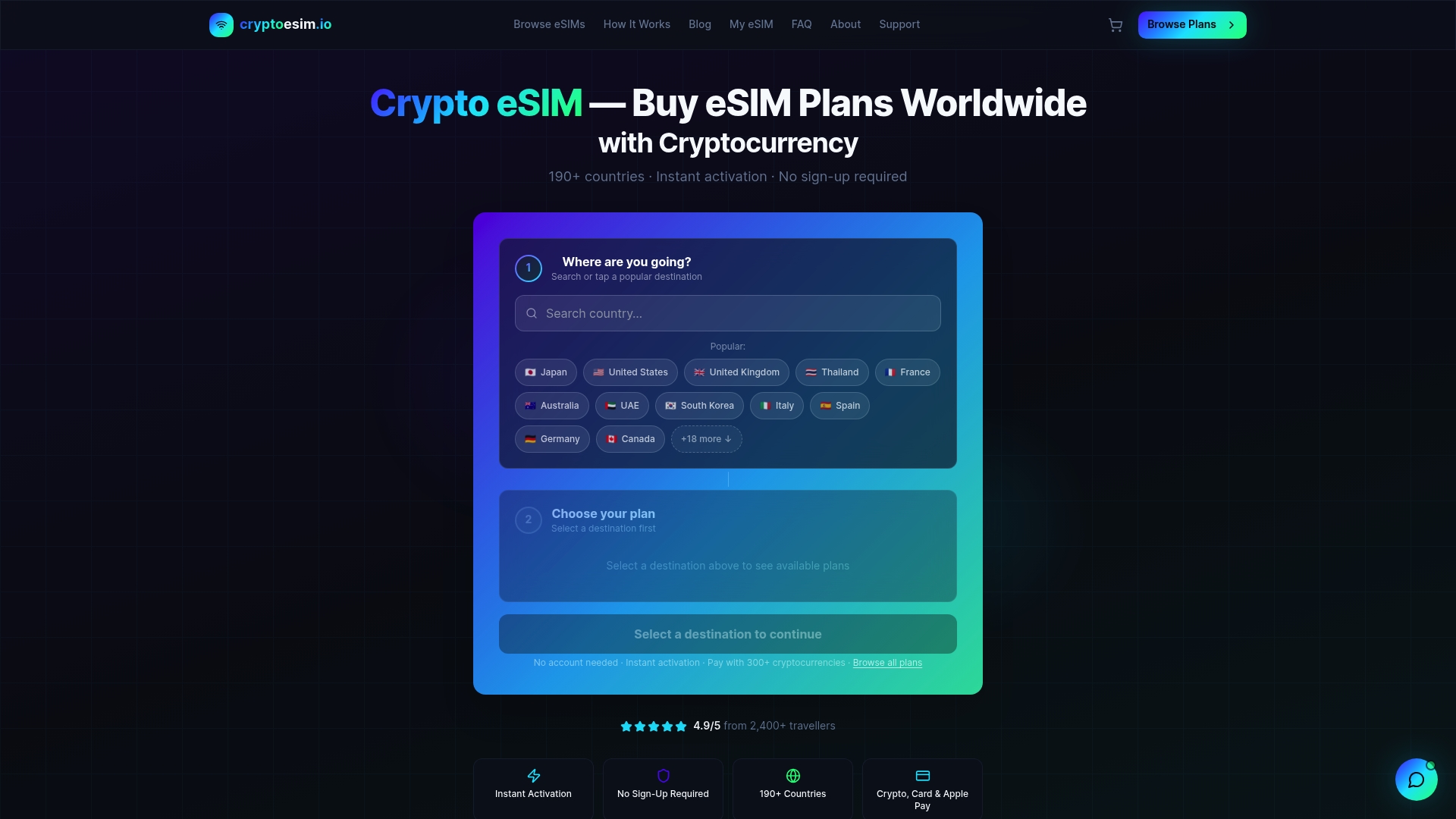
That means no waiting for a bank to settle, no exchange withdrawal delays, and no physical SIM to track down at an airport kiosk. For U.S. travelers heading abroad, it is one of the cleanest examples of crypto purchasing ability working exactly as the infrastructure promises. Browse available global data plans and pay directly from your crypto wallet.
Useful sources
- Digital Assets: From Investment to Spending Power, Payments Innovation Tracker (2026)
- What Living on Crypto Means, Genghis Crypto Livability Index
- Spending Rails: Where Crypto Pays, Genghis Crypto Livability Index
- How to Use Crypto for Everyday Payments Without an Exchange, Tangem Blog
- Uphold Unlocks Crypto Spending Power with a Premium Visa Signature Credit Card, Yahoo Finance
- Crypto’s $300 Billion Stablecoin Supply Is Increasingly Used as Everyday Money, The Block
- Crypto Assets: Buying and Selling, FINRA
- A Beginner’s Guide to Paying With Cryptocurrency, Investopedia
- Cryptoesim eSIM Privacy and No-KYC Options
- Consult a qualified U.S. tax professional for jurisdiction-specific guidance on crypto disposal events and IRS reporting obligations.