Pseudonymous Payments Explained for Travelers and Nomads

A pseudonymous payment is a transaction tied to a persistent identifier, like a cryptocurrency wallet address, rather than your real name or government ID. For travelers, the practical takeaway is straightforward: it shields your identity from merchants but does not make you invisible. Every amount, timestamp, and address is recorded permanently on a public blockchain ledger, and that record is linkable if someone connects your address to your real identity. For small, repeatable purchases like eSIM data plans, pseudonymous payments work well when combined with basic wallet hygiene.
Table of Contents
- What is pseudonymous payment and how does it technically work?
- How do pseudonymous, anonymous, and identity-tied payments compare?
- Why do travelers and digital nomads use pseudonymous payments?
- What are the real traceability limits and U.S. regulatory considerations?
- How to buy an eSIM with a pseudonymous payment, step by step
- Privacy and safety best practices for pseudonymous payments
- What costs and confirmation times should you expect?
- When are pseudonymous payments a poor choice?
- Key Takeaways
- Why this matters more than most travelers realize
- Cryptoesim makes pseudonymous eSIM checkout practical
- Primary sources and further reading
What is pseudonymous payment and how does it technically work?
Your wallet address is the identifier. It stands in for your name the way a pen name stands in for an author. When you send crypto, the blockchain records three things: the sending address, the receiving address, and the amount, along with a timestamp. Nobody sees “John Smith paid $12.” They see two alphanumeric strings and a value.
The core mechanics break down like this:
- Public/private keys: Your private key signs the transaction; your public key (wallet address) is what the world sees. The signature proves you authorized the payment without revealing who you are.
- Public ledger entries: Every confirmed transaction is permanently visible to anyone. Blockchain ledgers record amounts, timestamps, and addresses in full.
- Address reuse vs. fresh addresses: Reusing the same address across purchases creates a transaction history anyone can browse. Generating a fresh address per purchase breaks that clustering.
- Exchange KYC linkage: If you ever deposit to or withdraw from a centralized exchange that required ID verification, that exchange can connect your address to your legal name.
A simple transaction flow for buying an eSIM: your wallet broadcasts a signed transaction → nodes validate and include it in a block → the merchant’s payment processor detects the confirmed payment → your eSIM QR code is delivered. The merchant never sees your name, only an address and a confirmed amount.
How do pseudonymous, anonymous, and identity-tied payments compare?
The one-line version: pseudonymous means a persistent alternative identity; anonymous means no linkable identifier at all; identity-tied means your name and ID are attached from the start.
| Dimension | Anonymous (e.g., cash) | Pseudonymous (e.g., Bitcoin) | Identity-tied (e.g., credit card) |
|---|---|---|---|
| Identifier visibility | None | Wallet address (public) | Name, card number, billing address |
| Transaction traceability | Minimal | Full ledger history | Full bank/card record |
| Merchant KYC interaction | None | None by default | Required |
| Ease of use online | Very limited | Moderate | High |
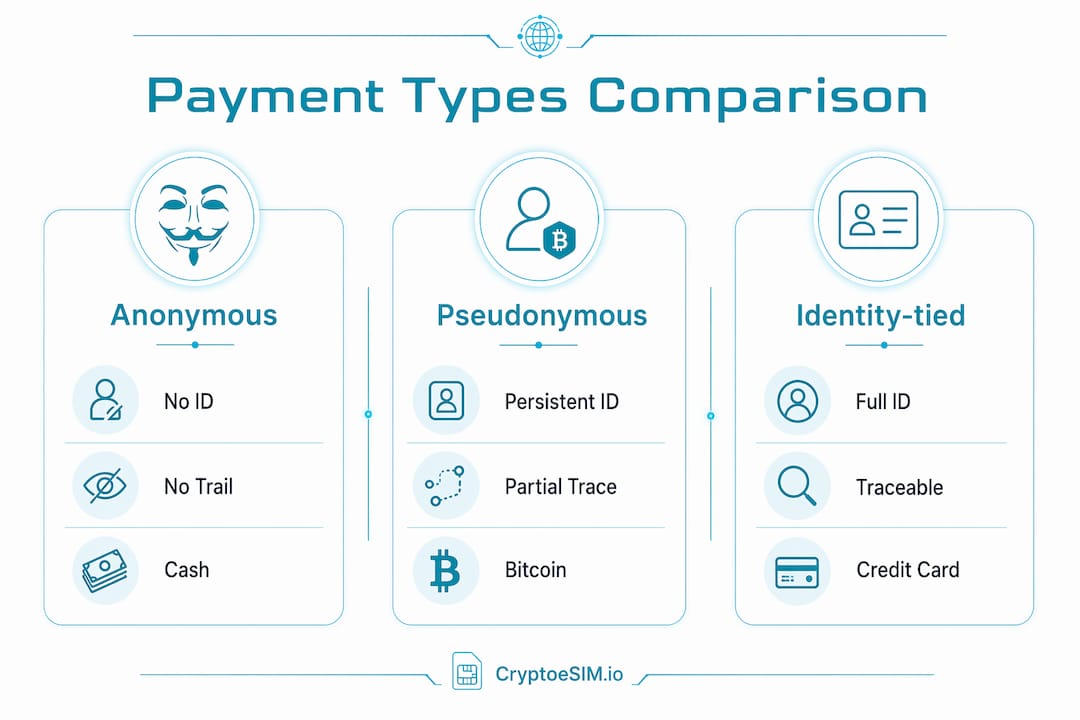
Cash is the clearest example of anonymous payment: no record, no identifier, no trail. A credit card is the clearest identity-tied example: your name is on every transaction. A Bitcoin address sits in the middle. The BIS working paper on privacy-enhancing technologies describes this spectrum precisely, noting that Bitcoin and Ethereum are pseudonymous and can be de-anonymized, while some privacy-focused coins offer stronger obfuscation. For most eSIM purchases, the pseudonymous middle ground is the practical sweet spot.
Why do travelers and digital nomads use pseudonymous payments?
The main benefits are privacy against merchants, lower friction across borders, and faster settlement. No bank hold, no currency conversion delay, no form asking for your billing address in a country you left three weeks ago.
Travel-specific advantages worth knowing:
- No cross-border holds: Crypto payments clear without triggering the fraud flags that often freeze cards used abroad.
- Less personal data shared: Merchants receive a wallet address, not your name, email, or card number.
- Quick micro-purchases: Buying a short-term eSIM plan takes minutes. No account creation, no ID upload.
- Lower fees on some networks: Reduced intermediary involvement cuts out processors and banks, which often means lower transaction costs, especially on faster chains.
For travelers buying multiple short-term eSIM plans across different countries, pseudonymous payments reduce the data footprint with each purchase. Each transaction exposes only a wallet address, not a growing profile of your travel history tied to a card number. ECB economic research supports the broader point: privacy-preserving payment forms can increase online commerce because users trade controlled privacy for convenience, benefiting both buyers and sellers.
What are the real traceability limits and U.S. regulatory considerations?
Pseudonymity protects your merchant-facing identity. It does not protect your ledger metadata. Amounts, timestamps, and address relationships are public and permanent.
The main deanonymization vectors:
- Exchange KYC linkage: If a wallet address was ever used on a KYC’d exchange, forensic tools can cluster related addresses and tie them to your legal identity.
- Address reuse: Reusing an address across purchases creates a browsable history. One slip, and the whole chain is exposed.
- IP address leaks: Broadcasting a transaction from your home IP can link your address to your location. A VPN at checkout reduces this risk.
- Merchant databases: If a merchant stores your email alongside your wallet address, that pairing can surface later.
In the U.S., the regulatory picture is clear: the Bank Secrecy Act and FinCEN rules require crypto exchanges and money services businesses to collect and report customer identity information under AML/KYC frameworks. Law enforcement can subpoena exchange records and use blockchain analytics to trace pseudonymous addresses to real people. For travelers, this means pseudonymous payments are legal and practical for everyday purchases, but they are not a mechanism for evading financial reporting obligations. Purchases that trigger reporting thresholds or involve regulated services will still require identity disclosure through the relevant institution.
How to buy an eSIM with a pseudonymous payment, step by step
You can complete a pseudonymous eSIM purchase without creating an account by paying from a fresh wallet address. Here is the exact flow using Cryptoesim as the example:
- Prepare a fresh wallet address. Generate a new address in your wallet app, or use a wallet that auto-generates a new address per transaction. Do not reuse an address linked to a KYC’d exchange.
- Select your eSIM plan. Browse Cryptoesim’s eSIM packages by country or region. No account required.
- Choose crypto at checkout. Select your preferred cryptocurrency. Cryptoesim accepts Bitcoin, Ethereum, and over 300 other tokens.
- Verify the payment address. Before sending, confirm the on-screen wallet address matches the one in your order confirmation. Clipboard-hijacking malware can silently replace addresses.
- Broadcast the transaction. Send the exact amount shown. Double-check the fee level for your urgency.
- Confirm the transaction ID. Copy the transaction hash from your wallet and verify it on a block explorer. This is your receipt.
- Receive your eSIM QR code. Once the payment confirms, your QR code is delivered instantly. Scan it to activate.
Pro Tip: Run a small-value test purchase first. Verify the receiving address through two channels, the checkout page and the order confirmation, before sending any larger amount.
Privacy and safety best practices for pseudonymous payments
Good wallet hygiene and minimal linking are the most effective privacy controls. Everything else is secondary.

Use disposable addresses. Generate a fresh address for each purchase. BIP-47 payment codes offer a structured way to do this without losing track of incoming payments.
Avoid KYC on/off ramps where possible. Never consolidate funds from a KYC’d exchange into the wallet you use for pseudonymous purchases. That single step destroys the privacy separation. For digital identity protection, keeping your pseudonymous wallet entirely separate from exchange-linked accounts is the single most important habit.
Connect over a VPN at checkout. Your IP address can link your wallet to your physical location. A VPN at the moment you broadcast a transaction reduces that exposure.
Keep receipts separate. Store transaction IDs and QR codes in a notes app or encrypted file that is not connected to your personal email or cloud account.
Watch for these red flags: a merchant asking for ID after advertising anonymous checkout, a request to pay via traceable bank transfer mid-flow, or a checkout requiring an account linked to your phone number or personal email.
Pro Tip: Never move funds from a KYC-linked exchange wallet directly into the pseudonymous wallet you use for purchases. The linkage follows the funds.
What costs and confirmation times should you expect?
On-chain fees and block confirmation times are the primary cost and delay drivers. Payment processors and layer-2 networks change that equation significantly.
- Slow chains (e.g., Bitcoin mainnet): Fees vary with network congestion; confirmation can take 10–60 minutes at standard fee levels.
- Fast chains (e.g., Solana, Polygon, BNB Chain): Fees are typically a fraction of a cent; confirmations often complete in seconds to a few minutes.
- Layer-2 options (e.g., Lightning Network for Bitcoin): Near-instant settlement at very low cost, though merchant support varies.
- Payment processor hold times: Some crypto checkout processors wait for multiple block confirmations before releasing the order. For instant services like eSIM activation, choose a network or processor that confirms quickly.
For time-sensitive purchases, a fast chain or a processor with single-confirmation release is the right call. If you are not in a hurry, a slower chain with lower fees works fine.
When are pseudonymous payments a poor choice?
Do not use pseudonymous payments for high-value purchases, regulated services requiring identity, or any transaction where you might need a refund or dispute resolution.
Crypto payments are irreversible. If you send to the wrong address or a merchant fails to deliver, there is no chargeback mechanism. For hardware purchases over a few hundred dollars, a credit card’s consumer protections are worth the identity exposure.
Regulated services, such as car rentals, hotel bookings requiring a deposit hold, or age-verified purchases, require identity verification by law. A pseudonymous payment will not satisfy those requirements and may cause the transaction to fail entirely.
When in doubt, use an identity-tied payment method. The privacy trade-off is real, but so is the legal recourse it preserves.
Key Takeaways
Pseudonymous payments use a wallet address as your identifier, giving you merchant-facing privacy while leaving a permanent, traceable record on the public ledger.
| Point | Details |
|---|---|
| Definition | A pseudonymous payment uses a wallet address instead of your real name; the ledger is fully public. |
| Primary privacy limit | Amounts, timestamps, and addresses are visible to anyone; metadata can identify you without a name. |
| Best practice | Use fresh wallet addresses per purchase and never mix KYC-linked funds into your pseudonymous wallet. |
| U.S. legal context | Crypto exchanges must comply with AML/KYC rules; law enforcement can trace pseudonymous addresses via exchange records. |
| Cryptoesim | Cryptoesim supports no-account, crypto-paid eSIM purchases across many countries, making it a practical test case for pseudonymous checkout. |
Why this matters more than most travelers realize
The privacy conversation around crypto payments tends to focus on the extremes: either “crypto is anonymous” or “everything is traceable.” Both framings miss the practical middle. Pseudonymous payments are genuinely useful for travelers who want to reduce their data footprint without disappearing entirely. The risk is not that governments will track your eSIM purchase. The risk is that your travel habits, spending patterns, and location data accumulate across merchants and platforms in ways you never consented to. A pseudonymous payment, used with basic wallet hygiene, limits that accumulation at the source. Creator and traveler privacy matters not because of what you are hiding, but because of what you are not handing over unnecessarily. The eSIM use case is a good entry point: low value, instant, no account, no card on file. That is exactly the kind of purchase where pseudonymous payments deliver their clearest benefit with the least operational complexity.
Cryptoesim makes pseudonymous eSIM checkout practical
Travelers who want to test a pseudonymous purchase without committing to a large transaction have a direct option. Cryptoesim offers instant eSIM activation in numerous countries with no account required, no KYC at checkout, and payment in Bitcoin, Ethereum, or many other tokens. You pick a plan, pay from a fresh wallet address, and receive your QR code immediately.
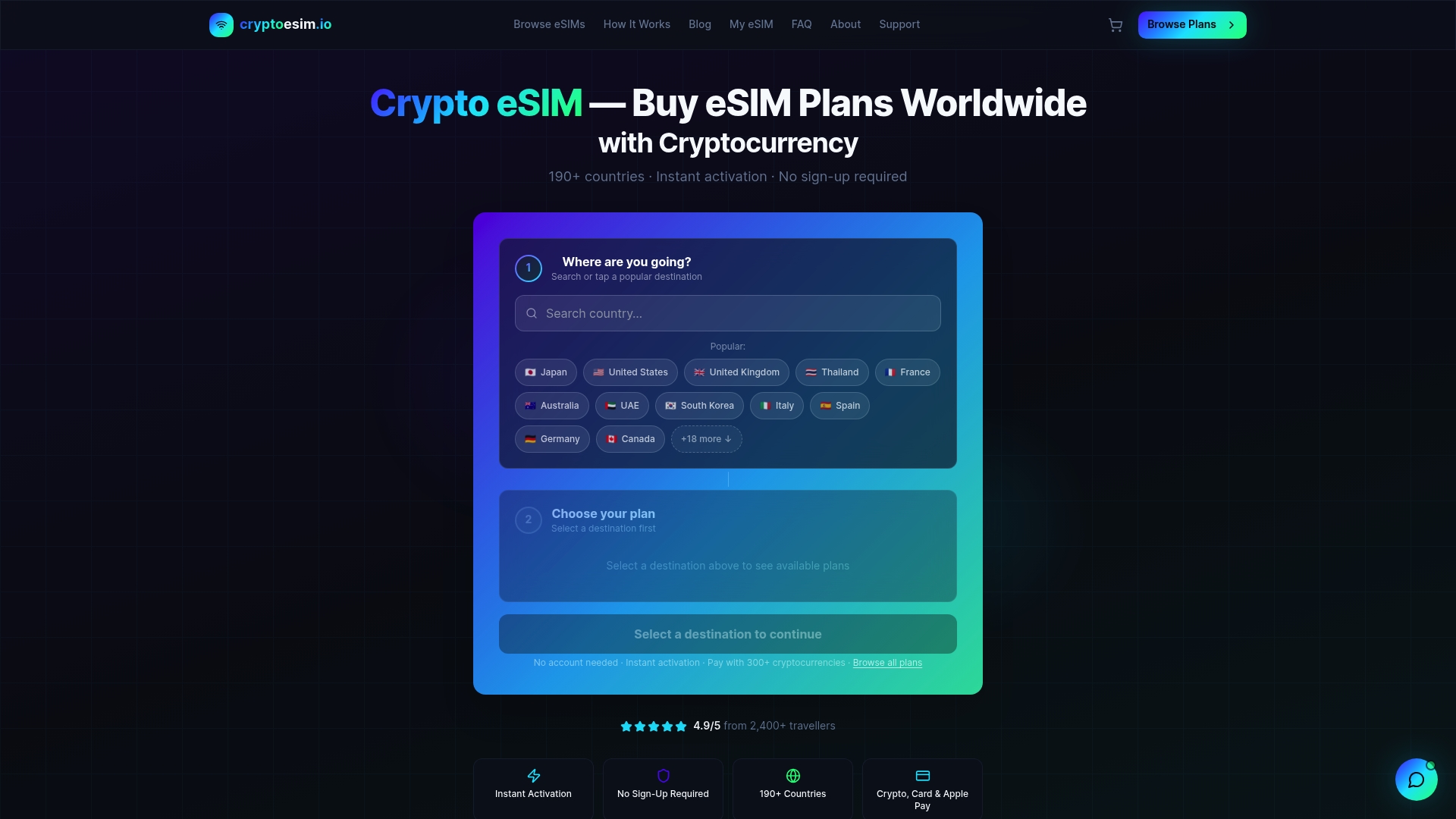
The checkout flow is designed for exactly this use case: small-value, repeatable, privacy-respecting purchases where you want connectivity without a data trail. Start with a short-term plan for your next destination and run the full pseudonymous checkout flow yourself. Browse available eSIM plans and complete your first crypto-paid activation in minutes.
This article is general information, not legal or financial advice. Confirm current AML/KYC reporting requirements with a qualified professional or the relevant U.S. regulatory authority for your specific situation.
Primary sources and further reading
- ECB Working Paper No. 2662: Payments and Privacy in the Digital Economy — Economic modeling of how privacy-preserving payment forms affect online commerce and welfare.
- Trezor: Is Crypto Anonymous? Understanding Privacy on the Blockchain — Clear explanation of pseudonymity vs. anonymity on public ledgers, including deanonymization vectors.
- BIS Working Paper No. 1242: Privacy-Enhancing Technologies for Digital Payments — Authoritative mapping of privacy levels across payment types, from cash to confidential transactions.
- BIP-47: Payment Codes for Hierarchical Deterministic Wallets — Technical specification for reusable payment codes that improve address privacy.
- Cryptoesim: Buy eSIM with Crypto, 190+ Countries, No KYC — Product page with checkout details and supported payment options used as the procedural example in this guide.