Why Crypto Has No Chargeback: eSIM Buyer’s Guide

TL;DR:
- Crypto payments are final once confirmed on the blockchain, meaning no chargebacks are possible. Merchants must voluntarily send refund transactions, which involve network fees and require proof of payment. Buyers should verify refund policies, record transaction details, and use trusted wallets to protect themselves in case of issues.
Cryptocurrency payments have no bank-style chargebacks because on-chain transfers are final and irreversible. Once confirmed on the blockchain, no bank, card network, or payment processor can pull that money back. The only way to get funds returned is if the merchant voluntarily sends a new transaction to your wallet. That’s the whole answer. Everything below explains why that’s true, when exceptions apply, and exactly what to do if an eSIM purchase goes sideways.
What this means for eSIM buyers specifically:
- Your payment is final the moment it confirms on-chain, regardless of whether the eSIM activates correctly.
- A refund is a separate, new transaction the merchant chooses to send, not a forced reversal.
- Save your transaction ID (TxID) and a screenshot of your order immediately after paying.
- Check the merchant’s refund policy before you pay, not after.
Table of Contents
- Why crypto has no chargeback: the blockchain explanation
- How confirmations work and why merchants wait for them
- When chargebacks or reversals can still apply to you
- How merchant refunds actually work in crypto
- Risks specific to buying eSIMs with crypto
- How to protect yourself before paying for an eSIM with crypto
- What to do if a crypto eSIM purchase goes wrong in the United States
- What to expect from Cryptoesim when you pay with crypto
- Key Takeaways
- Why this matters more than most travelers realize
- Cryptoesim: crypto-friendly eSIM plans with clear refund terms
- Authoritative resources for verifying transactions and reporting fraud
Why crypto has no chargeback: the blockchain explanation
The phrase “no chargeback” isn’t a policy decision any company made. It’s a structural property of how blockchains work. When you send Bitcoin or ETH to a merchant’s wallet, that transfer is broadcast to thousands of independent nodes. Once those nodes reach consensus and confirm the transaction, it’s recorded permanently across the entire network. Blockchain finality acts like hardening cement: once set, no single party can rewrite it.
With a credit card, your bank sits in the middle. It can reverse a charge because it controls the ledger. Crypto has no such middleman. The blockchain’s immutability keeps the network secure and prevents tampering, but it also means there’s no “dispute this charge” button anywhere in the system.
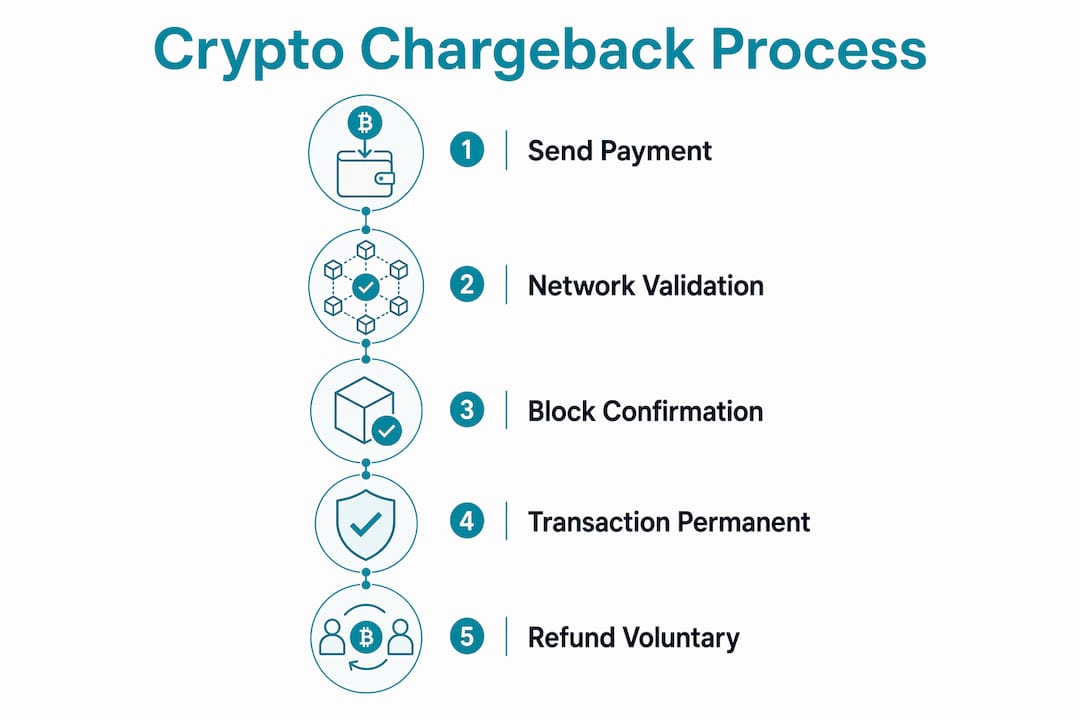
For eSIM purchases, the practical consequence is immediate: if you pay and the QR code doesn’t arrive, you can’t call your bank. Your recourse is the merchant’s goodwill and their documented refund process.
How confirmations work and why merchants wait for them
Each transaction goes through a validation process before it’s permanent. The network adds it to a block, and other blocks pile on top. Each additional block is a “confirmation.” The more confirmations, the harder it becomes to alter the record.
For Bitcoin, 6 confirmations are widely considered secure. Ethereum typically requires 12–20 blocks. For smaller networks, fewer confirmations may suffice. Merchants set their own thresholds: a low-value eSIM purchase might clear after 1–3 confirmations, while larger transfers can require many more.
Pro Tip: Before paying for an eSIM with crypto, ask the merchant how many confirmations they require. On Bitcoin, that can take 10–60 minutes depending on network congestion. On faster networks like Polygon or Solana, it’s often under a minute. Plan accordingly if you’re at an airport with limited Wi-Fi time.
When chargebacks or reversals can still apply to you
Pure on-chain transfers are final. But many travelers don’t pay purely on-chain. If you bought crypto with a credit card or ACH transfer on an exchange, that fiat leg can still be disputed through your bank, even though the subsequent on-chain transfer is irreversible.
| Payment Method | Chargeback Available? | Who to Contact |
|---|---|---|
| Direct wallet-to-wallet (on-chain) | No | Merchant only |
| Crypto bought via credit card on exchange | Yes (fiat leg only) | Your card issuer |
| Custodial exchange payment | Possibly | Exchange support |
| Crypto debit card (converts to fiat) | Possibly | Card issuer |
Situations where traditional dispute channels may still help:
- A stolen credit card was used to purchase crypto on an exchange before the eSIM payment.
- You paid through a custodial platform (like PayPal’s crypto service) that holds funds on your behalf.
- A crypto debit card converted your holdings to fiat at point of sale.
If funds land at a regulated exchange, law enforcement or court orders can sometimes freeze that account and recover value off-chain. It’s rare and slow, but it’s not impossible.
How merchant refunds actually work in crypto
A crypto refund is an entirely new transaction the merchant initiates voluntarily. Nothing about the original payment changes. Here’s the typical flow for an eSIM purchase:
| Step | What Happens | Who Acts |
|---|---|---|
| 1. You contact support | Report the issue, provide TxID and order ID | Buyer |
| 2. Merchant verifies | Confirms on-chain payment and order status | Merchant |
| 3. You provide wallet address | Send the address you want funds returned to | Buyer |
| 4. Merchant sends new tx | Initiates outgoing payment to your wallet | Merchant |
| 5. You receive funds | Minus network/gas fees; new TxID issued | Network |
Expect network fees to come out of the refund amount. Gas fees on Ethereum can be significant during congestion; Bitcoin fees vary by block demand. If the merchant denominated the refund in a different token or at a different exchange rate than when you paid, the dollar value you receive back may differ from what you sent. Some processors can automate merchant-initiated refunds, but the refund is still voluntary and still costs fees.
Risks specific to buying eSIMs with crypto
Because there’s no chargeback safety net, the risks fall entirely on you. The highest-impact ones:
Wrong wallet address. Copy-paste errors are permanent. Some malware replaces clipboard addresses with an attacker’s address. Always verify the last 6 characters of any address manually before confirming.

Phishing checkout pages. Fake storefronts mimic legitimate eSIM sellers. They display a real-looking QR code or wallet address, collect your payment, and disappear. A phishing page may also ask for your private key or seed phrase under the guise of “verifying” your wallet. Any service asking for your private keys is a scam, without exception.
Clone shops and fake listings. Marketplace listings or social media ads sometimes impersonate known eSIM providers. The URL is slightly different; the design is identical. Always navigate directly to the merchant’s official domain.
Volatility and refund value. If ETH drops 15% between your payment and the refund date, you’ll receive fewer dollars back even if the merchant refunds the exact token amount. This is exchange-rate exposure, and it’s real.
How to protect yourself before paying for an eSIM with crypto
The absence of chargebacks shifts responsibility entirely to you as the buyer. A short checklist before you hit “pay”:
- Verify the refund policy. Find it on the merchant’s site before checkout, not after a problem.
- Test merchant responsiveness. Send a support question. A response within a few hours is a good sign.
- Start with a small test payment if the platform allows partial purchases or if you’re buying for the first time.
- Double-check the wallet address. Paste it, then manually verify the first and last 6 characters against what the merchant displays.
- Screenshot everything. Order confirmation, wallet address shown at checkout, and the TxID from your wallet.
- Confirm the QR code activates before leaving a Wi-Fi connection.
- Use a reputable wallet. MetaMask, Trust Wallet, or a hardware wallet like Ledger are widely trusted. Never enter your seed phrase on any website.
Pro Tip: Send $5 worth of crypto first if you’re testing a new merchant. If the eSIM activates correctly, pay the remainder. The small fee is cheap insurance against a total loss.
What to do if a crypto eSIM purchase goes wrong in the United States
- Contact the merchant immediately. Provide your TxID, order ID, and a screenshot of the payment. Most legitimate merchants resolve issues within 24–48 hours.
- Preserve all evidence. Save TxIDs, wallet addresses, order confirmation emails, and any chat transcripts. You’ll need these for every subsequent step.
- Check your block explorer. Paste your TxID into Etherscan or Blockchain.com to confirm the transaction status and destination address.
- Contact your exchange or card issuer if you funded the purchase with a credit card or through a custodial platform. The fiat leg may still be disputable.
- File a complaint with the IC3 (FBI’s Internet Crime Complaint Center) for any suspected fraud or scam.
- Report to the FTC at ReportFraud.ftc.gov. The FTC aggregates reports and can act against repeat offenders.
- Contact your state consumer protection office for additional local remedies.
- Consider civil options. If the amount is significant, a civil attorney or small claims court may be viable, especially if the merchant is identifiable and U.S.-based.
Authorities can realistically freeze funds only if they reach a regulated, identifiable exchange. For direct wallet-to-wallet transfers to unknown addresses, recovery is practically impossible once confirmed.
What to expect from Cryptoesim when you pay with crypto
Cryptoesim is built for exactly this payment model. Key trust signals:
- 190+ countries covered with instant digital activation delivered via QR code.
- Bitcoin, Ethereum, and 300+ other tokens accepted, plus credit card and Apple Pay.
- No account required. Purchases are anonymous and completed at checkout.
- 24/7 support available for activation issues and refund requests.
- Documented refund process. The platform’s crypto payment guide and multi-currency payment help explain what to provide when requesting a refund.
To request a refund, contact Cryptoesim support with your TxID, the wallet address you paid from, your order confirmation, and a description of the issue. Having those four items ready speeds resolution significantly.
Key Takeaways
Crypto payments are final by design: the only refund possible is a new transaction a merchant voluntarily sends, so saving your TxID and checking refund policies before paying are non-negotiable steps.
| Point | Details |
|---|---|
| On-chain finality is permanent | Once confirmed, no bank or network can reverse a crypto transaction. |
| Refunds are new transactions | A merchant refund is a separate outgoing payment, not a reversal, and carries network fees. |
| Fiat legs can still be disputed | If you bought crypto with a credit card, that purchase may be chargeable through your bank. |
| Record TxID immediately | Your transaction ID is the only proof of payment and the starting point for any refund request. |
| Cryptoesim documents its process | Cryptoesim accepts 300+ tokens, provides 24/7 support, and publishes its refund steps for buyers. |
Why this matters more than most travelers realize
The conventional wisdom is that crypto’s no-chargeback rule is a merchant benefit and a buyer inconvenience. That framing misses something. For travelers buying eSIMs specifically, the absence of chargebacks is actually a feature of the payment model that rewards preparation. A traveler who saves a TxID, verifies the merchant’s domain, and reads the refund policy before paying is in a stronger position than a credit card user who assumes the bank will fix any mistake. The bank often won’t, especially for digital goods delivered instantly.
What people underestimate is how much of the risk is front-loaded. The moment you hit “send,” the risk profile locks in. Everything after that is either merchant goodwill or legal process. The pre-payment checklist in this article isn’t optional hygiene; it’s the entire protection mechanism available to you. Treat it that way.
Cryptoesim: crypto-friendly eSIM plans with clear refund terms
Paying for mobile data abroad with crypto shouldn’t mean flying blind on refunds. Cryptoesim covers 190+ countries with instant QR-code delivery, accepts Bitcoin, Ethereum, and hundreds of other tokens, and keeps its refund process documented and accessible before you ever reach checkout. No account needed, no waiting for a physical SIM, and support available around the clock if activation doesn’t go as planned.
For travelers who want to document payments and track refund requests cleanly, keeping a simple payment record alongside your TxID screenshot is the fastest way to resolve any issue. Ready to buy? Browse eSIM plans at Cryptoesim and check the refund policy directly on the product page before you pay.
Authoritative resources for verifying transactions and reporting fraud
- Etherscan — Ethereum block explorer; paste your TxID to confirm status, destination address, and confirmation count.
- Blockchain.com Explorer — Bitcoin transaction lookup; verify confirmations and wallet addresses.
- IC3.gov — FBI’s Internet Crime Complaint Center; file reports for crypto fraud and scams.
- ReportFraud.ftc.gov — FTC fraud reporting portal; relevant for fake sellers and phishing schemes.
- CoinMarketCap — Plain-language explainers on blockchain finality and how confirmations work.
How to use a block explorer: Copy your TxID from your wallet’s transaction history. Paste it into the search bar of the relevant explorer (Etherscan for ETH-based tokens, Blockchain.com for Bitcoin). The result shows the sending address, receiving address, amount, timestamp, and confirmation count. If the destination address doesn’t match the merchant’s address, you have documented proof of a misdirected payment.
Contact your exchange first if the funds landed at a known, regulated platform. File with IC3 and the FTC if you suspect fraud. Both reports together create a paper trail that law enforcement can act on, particularly when funds are traceable to a centralized exchange.