Advantages of Digital SIMs for International Travelers

TL;DR:
- A digital SIM, or eSIM, is a reprogrammable chip embedded in devices that stores mobile profiles without physical cards. It offers quick activation, allows multiple profiles, reduces roaming costs, and enhances security against theft and fraud. However, support varies by device and region, requiring travelers to verify compatibility before use.
A digital SIM, known in the industry as an eSIM (embedded SIM), is a reprogrammable chip soldered directly into your device that stores mobile profiles without any physical card. The advantages of digital SIMs are most visible when you cross a border and need data within minutes, not hours. The GSMA, the global standards body for mobile networks, established the eSIM specification that now powers hundreds of compatible devices worldwide. Unlike a plastic SIM you buy at an airport kiosk, an eSIM activates through a QR code scan or a carrier app, often in under five minutes. For international travelers, that difference is the gap between landing connected and landing lost.
How do digital SIMs work to simplify mobile connectivity?
eSIM activation works through a process called remote provisioning. Your carrier sends a profile digitally to the secure chip inside your phone. You scan an eSIM QR code, the profile downloads, and your connection is live. No store visit, no waiting for a package, no fumbling with a SIM ejector pin at the gate.
Modern smartphones store multiple eSIM profiles on a single device. By 2026, most compatible devices can hold 8–10 profiles, though only 1–2 are active at the same time. That means you can load a local data plan for Japan before you even board your flight from New York, then switch to a European profile when you connect in Frankfurt.
Compatibility is broad but not universal. iPhones from the iPhone XS onward, Google Pixel 3 and later, and most flagship Android devices from Samsung and others support eSIM. Budget and older devices often do not.
- Scan a QR code or use a carrier app to download a profile
- Toggle between stored profiles in your phone’s settings menu
- Keep your home number active on one profile while using local data on another
- Delete old profiles when plans expire to keep your profile list clean
Pro Tip: Download your travel eSIM profile while you still have Wi-Fi at home. Airport and hotel Wi-Fi can be slow or restricted, and you want your data plan ready the moment you land.
1. Instant activation anywhere with internet

eSIM activation takes 1–5 minutes via QR code or app, compared to 5–30 minutes plus a store visit for a physical SIM. That speed matters when you land in a new country at midnight and every SIM shop is closed. You activate from your hotel room, your seat on the train, or the airport lounge, as long as you have a Wi-Fi connection.
2. Keep your home number active while using local data
One of the most practical eSIM features for travelers is the ability to toggle between profiles without losing your home number. Your bank sends a verification code to your US number. Your family calls your regular line. Meanwhile, your local data plan handles maps, messaging apps, and browsing at local rates. Physical SIM users have to choose one or the other unless they carry a second phone.
3. Reduced roaming fees through flexible plan selection
Roaming charges from your home carrier can reach several dollars per megabyte in some regions. With an eSIM, you buy a local or regional data plan at local prices before you travel. The cost difference is significant on any trip longer than a weekend. Travelers who use local eSIM plans consistently spend far less on data than those who rely on home carrier roaming packages.
4. Stronger protection against SIM theft
eSIMs are soldered into motherboards and cannot be physically removed. A thief who steals your phone cannot pull the SIM, drop it into a burner phone, and intercept your SMS two-factor authentication codes. That specific attack vector, common in cities with high phone theft rates, is eliminated entirely with an eSIM. This matters most for travelers who rely on SMS-based banking and account verification while abroad.
“The physical extractability of traditional SIM cards is one of the most underappreciated security risks for travelers. An eSIM closes that gap by making the SIM inseparable from the device itself.”
5. Protection from physical SIM swap fraud
Physical SIM swap fraud requires a thief to get your SIM out of your phone. With an eSIM, that step is impossible. However, carrier-level SIM swap fraud remains a real risk. A bad actor who convinces your carrier to transfer your number to a new eSIM profile can still hijack your account. Strong carrier authentication, such as a PIN or passphrase on your account, is the defense here. The eSIM eliminates the physical threat but does not replace good account security habits.
Pro Tip: Call your home carrier before any international trip and add a verbal security PIN to your account. This blocks unauthorized eSIM transfers even if someone has your personal information.
Security comparison: eSIM vs physical SIM
| Threat type | Physical SIM risk | eSIM risk |
|---|---|---|
| Physical extraction by thief | High | None |
| SMS 2FA interception via stolen SIM | High | None |
| Carrier-level SIM swap fraud | Moderate | Moderate |
| Remote profile hijacking | Low | Low |
6. Store multiple travel plans without carrying extra cards
A wallet stuffed with SIM cards from past trips is a familiar problem for frequent travelers. With an eSIM, all those profiles live digitally on your device. You can store a plan for Southeast Asia, one for Europe, and one for the US, then activate the right one when you arrive. Multiple profiles stored digitally means zero physical clutter and zero risk of losing a card between trips.
7. Better device design and water resistance
Removing the physical SIM tray is not just a convenience feature. eSIM-only phones achieve higher IP ratings for water and dust resistance because the tray opening is a known weak point in a phone’s seal. The freed internal space also allows manufacturers to fit larger batteries. For travelers who spend long days away from power outlets, that extra battery capacity is a real, daily benefit.
8. Environmental benefits from eliminating plastic SIMs
eSIM technology reduces plastic waste by removing the need for physical card manufacturing, packaging, and shipping. Every physical SIM card involves plastic production, a blister pack, and logistics to get it to a store or your mailbox. Multiply that by billions of activations globally and the environmental cost is substantial. Switching to eSIM cuts that entire supply chain out of the equation.
9. No account required for privacy-conscious travelers
Some eSIM providers, including Cryptoesim, let you purchase and activate a plan without creating an account or submitting personal identification. Cryptoesim accepts Bitcoin, Ethereum, and over 300 other crypto tokens alongside credit cards and Apple Pay. That combination of no-KYC purchasing and instant digital delivery is particularly useful for travelers who prioritize privacy or want to avoid sharing personal data with multiple carriers.
10. What are the practical limitations of digital SIMs?
The advantages of eSIM cards are real, but so are the limitations. Understanding both helps you plan smarter.
- Only 1–2 profiles are active at once. You must manually switch profiles to avoid unexpected roaming charges from an inactive plan.
- Transferring an eSIM between devices requires re-authentication and a new QR code from your carrier. During a travel emergency, that process can be slow and frustrating.
- eSIM support varies by region and device. Some countries restrict eSIM activation for foreign carriers, and budget smartphones often lack eSIM hardware entirely.
- Dual SIM setups, one physical SIM for your home number and one eSIM for local data, often give travelers the best of both worlds when full eSIM commitment is not practical.
The benefits of virtual SIM cards are strongest when your device is compatible and your destination carriers support remote provisioning. Always verify both before you travel.
Key takeaways
Digital SIMs give international travelers faster activation, lower data costs, and stronger physical security than any physical SIM card can match.
| Point | Details |
|---|---|
| Instant activation | eSIM plans activate in 1–5 minutes via QR code, with no store visit needed. |
| Physical security | eSIMs cannot be removed from a device, blocking SIM theft and SMS interception attacks. |
| Multiple profiles | Devices store 8–10 profiles, letting travelers pre-load plans for every destination. |
| Environmental impact | Eliminating physical SIM cards cuts plastic waste and removes an entire supply chain. |
| Know the limits | Only 1–2 profiles are active at once, and device transfers require carrier re-authentication. |
Why I think most travelers still underestimate eSIMs
I have used eSIMs across four continents over the past two years, and the single biggest surprise was not the cost savings. It was the mental load reduction. Arriving in a new country without hunting for a SIM shop, without deciphering a foreign language package menu, and without the anxiety of whether my home number is still reachable changed how I experience the first hours of any trip.
The security angle also hits differently once you have traveled in cities where phone theft is common. Knowing that a stolen phone cannot be used to drain my bank account via SMS codes is not a small thing. It is the kind of protection that used to require a separate travel phone or a complicated app setup.
That said, I do not travel without a physical SIM backup for destinations where eSIM support is patchy. The device transfer process is genuinely clunky if your phone breaks or gets stolen and you need to re-authenticate a profile on a replacement device. The mobile security guidance for travelers consistently recommends a hybrid approach, and I agree with it.
The travelers who get the most from eSIM are those who plan ahead. Load your profiles before you leave. Set your carrier PIN. Know which profile is active before you land. Do those three things and the benefits of eSIM technology will be obvious from your first trip.
— Mohammed
Cryptoesim: eSIM plans for travelers who value privacy
Travelers who want instant connectivity across more than 190 countries without handing over personal data have a direct option with Cryptoesim.
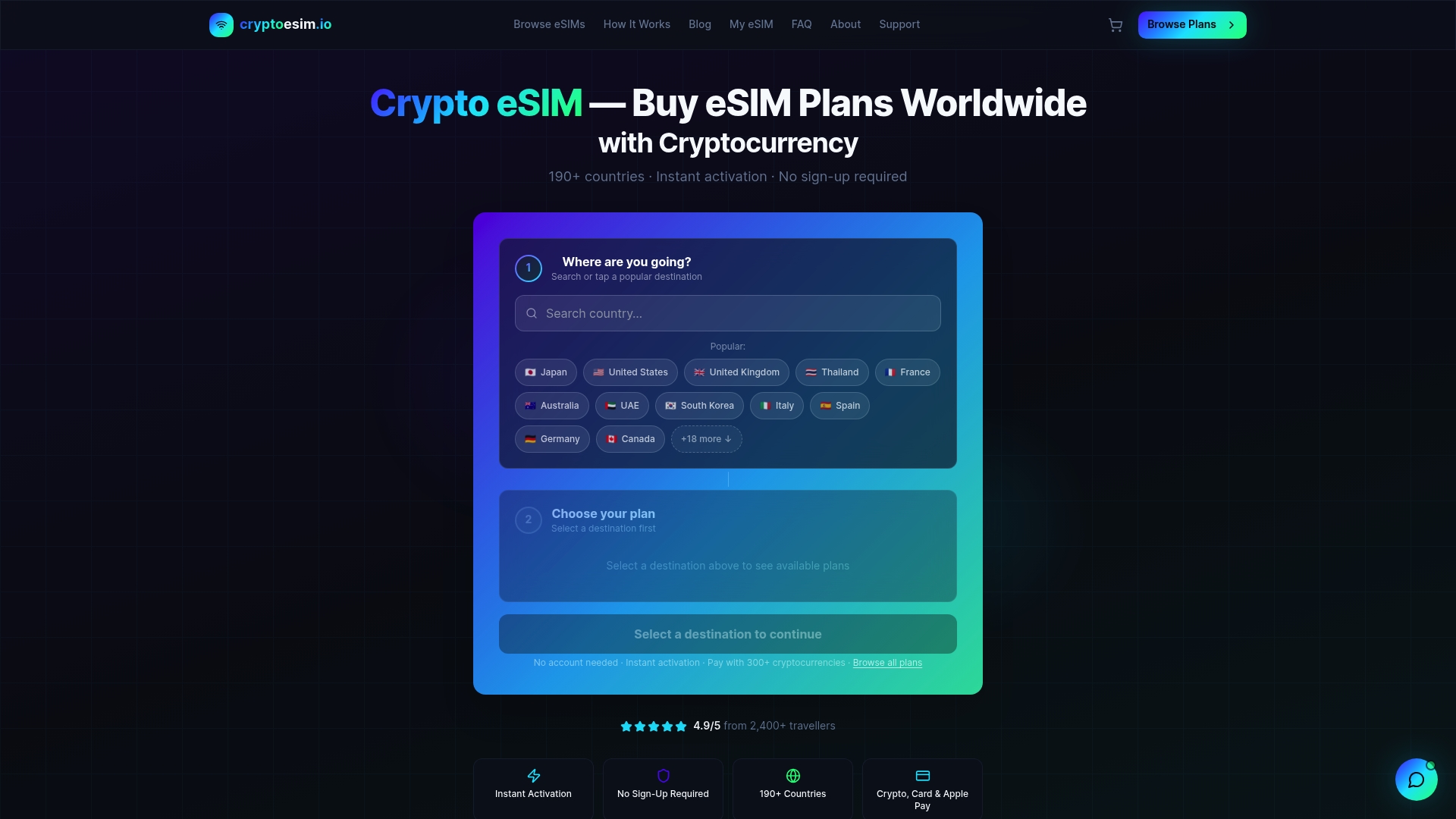
Cryptoesim sells eSIM data plans with no account creation required and no KYC process. You pay with Bitcoin, Ethereum, a credit card, or Apple Pay, and your plan is ready to activate within minutes. Coverage spans over 190 countries, making it practical for multi-destination trips and long-term travel. For travelers who want local data rates, strong privacy, and the flexibility to buy an eSIM with crypto or traditional payment, Cryptoesim is a direct, no-friction option worth checking before your next departure.
FAQ
What is a digital SIM and how does it differ from a physical SIM?
A digital SIM, or eSIM, is an embedded chip inside your device that stores mobile profiles without a removable card. Unlike a physical SIM, it activates remotely via QR code and cannot be physically swapped or stolen.
How long does eSIM activation take for travelers?
eSIM activation typically takes 1–5 minutes through a QR code scan or carrier app, compared to 5–30 minutes plus a store visit for a physical SIM card.
Can I keep my home number active while using a travel eSIM?
Yes. Most eSIM-compatible devices allow you to store multiple profiles and keep your home number active on one profile while using a local data plan on another simultaneously.
Are digital SIMs more secure than physical SIM cards?
eSIMs eliminate the physical extraction threat because they are soldered into the device. However, carrier-level SIM swap fraud remains possible, so adding a security PIN to your carrier account is still necessary.
Do all smartphones support eSIM technology?
No. eSIM support is standard on most flagship devices from 2018 onward, including iPhones from the XS model and Google Pixel 3 and later, but many budget and older devices do not include eSIM hardware.