Decentralized payments: faster, safer mobile data for travelers

Every time you swipe a credit card or wire money abroad, banks quietly take their cut. The average remittance fee sits at 6.49%, and that’s before processing delays, currency conversion markups, or the occasional frozen account. For digital nomads buying mobile data or eSIMs on the road, these friction points aren’t just annoying. They’re expensive. Decentralized payments, built on blockchain technology, are changing that equation fast, offering near-instant, low-fee, and often private alternatives that work in over 190 countries without a bank in sight.
Table of Contents
- What are decentralized payments?
- Traditional payments vs. decentralized: The surprising cost and speed gap
- Privacy and anonymity: Protecting your data as you roam
- How decentralized payments work for travelers: Mechanics and scenarios
- The risks: What to watch for with decentralized payments
- Who should use decentralized payments and when?
- Next steps: Secure your mobile data with decentralized payments
- Frequently asked questions
Key Takeaways
| Point | Details |
|---|---|
| Lower fees and instant | Crypto payments for mobile data are faster and much cheaper than traditional banking systems. |
| Stronger privacy | Decentralized payments protect personal identity and financial data, requiring no KYC for most eSIM buys. |
| Global access | Travelers can connect in 190+ countries without the need for local banks or credit cards. |
| Stablecoins reduce risk | Using USDT/USDC can help travelers avoid volatility and increase payment reliability. |
| Know the limits | Travelers should be aware of irreversible transactions and regulatory variations before relying solely on crypto. |
What are decentralized payments?
Decentralized payments happen directly between two parties, wallet to wallet, without a bank, credit processor, or financial intermediary in the middle. The transaction is recorded on a public blockchain, verified by a distributed network of computers rather than a central authority. No one can freeze your funds, reverse your payment, or demand a processing fee just because you crossed a border.
For travelers buying mobile data, this is a practical upgrade. You don’t need a local bank account, a compatible credit card, or even a stable home currency. Common options include:
- Bitcoin (BTC): The original, widely accepted, best for larger purchases
- Lightning Network: Bitcoin’s fast-payment layer, ideal for small purchases like eSIM top-ups
- Stablecoins (USDT, USDC): Pegged to the US dollar, no price volatility, perfect for everyday spending
- Solana and Polygon tokens: Low fees, fast confirmation times, growing eSIM platform support
Wallet-to-wallet stablecoin payments and Lightning Network transfers enable near-instant, low-fee transactions, even for micro-purchases like eSIMs. You scan a QR code, confirm the amount, and your eSIM is delivered digitally within seconds. No forms, no waiting, no bank approval needed. If you’re new to how crypto and eSIMs connect, the crypto eSIM explainer breaks it down step by step.
Pro Tip: Stablecoins are the best starting point for travelers new to crypto payments. You get all the speed and privacy benefits without worrying about Bitcoin’s price moving between the time you pay and the time your eSIM activates.
Traditional payments vs. decentralized: The surprising cost and speed gap
Let’s put real numbers on the table. When you use a credit card abroad, you’re typically paying a 1% to 3% foreign transaction fee, plus a 1% to 3% currency conversion spread, plus potential ATM or cash advance fees if you’re pulling local currency. Banks also operate on business hours, meaning weekend or late-night purchases can sit in limbo.
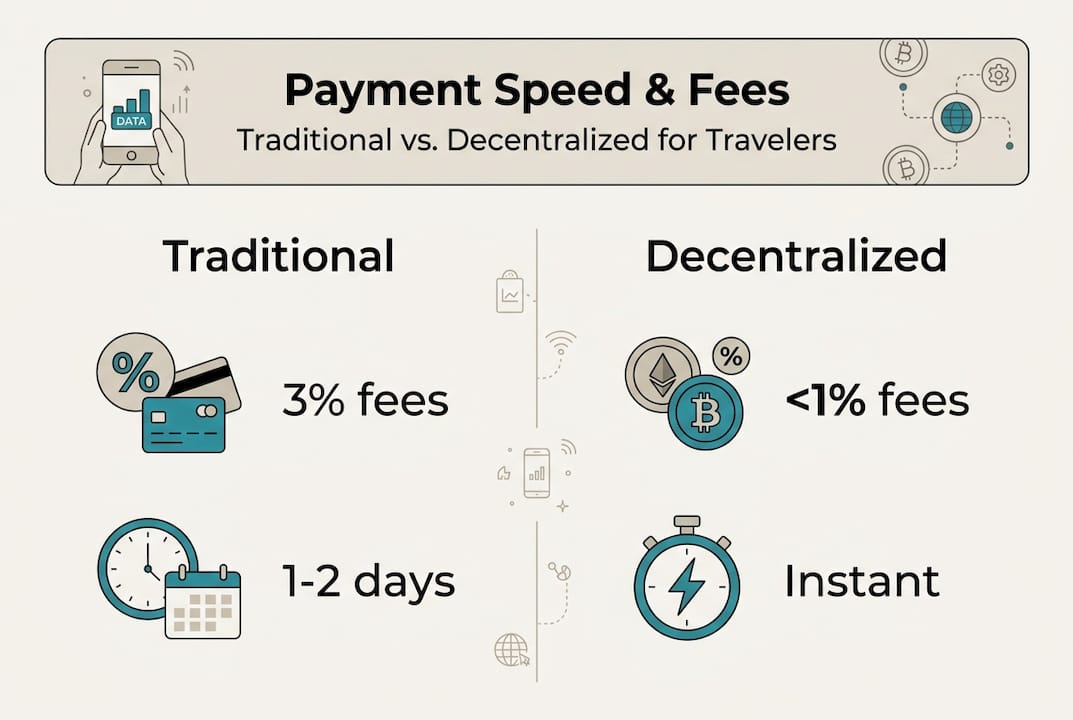
Decentralized payments flip that model. Crypto fees average under 1% compared to 6.49% for traditional remittance channels, and settlement happens in seconds rather than days. Here’s how the two systems compare for a typical traveler buying a regional eSIM plan:
| Feature | Traditional payment | Decentralized payment |
|---|---|---|
| Average fee | 3% to 6.49% | Under 1% |
| Settlement time | Minutes to 3 days | Seconds to 2 minutes |
| Available hours | Business hours | 24/7/365 |
| KYC required | Yes (card/bank) | Usually no |
| Chargeback option | Yes | No |
| Works without local bank | Rarely | Always |
| Privacy level | Low | Medium to high |
“The gap isn’t marginal. For a traveler buying eSIM plans monthly across multiple countries, switching to crypto can save hundreds of dollars per year in fees alone.”
The comparison between eSIM and traditional SIM abroad shows a similar pattern: digital-first solutions consistently outperform legacy systems on cost, speed, and convenience. The crypto vs. banks remittance data reinforces this, showing that decentralized rails are no longer just a tech experiment. They’re a practical financial tool.
Privacy and anonymity: Protecting your data as you roam
Cost matters, but for many nomads, privacy is the real game changer, especially in regions with strict financial controls or surveillance infrastructure. Traditional payment methods require you to hand over card numbers, passport details, or bank credentials every time you buy a SIM or data plan. That data trail follows you.

Most crypto eSIM stores require only an email and a payment, with no passport or bank data needed. Monero takes it further, enabling complete transaction privacy where even the payment amount is obscured. For journalists, activists, or anyone working in politically sensitive regions, this isn’t a luxury. It’s a safety requirement.
Here’s what you typically avoid when paying with crypto for mobile data:
- No passport scan or government ID upload
- No bank account linking or card registration
- No credit check or financial history review
- No exposure to card skimming or data breaches
The privacy and no-KYC advantages of crypto eSIM purchases are well documented. That said, privacy isn’t absolute. Your phone’s IMEI number and carrier metadata can still be logged by network operators. Using a VPN alongside your eSIM adds another layer of protection. Self-custody wallets (where you hold your own private keys) are also strongly recommended over exchange wallets for maximum control.
Pro Tip: If privacy is your top priority, pair a Monero or stablecoin payment with a no-log VPN and a self-custody wallet. This combination gives you the strongest protection available for mobile data purchases while traveling. Learn more about secure crypto payments for travelers to build your full setup.
For a deeper look at real-world privacy lessons, this account from a crypto-native eSIM store builder is worth reading.
How decentralized payments work for travelers: Mechanics and scenarios
Understanding the privacy and savings is key, but how does this actually play out in real travel situations? The process is simpler than most people expect.
- Choose your provider. Select a crypto-friendly eSIM platform that covers your destination country.
- Pick your data plan. Choose the region, data amount, and validity period that fits your trip.
- Select your crypto. Most platforms accept Bitcoin, Ethereum, USDT, USDC, and dozens of other tokens.
- Send from your wallet. Scan the payment QR code or paste the wallet address, confirm the amount, and send.
- Receive your eSIM instantly. A QR code or activation code is delivered to your email within seconds.
- Scan and activate. Open your phone’s eSIM settings, scan the code, and you’re connected.
Roam and Zebec let users buy eSIMs using wallet-to-wallet transfers with stablecoins, integrated directly into data delivery platforms. Here’s how major crypto payment options compare for eSIM purchases:
| Payment method | Avg. transaction time | Typical fee | Info required |
|---|---|---|---|
| Bitcoin (on-chain) | 10 to 30 minutes | 0.5% to 1% | Email only |
| Lightning Network | Under 5 seconds | Near zero | Email only |
| USDT/USDC (Polygon) | Under 30 seconds | Under 0.1% | Email only |
| Monero | 2 to 5 minutes | Under 0.5% | Email only |
| Credit card | Instant to 2 minutes | 3% to 6% | Card + ID |
Practical scenario: you land in Amsterdam, need data immediately, and your home bank card is blocked for international use. You open your crypto wallet, pay 8 USDC for a 7-day European eSIM, and you’re online before you reach baggage claim. No roaming charges, no SIM kiosk line, no paperwork. For a full walkthrough, the guide on buying eSIMs with Bitcoin covers every step in detail.
Pro Tip: Keep a small amount of stablecoins in a mobile wallet specifically for travel purchases. Separating travel funds from your main crypto holdings reduces risk and keeps your spending organized.
The risks: What to watch for with decentralized payments
While the benefits are clear, every payment system comes with downsides travelers should be aware of. Decentralized payments are no exception, and going in without understanding the risks can be costly.
Volatility is the most obvious concern. Bitcoin and Ethereum prices can swing 5% to 10% in a single day. If you’re holding crypto and the price drops between purchase and payment, you’ve effectively paid more than expected. Stablecoins solve this almost entirely.
No chargebacks is the other major trade-off. Volatility and no-chargeback policies mean travelers face significant loss if defrauded, with hybrid stablecoin models reducing but not eliminating that risk. Unlike a credit card dispute, a crypto transaction sent to the wrong address or a fraudulent vendor cannot be reversed.
Other risks to keep in mind:
- On/off-ramp fees: Converting fiat to crypto (or back) through exchanges adds spread costs, sometimes 1% to 3%
- Wallet errors: Sending to the wrong network (e.g., sending ERC-20 tokens to a Solana address) can result in permanent loss
- Regulatory uncertainty: Some countries restrict or ban crypto transactions entirely
- Phishing and fake platforms: Always verify the platform URL before sending any payment
“The safest approach: use stablecoins on established platforms, double-check every wallet address, and never send more than you need for the immediate purchase.”
For a balanced view of crypto eSIM vs. regular eSIM risks, the tradeoffs are manageable for most travelers. The crypto remittance risk breakdown is also useful reading before your first transaction.
Who should use decentralized payments and when?
Knowing the best and worst use cases lets you decide if decentralized payments fit your lifestyle. Not everyone needs to go fully crypto-native, but for certain travelers, it’s the obvious choice.
Decentralized payments are a strong fit if you are:
- A frequent traveler crossing multiple borders monthly
- A digital nomad without a stable home banking relationship
- A journalist, activist, or researcher working in sensitive regions
- Someone whose home bank regularly blocks international transactions
- A privacy-conscious user who wants minimal data exposure
- Living or working in a country with capital controls or banking restrictions
When decentralized payments make the most sense:
- Buying eSIMs or mobile data plans abroad
- Topping up data quickly between countries
- Making small, recurring purchases where card fees add up fast
- Situations where instant settlement is critical
When to be cautious:
- High-value, irreversible transactions where a chargeback would matter
- If you’re not yet comfortable with wallet security basics
- In countries where crypto use is legally restricted
Best use cases for nomads include users without local bank ties, those doing sensitive work, and anyone using crypto as a hedge against banking interruptions. For region-specific eSIM recommendations, the best eSIM plans for Europe and Asia guide helps you match the right plan to your destination. For broader context on how crypto is reshaping global mobility, the cross-border payments overview is worth a read.
Next steps: Secure your mobile data with decentralized payments
Ready to try decentralized payments on your next trip? Here’s where to start.
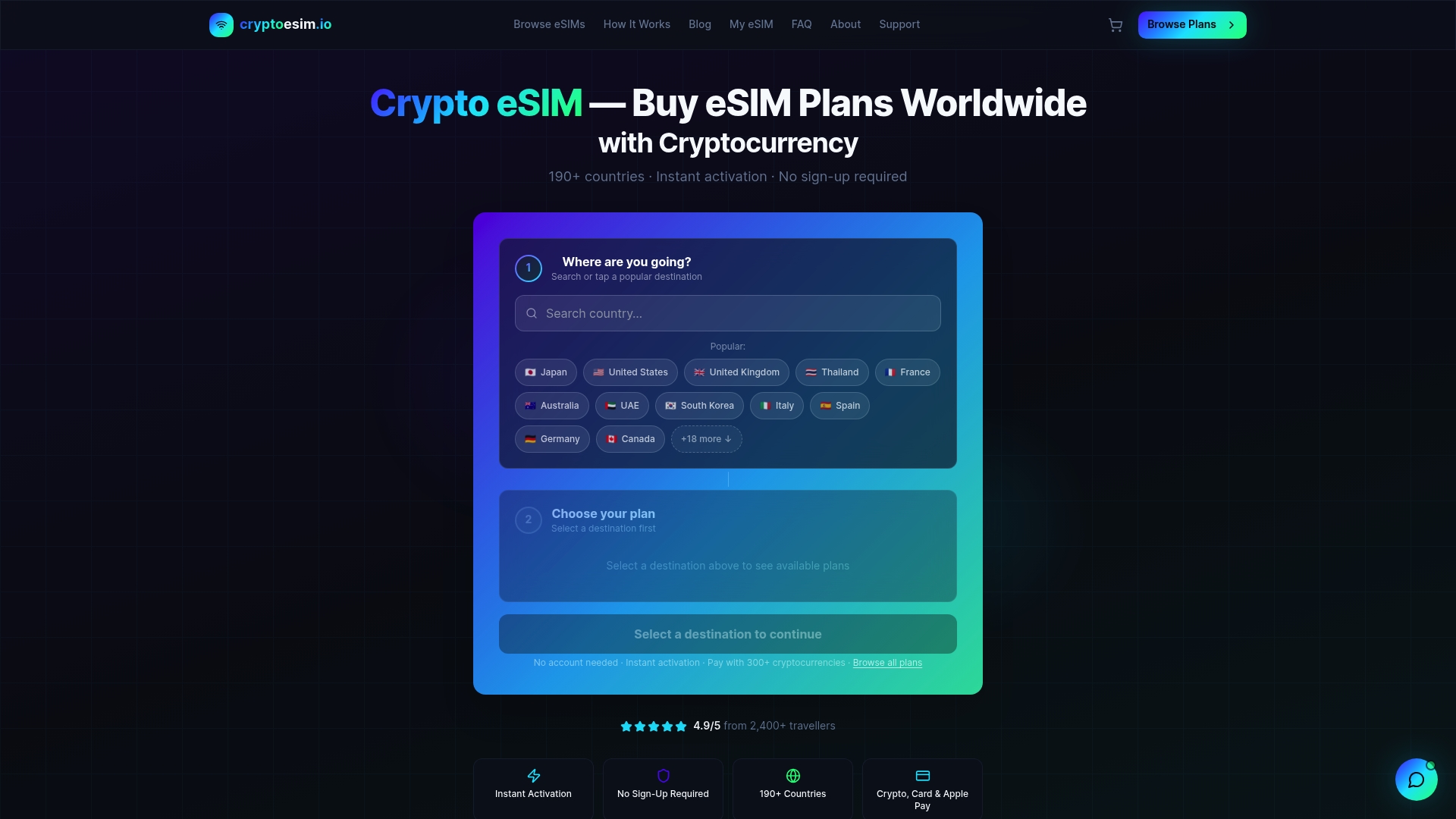
Everything covered in this article, the fee savings, the privacy benefits, the instant activation, comes together at CryptoEsim.io. You can buy eSIM data plans for over 190 countries using Bitcoin, Ethereum, USDT, USDC, and more than 300 other crypto tokens, or pay with a card or Apple Pay if you prefer. No account creation required. No KYC. Just pick your plan, pay, and activate.
If you want to go deeper before your first purchase, the privacy-first eSIM guide walks you through the full setup, from choosing a wallet to activating your eSIM securely. Whether you’re a seasoned nomad or planning your first long-term trip, decentralized payments for mobile data are ready to use right now. The infrastructure is there. The savings are real. The only step left is yours.
Frequently asked questions
Are decentralized payments safe for buying mobile data while traveling?
Yes, when you use stablecoins and self-custody practices on reputable platforms, decentralized payments are secure for most international travelers. The main risks come from user error, not the technology itself.
What are the main fees when using decentralized payments for eSIMs?
Crypto transaction costs typically run under 1%, compared to 6% or more for traditional bank and card payments. Settlement is near-instant, so there are no hidden delay costs either.
Do I need to verify my identity (KYC) to buy a data eSIM with crypto?
Most crypto-native eSIM stores require only an email address, with no passport, bank account, or government ID needed to complete a purchase.
Are decentralized payments available for all countries?
Nearly all countries are covered. The Roam network spans 190+ countries with crypto payment support, though you should always confirm availability for your specific destination before traveling.
What happens if a crypto payment fails or is sent to the wrong address?
Crypto transactions are irreversible and offer no recourse for mistaken transfers, so always double-check the wallet address and network before confirming any payment.