Best eSIM.me Alternatives in 2026 for US Travelers

TL;DR:
- The best eSIM alternatives in 2026 vary based on travelers’ frequency, destinations, and connection needs. Cryptoesim stands out for privacy, offering instant activation in over 190 countries without account creation or KYC. Selecting the right provider depends on your travel habits, required features, and payment preferences.
What are the best esimplus.me alternatives right now?
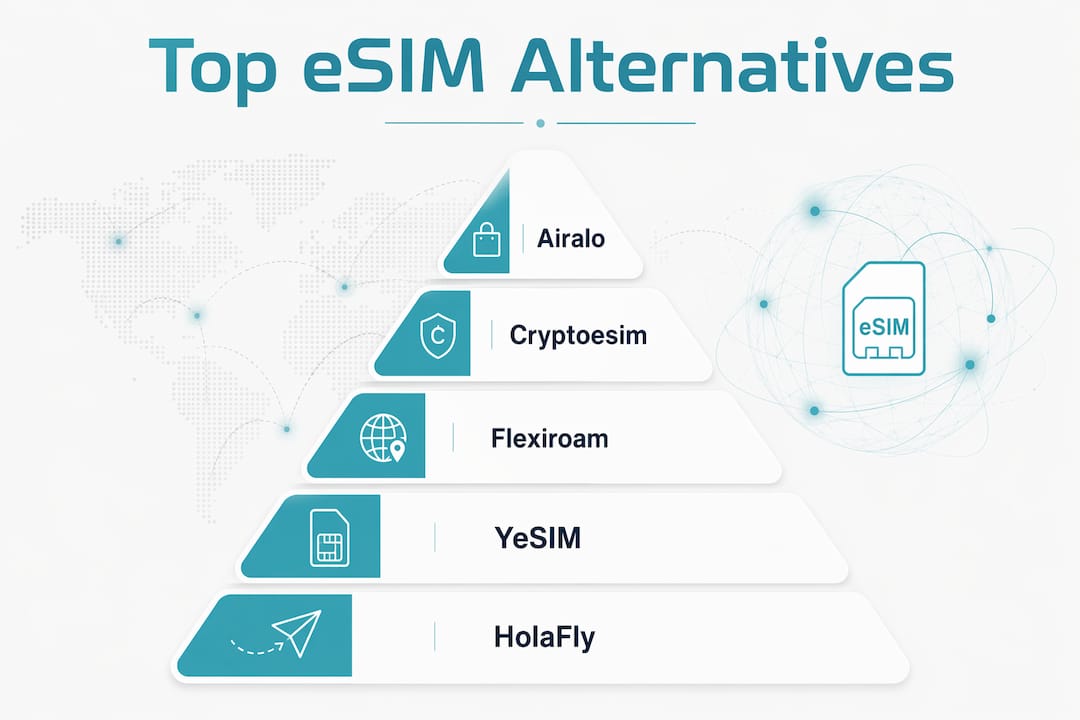
The strongest eSIM.me alternatives available to US users in 2026 are Airalo, Flexiroam, YeSIM, AloSIM, eSIM Card, Saily, HolaFly, Maya Mobile, and CryptoEsim.io. Each one solves a slightly different problem, so the “best” depends entirely on how you travel and what you need your connection to do.
Here’s the quick breakdown before we go deeper:
- Airalo covers 200+ countries and runs the lowest per-GB prices on the market, especially for regional plans across Europe.
- Flexiroam suits multi-destination trips with a single reusable eSIM that works across regions.
- YeSIM offers a pay-as-you-go “Pay & Fly” model that bills for exact megabytes consumed across 170+ countries, no per-country purchases required.
- AloSIM targets casual travelers who want a clean, no-fuss app experience.
- eSIM Card provides a solid marketplace with competitive pricing and broad destination coverage.
- Saily is built by the NordVPN team, with a built-in ad blocker saving around 28.6% data and DNS-level web protection baked in.
- HolaFly offers unlimited data plans in 170+ countries, ideal for heavy users who hate tracking gigabytes.
- Maya Mobile focuses on long-term stays with auto-renewal and heavy data support for digital nomads.
- CryptoEsim.io activates instantly in 190+ countries and accepts Bitcoin, Ethereum, 300+ tokens, credit cards, and Apple Pay with no account creation or KYC required.
| Provider | Best For | Coverage | Data/SMS/Calls | Crypto Payment |
|---|---|---|---|---|
| Airalo | Budget travelers, rare destinations | 200+ countries | Data only | No |
| Flexiroam | Multi-region trips | 150+ countries | Data only | No |
| YeSIM | Pay-per-use travelers | 170+ countries | Data + virtual number | No |
| AloSIM | Casual travelers | 130+ countries | Data only | No |
| eSIM Card | Broad marketplace users | 190+ countries | Data only | No |
| Saily | Security-conscious travelers | 150+ countries | Data only | No |
| HolaFly | Heavy data users | 170+ countries | Data only | No |
| Maya Mobile | Digital nomads, long stays | 35+ countries (Europe) | Data only | No |
| CryptoEsim.io | Crypto users, privacy-focused | 190+ countries | Data | Yes (300+ tokens) |
Table of Contents
- Detailed profiles of each top eSIM.me alternative
- Side-by-side comparison of key criteria
- How do you choose the right eSIM.me alternative?
- Why Cryptoesim stands out for privacy-first global connectivity
- Cryptoesim covers 190+ countries with no account required
- Key Takeaways
Detailed profiles of each top eSIM.me alternative
Airalo
Airalo is the largest eSIM marketplace by country count, and that scale is its defining trait. Rather than running its own network, it aggregates plans from local operators worldwide and sells them through a single app. For major destinations like the US, UK, Germany, Japan, and Australia, the carrier quality is strong. For smaller or more remote destinations, quality can vary, so checking the coverage map before buying is worth the 60 seconds it takes.
Pricing is consistently the lowest per GB among the major providers. Their regional “Eurolink” plan covering 39 European countries is one of the best-value options available for European travel. Setup is QR-code based, works on all eSIM-compatible iOS and Android devices, and takes under five minutes. Customer support runs through email and a community forum, with no live chat option.
Pros: Widest country selection, lowest per-GB pricing, regional multi-country plans. Cons: Speed inconsistency on lesser-known routes, no live chat support.
Flexiroam
Flexiroam positions itself around the idea of one eSIM for everywhere. Its plans cover 150+ countries and are designed for travelers who bounce between regions without wanting to buy a new plan at each border. The platform has been around long enough to build a reliable reputation, particularly among frequent flyers in Asia-Pacific markets.

Data-only plans are the core product. Voice and SMS are not natively supported, which limits it for users who need a local number. The app is functional without being flashy, and activation is straightforward via QR code.
Pros: Good multi-region coverage, reusable eSIM profile. Cons: No voice or SMS support, app experience is utilitarian.
YeSIM
YeSIM’s standout feature is its Pay & Fly plan, which automatically bills for exact megabytes consumed across 170+ countries without requiring per-country plan purchases. For travelers who visit multiple countries on a single trip and hate pre-planning data, this is genuinely useful.
Beyond data, YeSIM layers on virtual phone number support, which means you can get an actual number for calls and SMS in select markets. That said, many virtual number tiers offer incoming SMS only, which works for two-factor authentication but falls short for active voice communication. If you need outgoing calls, verify the specific plan before buying.
Pros: True pay-as-you-go model, virtual number support, automatic multi-country billing. Cons: Virtual number call/SMS capabilities vary by plan tier.
AloSIM
AloSIM keeps things simple. It covers 130+ countries with straightforward data plans, a clean mobile app, and a buying process that takes about three minutes. There’s no subscription required, no account needed for basic purchases, and pricing is transparent upfront.
It’s not the cheapest option per GB, and it doesn’t offer voice or SMS. But for a traveler who wants to grab a plan quickly without reading fine print, AloSIM delivers exactly what it promises.
Pros: Fast purchase process, clean UX, no account required. Cons: Smaller country selection, data only, not the lowest pricing.
eSIM Card
eSIM Card operates as a marketplace similar to Airalo, covering 190+ countries with a range of local, regional, and global plans. Pricing is competitive, and the platform supports a wide range of devices. The user interface is clean and the activation process is standard QR-code based.
Where eSIM Card differentiates itself is in plan variety. You can find short-duration plans for weekend trips or longer-duration plans for extended stays, often at prices that undercut the bigger-name providers on specific routes.
Pros: Wide coverage, varied plan durations, competitive pricing on specific routes. Cons: Less brand recognition, customer support quality is inconsistent.
Saily
Saily is built by the team behind NordVPN, and that heritage shows in its feature set. It covers 150+ countries with LTE/4G speeds (5G in supported markets) and partners with Tier-1 carriers in major regions. In Europe, it runs on top-tier networks. In Japan, it uses the Docomo network.
The security features are what set Saily apart from most eSIM providers. It includes a built-in ad blocker that saves a significant portion of data, DNS-level web protection, and virtual location features. For travelers who care about what happens to their data while connected to foreign networks, these protections matter. Pricing sits in the mid-range, and 24/7 live chat support is available. Reusable eSIM profiles make it particularly well-suited for frequent travelers who want a consistent, security-first experience across trips.

Pros: Strong security features, consistent network quality, 24/7 live chat, reusable eSIM. Cons: Smaller country selection than Airalo, no voice or SMS.
HolaFly
HolaFly’s entire model is built around unlimited data. Every plan removes the data cap anxiety that comes with fixed-GB options. The catch: after a daily usage threshold (typically 1–2 GB/day depending on the plan), speeds throttle to around 1 Mbps. For maps, messaging, and light browsing, that’s fine. For video calls or uploading content, it will feel slow.
Coverage spans 170+ countries. Pricing runs higher than Saily or Airalo on a per-day basis. A 30-day unlimited US plan runs at a premium price, and a 7-day unlimited Europe plan is also priced higher than typical data-only plans. The 24/7 live chat support is a genuine differentiator. If your eSIM fails to activate at 2 AM in a foreign airport, someone is actually there.
Pros: Unlimited data, 24/7 live chat, strong Americas and Europe coverage. Cons: Premium pricing, speed throttling after daily threshold, no voice or SMS.
Maya Mobile
Maya Mobile targets digital nomads and remote workers who need connectivity for weeks or months, not days. Its tailored plans offer auto-renewal, heavy data support, and control over duration, making it a better fit for extended European stays than a short vacation eSIM. For cities like Lisbon, Barcelona, or Berlin, the coverage is solid.
The trade-off is geographic scope. Maya Mobile covers 35+ European countries, which is narrower than Airalo’s 42+ European destinations. Outside Europe, options are limited. For a nomad spending six months in Portugal, it’s a strong choice. For someone hopping between continents, it’s not the right tool.
Pros: Auto-renewal, heavy data support, built for long stays. Cons: Primarily Europe-focused, limited global coverage.
Cryptoesim
Cryptoesim covers 190+ countries with instant digital eSIM activation and no account creation or KYC process required. The defining feature is payment flexibility: Bitcoin, Ethereum, and 300+ crypto tokens are accepted alongside credit/debit cards and Apple Pay. For users who prioritize financial privacy or simply prefer crypto transactions, no other provider on this list matches that range.
Activation is immediate after purchase, and the platform is built for users who want to move fast without creating profiles or sharing personal data. The focus is on secure mobile data and privacy-first connectivity.
Pros: 190+ countries, crypto payments with 300+ tokens, no KYC, no account needed, instant activation. Cons: Primarily data-focused; voice and SMS depend on plan selection.
Side-by-side comparison of key criteria
| Provider | Best Use Case | Pricing Model | Coverage | Setup Experience | Data/SMS/Calls | Crypto Payment |
|---|---|---|---|---|---|---|
| Airalo | Budget travel, rare destinations | Pay-per-plan, lowest per GB | 200+ countries | Easy, QR code | Data only | No |
| Flexiroam | Multi-region frequent travel | Pay-per-plan, reusable | 150+ countries | Easy, QR code | Data only | No |
| YeSIM | Pay-per-use, multi-country | Pay-as-you-go (per MB) | 170+ countries | Easy, QR code | Data + virtual number | No |
| AloSIM | Casual, quick-buy travelers | Pay-per-plan | 130+ countries | Very easy | Data only | No |
| eSIM Card | Marketplace variety seekers | Pay-per-plan | 190+ countries | Easy, QR code | Data only | No |
| Saily | Security-conscious, frequent | Fixed GB bundles | 150+ countries | Very easy | Data only | No |
| HolaFly | Heavy data users, remote work | Unlimited (throttled) | 170+ countries | Easy, QR code | Data only | No |
| Maya Mobile | Long-stay nomads, Europe | Subscription, auto-renew | 35+ countries | Moderate | Data only | No |
| CryptoEsim.io | Crypto users, privacy-first | Pay-per-plan | 190+ countries | Instant, no account | Data | Yes (300+ tokens) |
A few things this table makes clear. Airalo wins on raw country count and price per GB, but its marketplace model means speed can be inconsistent depending on the carrier it sources in a given country. Saily trades some of that geographic breadth for a more uniform experience and built-in security tools. HolaFly’s unlimited model sounds appealing until you hit the throttle threshold during a video call.
YeSIM is the only provider here that genuinely charges per megabyte consumed rather than per plan purchased, which benefits travelers who use data unpredictably across multiple countries. Maya Mobile is the only one built explicitly for multi-month stays with auto-renewal logic. And Cryptoesim is the only one that accepts cryptocurrency at scale, with no identity verification required at any point in the process.
On pricing transparency: most providers show base plan prices clearly, but throttle thresholds, speed tiers, and overage behavior are often buried in plan details. Always read the specific plan description, not just the headline price.
How do you choose the right eSIM.me alternative?
The decision comes down to four variables: how often you travel, where you go, what you need the connection to do, and how you prefer to pay.
Travel frequency matters most. Experts consistently recommend reusable eSIMs for high-frequency travelers and marketplace-style apps for occasional trips. If you’re crossing borders every few weeks, a reusable profile with a provider like Saily saves you from buying and installing a new eSIM every trip. If you travel twice a year, Airalo’s per-trip marketplace model is more cost-efficient.
Destination coverage determines your shortlist. For mainstream destinations in Europe, North America, and East Asia, nearly every provider on this list works well. For less-traveled routes in Central Asia, parts of Africa, or remote Pacific destinations, Airalo’s marketplace model gives it a coverage edge that others can’t match.
Data-only vs. voice and SMS is a real fork in the road. Most eSIM providers on this list are data-only. If you need a local phone number for calls or SMS, YeSIM is the clearest option here. But verify the specific plan: many virtual number services support incoming SMS only, which is enough for two-factor authentication but not for active voice communication. Non-VoIP, carrier-backed numbers are also more reliable for account verification on major platforms, since VoIP numbers are frequently flagged and blocked by apps like WhatsApp during registration.
Payment flexibility matters for some users more than others. If you hold crypto and prefer not to link a credit card to a travel purchase, Cryptoesim is the only provider here that accepts Bitcoin, Ethereum, and 300+ tokens without requiring account creation. For everyone else, credit cards and Apple Pay are universally supported.
Security features are worth evaluating. If you regularly connect to public Wi-Fi in airports or hotels, a provider with built-in DNS filtering and ad blocking (Saily) adds a meaningful layer of protection. For users who want privacy at the payment level, Cryptoesim’s no-KYC model keeps your identity out of the transaction entirely.
Pro Tip: Before committing to a subscription-style plan like Maya Mobile, calculate your actual daily data use from your last two trips. Most travelers overestimate consumption and overpay for unlimited plans when a 5–10 GB fixed plan would have covered the entire trip.
For travelers who need a Nexus Program card or other trusted traveler credentials, understanding your entry program options alongside your connectivity setup can streamline border crossings significantly.
Why Cryptoesim stands out for privacy-first global connectivity
Cryptoesim operates at the intersection of telecommunications and fintech, and that positioning is deliberate. The platform covers 190+ countries with instant eSIM activation, meaning you can purchase a plan and be connected before your flight boards.
What makes it genuinely different from every other provider on this list:
- No account creation required. You buy, you activate, you connect. No email registration, no profile, no stored personal data.
- No KYC process. Your identity stays out of the transaction entirely.
- 300+ cryptocurrency tokens accepted, including Bitcoin and Ethereum, alongside credit/debit cards and Apple Pay.
- Instant digital delivery. No waiting for a physical SIM, no shipping delays, no carrier store visits.
- 190+ country coverage with plans designed for travelers, remote workers, and digital nomads.
For tech-savvy users who already transact in crypto, the ability to buy connectivity the same way you buy anything else in your digital life is a real convenience. For users who prioritize privacy, the no-KYC, no-account model means your connectivity purchase leaves no personal data trail.
The platform’s design reflects its audience: dark navy background, clean typography, no friction in the purchase flow. It’s built for people who know what they want and don’t need a tutorial to get it.
Cryptoesim covers 190+ countries with no account required
If you’ve read through the alternatives above and the thing that keeps standing out is privacy and payment flexibility, Cryptoesim is the direct answer. Every other provider on this list requires some form of account creation or personal data submission. Cryptoesim does not.
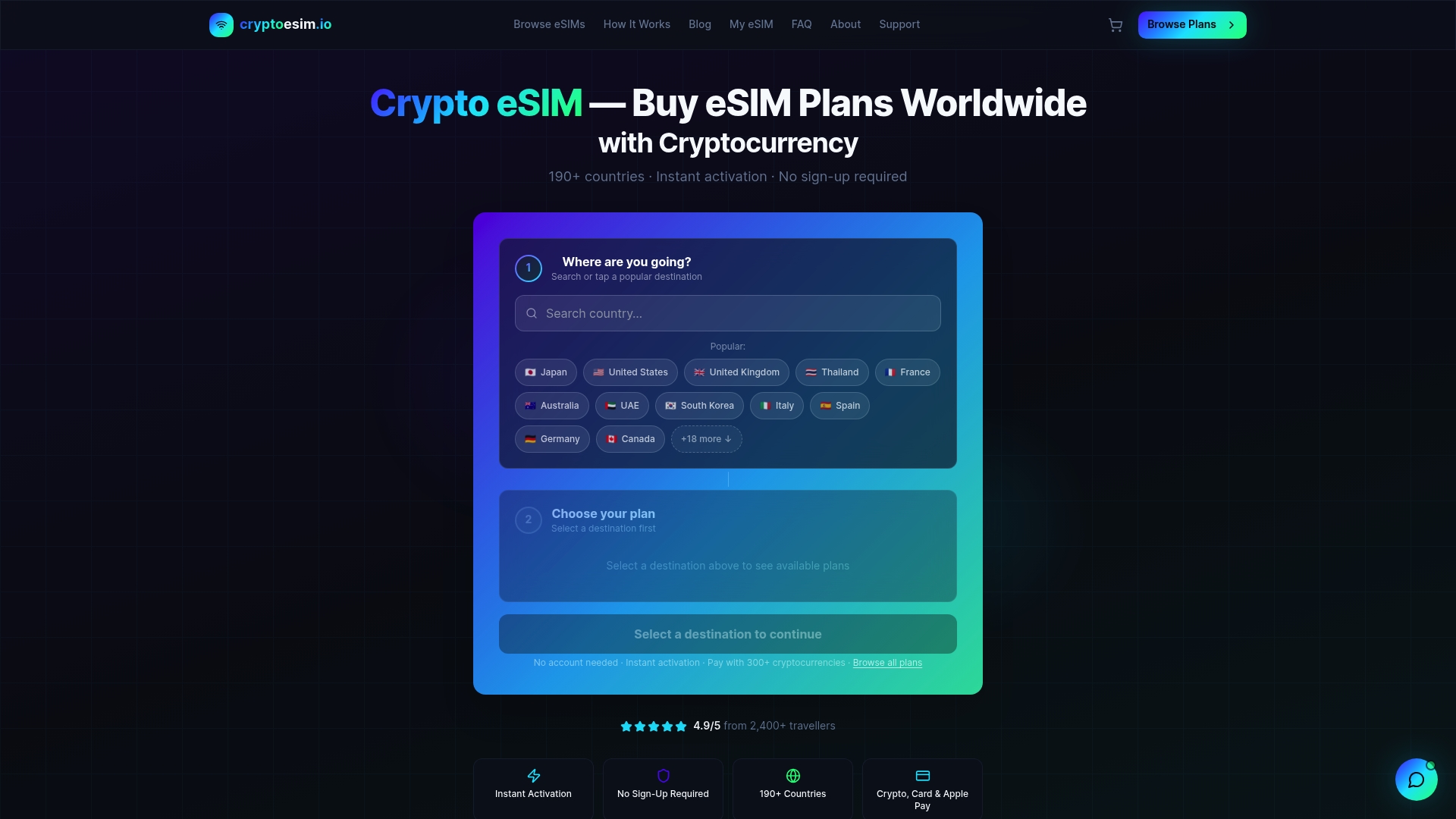
You get instant eSIM activation across 190+ countries, payment in Bitcoin, Ethereum, or 300+ other tokens (plus cards and Apple Pay), and zero paperwork. No subscription traps, no stored profiles, no KYC. For a digital nomad who moves fast and values privacy, that combination is hard to find anywhere else in the eSIM market.
Pick your destination, choose a plan, pay with crypto or a card, and activate. The whole process takes under three minutes. Browse available global eSIM plans and get connected before your next trip.
Key Takeaways
The strongest eSIM.me alternatives in 2026 each serve a distinct traveler profile, and matching the provider to your actual usage pattern is what determines value.
| Point | Details |
|---|---|
| Travel frequency drives the choice | Frequent travelers benefit from reusable eSIMs like Saily; occasional travelers get better value from marketplace apps like Airalo. |
| YeSIM’s Pay & Fly model is unique | It bills for exact megabytes consumed across 170+ countries, with no per-country plan purchases required. |
| Virtual numbers vary significantly | Many services offer incoming SMS only; verify outgoing call support before buying if you need active voice communication. |
| Saily’s security features are built-in | A built-in ad blocker saves around 28.6% data, with DNS-level protection included at no extra cost. |
| Cryptoesim requires no account or KYC | It covers 190+ countries, accepts 300+ crypto tokens, and activates instantly with no personal data required. |