eSIMs and Borderless Connectivity: 2026 Travel Guide
TL;DR:
- eSIMs are reprogrammable, embedded chips that enable instant carrier profile downloads, replacing physical SIM cards for borderless connectivity. They offer speed, cost savings, and environmental benefits for travelers and IoT devices, with multi-provider platforms providing seamless profiles worldwide. Understanding eSIM, eUICC, and standards like SGP.32 and SGP.41 unlocks their full potential across personal and industrial applications.
Plugging a physical SIM into your phone at every border crossing is a relic. The conversation around eSIMs and borderless connectivity has moved far beyond novelty, and yet most travelers still reach for roaming plans that overcharge and underdeliver. An eSIM, or embedded SIM, is a reprogrammable chip built directly into your device. Paired with GSMA’s Remote SIM Provisioning (RSP) standard, it lets you download carrier profiles over the air in seconds. What used to require a trip to an airport kiosk now happens from your settings menu before your flight even boards.
Key takeaways
| Point | Details |
|---|---|
| eSIM vs. eUICC distinction | eSIM is the physical chip; eUICC is the software platform enabling remote profile management. |
| Zero-touch activation | Travel eSIMs now support instant carrier switching without physical SIM swaps or in-store visits. |
| IoT scales eSIM further | SGP.32 and SGP.41 standards extend borderless connectivity to industrial devices with no user interface. |
| Activation reliability varies | SM-DP+ server quality differs by region, so choosing a provider with strong infrastructure matters. |
| Crypto-friendly eSIM access | Platforms like Cryptoesim let you buy global data plans with Bitcoin or 300+ other tokens, no account needed. |
How eSIMs enable borderless connectivity
Before getting into the travel benefits, let’s get the terminology straight. eSIM and eUICC are not the same thing, and conflating them causes real compatibility headaches. The eSIM is the physical form factor, a chip soldered onto the motherboard. The eUICC (Embedded Universal Integrated Circuit Card) is the secure operating environment running on that chip, and it’s the eUICC that actually manages multiple carrier profiles, handles cryptographic authentication, and interfaces with GSMA’s RSP infrastructure.
441 operators across 123 countries offered eSIM smartphone services as of June 2024, and Counterpoint forecasts nearly 70% of cellular devices will support embedded SIM by 2030. That’s the network effect you want working for you when you land in Tokyo, Nairobi, or Buenos Aires.
There’s also a third layer worth knowing: iSIM, or integrated SIM. Where an eSIM is a separate chip on the board, an iSIM integrates SIM functionality directly into the application processor. Smaller, more power-efficient, and increasingly common in wearables and next-gen smartphones.
Here’s what those terms mean in practice:
- eSIM (form factor): The physical chip that replaces a removable SIM tray. Your iPhone 15 or Samsung Galaxy S24 already has one.
- eUICC (software platform): The secure element managing your downloaded carrier profiles, keys, and switching logic.
- iSIM (next generation): SIM logic fused into the main processor. Expect this in flagship devices and IoT sensors by 2027.
- SM-DP+ (provisioning server): The carrier-side server that delivers encrypted profile packages to your device over Wi-Fi.
Pro Tip: Before you buy an eSIM plan, confirm your device reports an EID (eSIM identifier) in its settings. No EID means no eSIM hardware, regardless of what the spec sheet claims.
Practical advantages for international travelers
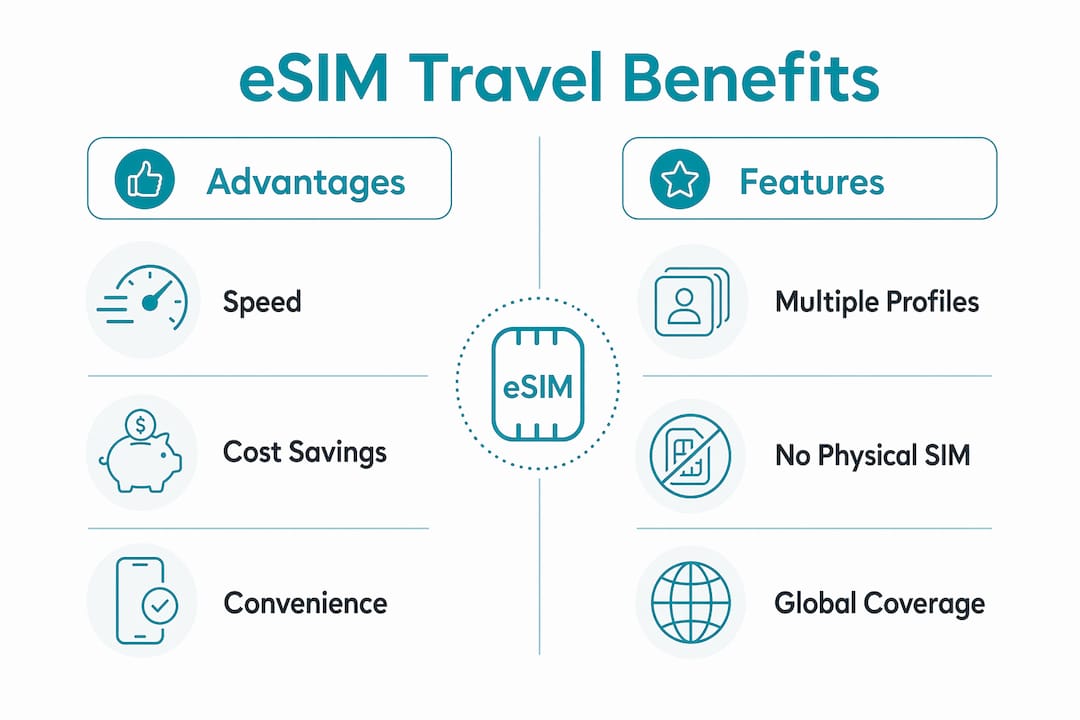
The most obvious win is speed. Instead of queuing at an airport SIM vendor, you activate a local data plan from the gate. But the advantages of eSIMs go deeper than convenience.
Zero-touch activation via travel eSIMs unifies billing directly on your home carrier account, which means no separate invoices to track across five countries. Amdocs demonstrated exactly this at MWC 2026, showing how operators can offer trusted support abroad through the same billing relationship travelers already have at home. That’s a significant shift from the “buy a local SIM and hope the data works” approach.
Here’s how the traveler experience actually unfolds with eSIM global data plans:
- Buy your plan before departure. Most providers let you purchase and download a profile while still on home Wi-Fi, so you arrive with a working data connection.
- Scan the QR code or enter the activation details. Your phone contacts the carrier’s SM-DP+ server, verifies your device’s EID, and downloads the encrypted profile.
- Set the travel eSIM as your data line. On dual-SIM devices, keep your home SIM active for calls and texts while routing all data through the cheaper local profile.
- Switch profiles at the destination level, not the carrier level. For multi-country trips, manage separate regional profiles rather than one global roaming plan. The cost difference is substantial.
- Delete the profile when done. No expired SIM to discard, no plastic waste, and your slot is ready for the next destination.
Cost is where most travelers leave money on the table. A carrier roaming plan for two weeks in Southeast Asia can run $10 to $15 per day. A regional eSIM plan covering the same area typically costs $15 to $30 total. That gap is real, and it compounds across frequent travel.
Pro Tip: If your phone supports dual eSIM profiles simultaneously (many recent Android flagships do), you can keep a local data eSIM active while your home eSIM handles voice calls, completely avoiding per-minute roaming charges on your primary number.
The environmental argument is less discussed but legitimate. Physical SIM cards generate plastic waste at scale. Every profile you download instead of swapping a physical card is a small but measurable reduction in that footprint.
eSIM for IoT and enterprise deployments
Consumer travel is only one slice of where borderless mobile services are heading. The more technically interesting story is what’s happening in IoT, and it requires understanding two standards you’ve probably never heard of: SGP.32 and SGP.41.
SGP.32 enables remote eSIM management on resource-constrained devices with no user interface at all. No QR code. No settings menu. A smart meter in rural Portugal or a fleet tracking unit in Kazakhstan can switch carriers dynamically based on signal quality, without any human touching the device. The management commands flow from a server directly to the eUICC using a lightweight protocol designed for low-power environments.
SGP.41 (factory provisioning) complements this by allowing profiles to be loaded during manufacturing. The device arrives in the field with a working operator profile already installed, skipping the first-boot activation overhead entirely. For devices with small batteries or limited network access at deployment, this matters enormously.
| Standard | Use case | Key benefit |
|---|---|---|
| SGP.22 (consumer RSP) | Smartphones, tablets, wearables | QR code or app activation, user-managed profiles |
| SGP.32 (IoT RSP) | Sensors, meters, trackers with no UI | Server-side orchestration, no human interaction required |
| SGP.41 (factory provisioning) | Long-lifetime industrial IoT devices | Profile pre-loaded at manufacture, zero first-boot friction |
The growth trajectory here is sharp. The iSIM installed base is projected to climb from 800,000 units in 2024 to over 10 million by 2026. Enterprise buyers managing connected assets across borders have discovered that server-managed profile orchestration removes the dependency on local IT teams or carrier support desks in every country of operation.
This is eSIM technology benefits scaled to industrial reality, not just a convenience feature for travelers with iPhones.
Setting up and troubleshooting your eSIM
Activation sounds simple until it fails at midnight in a foreign airport. The reality is that eSIM QR codes are cryptographic tokens tied to your device’s EID and validated against the carrier’s SM-DP+ server. Several things can break this chain.
- Wi-Fi stability: The provisioning handshake requires a sustained connection. Hotel lobby Wi-Fi with a captive portal will block it. Use a trusted network or your home connection before traveling.
- Device clock accuracy: If your phone’s clock is even slightly off, the TLS certificates in the provisioning session can fail validation. Turn on automatic time before activating.
- Token reuse: Each QR code is single-use. If activation partially failed, the token may be burned. Contact the provider for a fresh code, not a re-scan of the same QR.
- Carrier roaming agreements: Your eSIM profile connects to one carrier’s network, but coverage in remote areas depends on that carrier’s local roaming partners. Check their partner list before buying.
- Profile limits: Some devices cap stored profiles at five or ten. Delete old profiles you no longer use before adding new ones.
SM-DP+ server infrastructure quality varies wildly by provider. Real-world testing on iPhone 15 devices showed activation times ranging from 22 seconds to outright failure at the three-minute mark depending on the provider and region. That gap is entirely about server-side infrastructure, not your phone.
The single most underrated activation tip: download your eSIM profile at home, on your own Wi-Fi, at least 24 hours before departure. You sidestep airport network chaos, time-zone clock drift, and the stress of troubleshooting in a foreign language.
Pro Tip: Screenshot the activation QR code and store it in a local photo album before traveling. Cloud-synced photos can be inaccessible without connectivity, which defeats the purpose when you’re activating your first international data plan.
You should also verify whether your purchased plan includes data-only service or also supports voice and SMS via VoIP. Many global data plans are data-only by design, relying on apps like WhatsApp or Signal for communication. Know what you’re buying before you need it.
Comparing eSIM platforms in 2026
Not all eSIM providers are alike, and the differences matter more than marketing copy suggests.
| Feature | Standard carriers | Multi-carrier platforms | Privacy-focused providers |
|---|---|---|---|
| Coverage | Home country + roaming | 100 to 190+ countries | 190+ countries |
| Profile management | Single profile per carrier | Multi-profile app | No-KYC, instant activation |
| Payment options | Credit card only | Credit card, PayPal | Crypto, card, Apple Pay |
| Account required | Yes | Usually yes | Often no |
| Activation speed | Minutes to hours | Near-instant | Near-instant |
| Enterprise/IoT support | Limited | Select providers | Select providers |
Multi-carrier managed SIM platforms like UniSIM add automatic failover, dynamically switching between carrier networks when signal degrades. For enterprise deployments with distributed operations, that carrier-agnostic approach prevents downtime that a single-carrier eSIM would not catch.
On the consumer side, platforms like Goconnect offer over-the-air profile management with an in-app data marketplace, letting travelers browse and buy plans across iOS and Android. The multi-profile capability is the real draw for people who move between regions frequently.
Where Cryptoesim stands out is specifically at the intersection of privacy and global reach. No-KYC purchasing across 190+ countries with crypto payment support places it in a category that most standard carriers simply do not serve, and that distinction matters to a growing segment of privacy-conscious travelers and remote workers.
My take on where eSIM technology is actually heading
I’ve watched the eSIM space long enough to see through the hype cycles, and here’s what I think most people get wrong: they treat eSIM as a slightly better physical SIM. It’s not. It’s a programmable network access layer, and that distinction changes everything about how you should think about connectivity abroad.
The travelers who still fumble with local SIM swaps are leaving real money and security on the table. Every time you hand a physical SIM to a street vendor in a foreign city, you’re trading a hardware token that can be cloned or tracked. An eSIM profile on a secure mobile connection abroad never physically leaves your device.
What I find genuinely underappreciated is the IoT angle. The SGP.32 standard is setting up a world where every connected device, from shipping containers to environmental sensors, manages its own carrier relationships without any human intervention. That’s not a feature. That’s a structural shift in how global infrastructure will work. The iSIM projection of 10 million units by 2026 is the early signal of a much larger wave.
My honest advice for travelers: stop treating eSIM profiles as one-time purchases. Build a library of regional profiles, learn your device’s profile management screen, and treat connectivity as something you configure before you travel, not something you scramble to fix when you arrive.
— Mohammed
Get connected before you land with Cryptoesim
If you’ve been putting off making the switch from physical SIMs, the only thing you’re gaining is friction. Cryptoesim gives you instant access to eSIM data plans across 190+ countries, with no account creation required and no KYC hurdles.
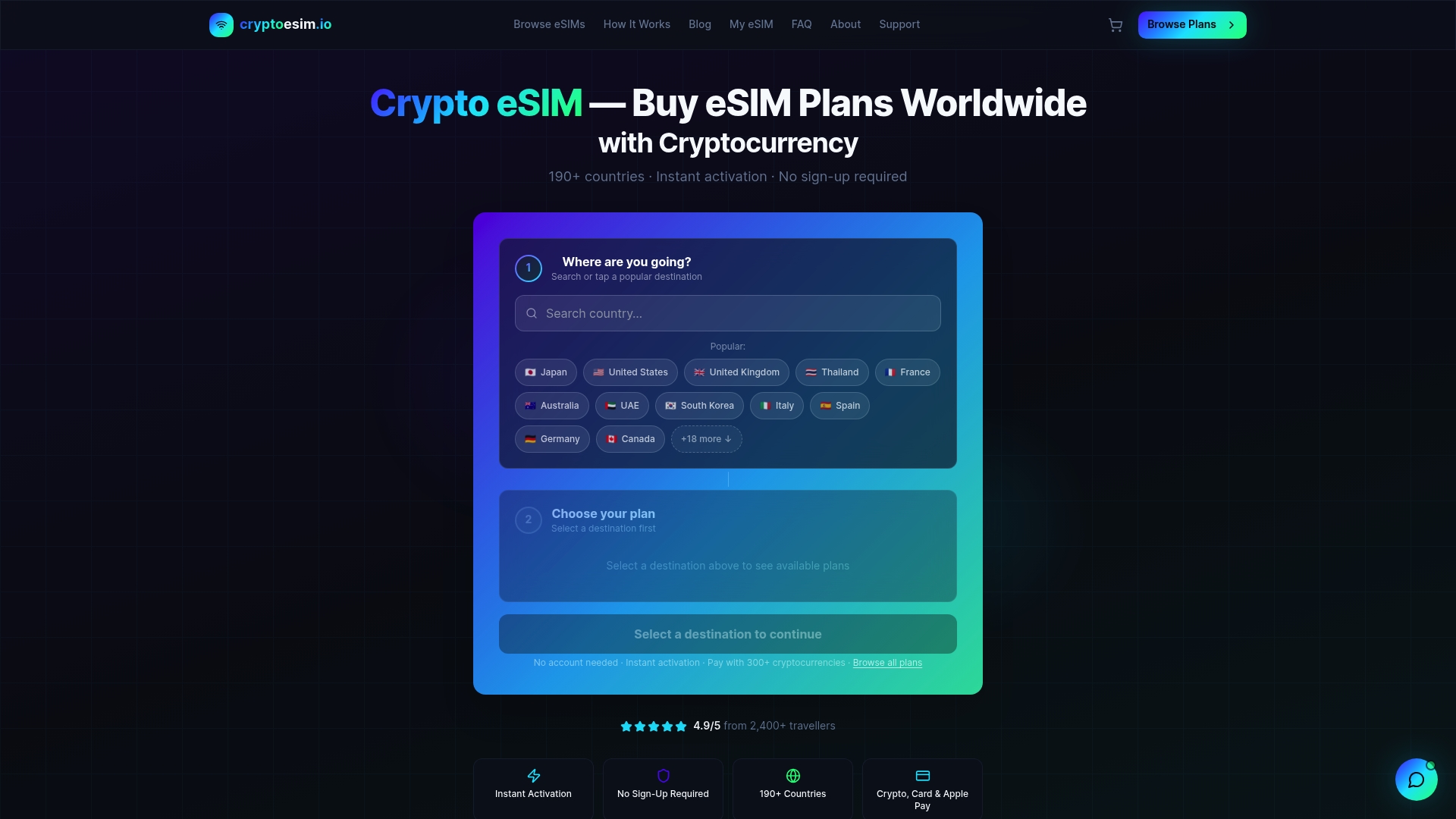
You can pay with Bitcoin, Ethereum, or over 300 other cryptocurrencies, along with credit cards and Apple Pay. Plans activate in seconds via QR code, and you manage everything from your device settings. For travelers who value privacy and flexibility, this is exactly what mobile connectivity should look like. Explore available eSIM packages and find a plan that matches your next destination before you pack your bag.
FAQ
What is the difference between eSIM and eUICC?
An eSIM is the physical embedded chip in your device, while the eUICC is the secure software platform on that chip that manages carrier profiles remotely. Understanding this distinction prevents compatibility errors when evaluating borderless mobile services.
How do eSIMs work for international travel?
You purchase a plan, scan a QR code on stable Wi-Fi, and your device downloads an encrypted carrier profile from the provider’s SM-DP+ server. The process takes seconds and requires no physical SIM swap.
Why does eSIM activation sometimes fail?
Activation failures are typically caused by unstable Wi-Fi, an incorrect device clock, a single-use QR code that was partially consumed, or regional SM-DP+ server issues. Activating at home before travel eliminates most of these variables.
Can I use eSIM for IoT devices?
Yes. The SGP.32 standard enables headless eSIM provisioning on resource-constrained IoT devices with no user interface, allowing server-side carrier switching for sensors, trackers, and meters deployed globally.
Are eSIM plans cheaper than roaming?
In most cases, yes. Regional eSIM data plans consistently undercut carrier roaming rates, often by 60 to 80 percent for multi-week trips to popular international destinations.