Crypto Payment Volatility Explained: Risks and Solutions

Cryptocurrency payment volatility describes the rapid, often dramatic swings in a digital asset’s price that occur during the window between when a payment is sent and when it settles or converts to fiat. For Bitcoin, that window can cost you real money in seconds. Unlike a credit card transaction where the dollar amount is locked the moment you tap your card, a crypto payment’s fiat value keeps moving until conversion is complete. That gap is where the risk lives.
Why does this matter practically? Consider a merchant who accepts Bitcoin for a $500 order. If Bitcoin drops 5% before the payment converts, that merchant just absorbed a $25 loss with no recourse. The core issues this creates include:
- Revenue unpredictability: The fiat value of incoming crypto payments can shift materially between invoice and settlement.
- Margin erosion: For businesses operating on thin margins, even a 2–3% price swing can wipe out profit on a transaction.
- Treasury complexity: Holding unconverted crypto creates an unhedged position that compounds with every new payment received.
- Reconciliation headaches: Accounting teams must track the fiat equivalent at the exact moment of receipt, not at the time of conversion.
- Consumer confusion: Buyers sometimes see their crypto balance unchanged while the fiat equivalent has moved, creating disputes.
Stablecoins like USDC exist precisely to address this problem. Bitcoin represents the volatility challenge at its most visible; USDC represents the industry’s most widely adopted answer. Understanding how crypto price fluctuations work, what drives them, and how to contain their impact is the foundation of any serious crypto payment risk analysis.
How crypto volatility compares to traditional financial markets
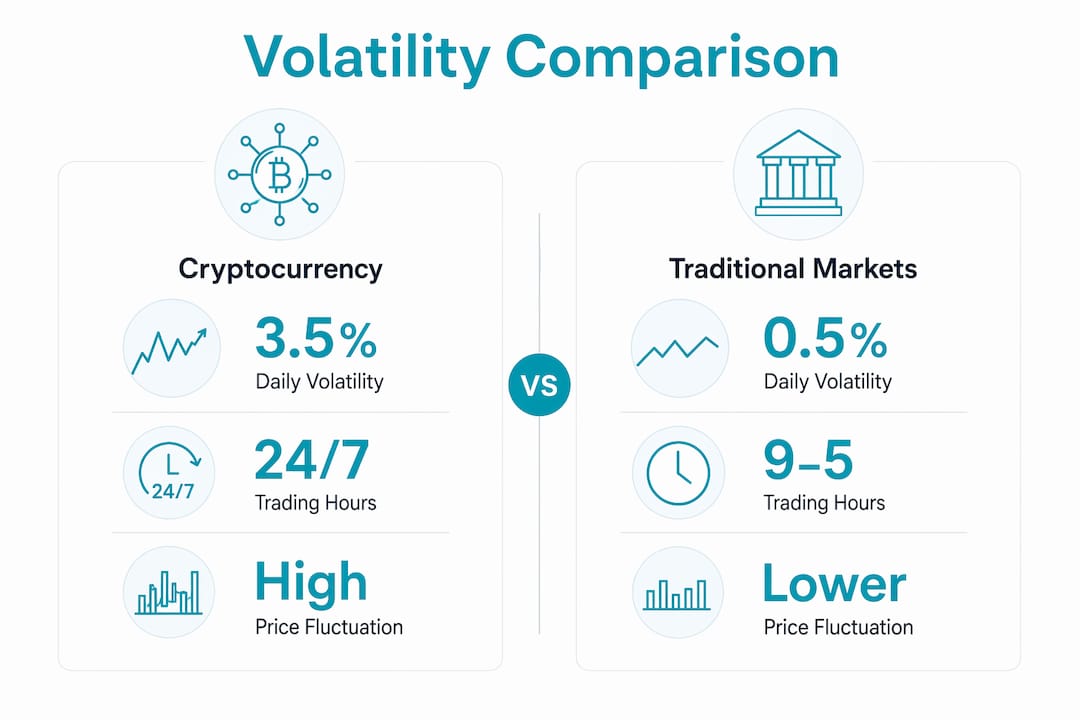
Bitcoin’s daily price volatility runs at roughly 3.5% on average, compared to about 0.5% for the S&P 500. That is a significantly higher difference in day-to-day price movement, and it compounds quickly over a payment processing window of even a few hours.
| Asset | Avg. daily volatility | Annualized 30-day volatility | Trading hours |
|---|---|---|---|
| Bitcoin (BTC) | ~3.5% | ~32.7% (mid-2025) | 24/7, no circuit breakers |
| S&P 500 | ~0.5% | ~10% (typical) | market hours, halts exist |
| Gold | ~0.5% | ~10% (typical) | Limited sessions |
| USDC (stablecoin) | — | Near zero by design | 24/7 |

Two structural differences explain most of this gap. First, crypto markets run continuously, 24 hours a day, seven days a week, with no circuit breakers to pause trading during a freefall. Stock exchanges halt trading when prices drop too fast; Bitcoin does not. Second, crypto markets are still relatively thin compared to equities, meaning a single large order can move prices far more than it would in a deep, liquid market.
That said, volatility is declining for major assets like Bitcoin as institutional participation grows and spot ETF products improve market liquidity. The trend is real, but the gap with traditional assets remains wide enough to demand active risk management for anyone accepting crypto payments today.
Practitioners measure crypto price fluctuation using Historical Volatility (HV), which calculates the standard deviation of price returns over a rolling window, and the Average True Range (ATR), which captures the average daily price range. Both metrics feed directly into payment gateway risk models and treasury hedging decisions.
What actually drives cryptocurrency payment fluctuations
Volatility in crypto markets stems primarily from low liquidity, sentiment-driven price discovery, and regulatory uncertainty. Those three forces interact constantly, and any one of them can trigger a cascade.
The main drivers behind cryptocurrency payment fluctuations:
- Thin order books: When buy and sell orders are sparse at any given price level, even a moderately sized trade can gap the market by several percentage points. This is especially acute for smaller tokens outside Bitcoin and Ethereum.
- Retail sentiment and FOMO: Crypto markets attract a high share of retail participants who react to news, social media, and price momentum rather than fundamentals. Fear of missing out drives buying sprees; fear of loss triggers panic selling.
- Regulatory shifts: A single government announcement, whether a ban, a tax ruling, or an ETF approval, can move Bitcoin by double digits in hours. The U.S. regulatory environment in particular carries outsized influence on global crypto prices.
- No central stabilization: Central banks can intervene in currency markets; no equivalent mechanism exists for crypto. There is no lender of last resort, no market maker of last resort.
- Whale trades and liquidation cascades: Large holders can move markets dramatically. A $2.7 billion Bitcoin sell-off in august 2025 wiped $200 billion in total market capitalization and triggered $550 million in leveraged position liquidations within hours.
- 24/7 exposure window: Unlike stock markets that close overnight, crypto prices move while businesses sleep. A payment received at 11 PM can be worth meaningfully less by 6 AM.
Pro Tip: The longer a payment sits unconverted in crypto, the more volatility risk accumulates. Every minute of “time-in-crypto” is a minute of unhedged price exposure. Treat the conversion window, not the asset itself, as the primary risk variable.
Understanding how crypto prices change at a mechanical level, order flow, liquidity depth, and sentiment cycles, gives you a clearer picture of why even a well-timed payment can arrive at a different value than expected.

How volatility hits merchants and consumers in practice
The primary risk for businesses accepting crypto payments is not the asset itself. It is the length of time funds remain in volatile crypto before fiat conversion. That interval, however brief, is the entire exposure window.
Here is how that plays out across different stakeholders:
- Merchants with thin margins: A retailer selling goods at a 10% margin who accepts Bitcoin faces potential margin wipeout if BTC drops 8% before conversion. The product ships; the revenue does not cover cost.
- Subscription and recurring billing: Businesses charging monthly fees in crypto face a different invoice value every cycle, complicating revenue forecasting and customer communication.
- Cross-border payments: A U.S. business receiving payment from an overseas buyer in ETH must account for both crypto volatility and FX movement simultaneously.
- Consumers making purchases: Buyers who pay with Bitcoin for a fixed-price item may find their wallet balance looks unchanged while the fiat equivalent of what they spent has shifted. Payment processors fix the invoice value at purchase time, but the crypto amount sent reflects the price at that exact moment.
This confusion, well-documented by payment processors, is one of the most common sources of customer support tickets in crypto commerce. The fix is clear communication: the fiat price is locked at checkout; the crypto amount is a snapshot of that moment’s exchange rate.
Mitigation strategies that actually work:
- Instant auto-conversion: Payment gateways that convert crypto to fiat or stablecoins within seconds of receipt eliminate virtually all volatility exposure. Some gateways support 70+ tokens with conversion times under 20 seconds.
- Stablecoin invoicing: Pricing invoices in USDC rather than BTC or ETH removes price movement from the equation entirely, since USDC tracks the U.S. dollar.
- Wallet balance thresholds: Setting a maximum unconverted crypto balance triggers automatic conversion before exposure builds beyond a defined limit.
- Fiat-denominated pricing with crypto payment: The invoice shows a dollar amount; the crypto equivalent is calculated at checkout and locked. The buyer pays the crypto amount; the merchant receives the dollar value.
Platforms like Cryptoesim apply this logic directly. When you buy an eSIM with crypto, the price is denominated in fiat, the crypto equivalent is calculated at the moment of purchase, and the transaction settles without leaving you or the platform exposed to a price swing mid-transaction.
Research insights on stablecoins and payment risk management
The market’s answer to crypto payment volatility is increasingly clear: move to stablecoins or compress the conversion window to near zero. Both approaches work; the data on adoption backs them up.
USDC merchant payment volume increased by over 300% between 2024 and the first half of 2025. That is not a niche experiment. It reflects a broad shift among businesses that want crypto payment rails without the price risk that comes with holding Bitcoin or Ethereum on the balance sheet.
This framing, consistent with expert analysis of crypto market structure, reorients the conversation. Businesses do not need to wait for Bitcoin to become stable. They need systems that remove their exposure to Bitcoin’s price movement during the payment window.
The gold standard, according to payment infrastructure experts, is reducing time-in-crypto to seconds via automated conversion at receipt. Pair that with stablecoin settlement options and fiat-denominated invoicing, and the volatility problem becomes largely operational rather than existential.
Research from the Federal Reserve Bank of Kansas City notes that the share of U.S. consumers using cryptocurrency for payments has remained small, partly because volatility and complexity create friction. The GENIUS Act, passed by Congress to establish a stablecoin regulatory framework, is expected to accelerate stablecoin adoption for everyday payments by giving merchants and consumers a clearer legal foundation for using dollar-pegged assets.
For treasury teams, the practical toolkit looks like this: auto-conversion at receipt, stablecoin buffers for crypto liquidity needs, wallet thresholds to cap unhedged exposure, and fiat-denominated pricing at checkout. None of these require abandoning crypto payments. They just require treating volatility as an engineering problem rather than an unavoidable market condition.
Security matters alongside volatility management. Phishing attacks targeting crypto wallets can disrupt payment flows just as severely as price swings, and crypto wallet phishing remains an active threat for anyone transacting in digital assets. Volatility controls and security controls belong in the same risk framework.
Cryptoesim accepts Bitcoin, Ethereum, and over 300 other tokens for eSIM purchases across 190+ countries. The pricing is fiat-denominated, the crypto equivalent locks at checkout, and no account creation is required. If you want to use crypto for global connectivity without worrying about a price swing eating into your purchase, get your eSIM here.
Key Takeaways
Crypto payment volatility is manageable when you compress the conversion window to near zero and price invoices in fiat or stablecoins from the start.
| Point | Details |
|---|---|
| Bitcoin daily volatility | Bitcoin’s average daily price swing is ~3.5%, versus ~0.5% for the S&P 500. |
| Time-in-crypto is the core risk | The longer crypto sits unconverted after receipt, the greater the fiat value exposure. |
| Stablecoin adoption is accelerating | USDC merchant payment volume grew over 300% between 2024 and mid-2025. |
| Auto-conversion is the gold standard | Gateways supporting 70+ tokens can convert to fiat in under 20 seconds at receipt. |
| Volatility reflects market immaturity | Low liquidity and sentiment-driven trading cause swings, not a flaw in blockchain technology. |