How Bitcoin powers secure online purchases for travelers

Bitcoin is accepted by tens of thousands of merchants worldwide, yet most travelers still think of it purely as a speculative asset. That assumption is costing them real convenience. When your bank blocks a foreign transaction or slaps you with a 3% foreign exchange fee, Bitcoin enables purchases through direct wallet transfers, third-party processors, or the Lightning Network without any of that friction. For international travelers and digital nomads, this matters most when buying mobile data and telecom services across borders. This guide breaks down exactly how Bitcoin works for online purchases, where it shines, and how to use it confidently for your next trip.
Table of Contents
- Bitcoin in online purchases: How it works
- The Lightning Network: Transforming small online payments
- Where and what can you buy with Bitcoin? Telecom and data services
- Pros and cons of using Bitcoin for online purchases
- Expert insights and future outlook for Bitcoin payments
- Ready to try Bitcoin for mobile and data while abroad?
- Frequently asked questions
Key Takeaways
| Point | Details |
|---|---|
| Lightning unlocks easy micro-purchases | The Lightning Network makes small, instant, global data and telecom buys with Bitcoin practical and very low-fee. |
| eSIMs and airtime made simple | You can buy prepaid eSIMs and top up mobile data worldwide with Bitcoin, usually no banking or ID hurdles required. |
| Understand the risks before you buy | Security, fraud risk, and price swings mean you should choose platforms wisely and know about the lack of chargebacks. |
| Adoption is up, but usage is niche | While merchant acceptance of Bitcoin is climbing rapidly, only a small share of travelers and consumers use it so far. |
Bitcoin in online purchases: How it works
Bitcoin enters the online purchasing ecosystem in three main ways, and each one has a different speed, cost, and complexity profile. Understanding which method fits your situation is the first step to using it effectively.
On-chain transfers are the original method. You send Bitcoin directly from your wallet to a merchant’s wallet. It works, but confirmation times can run 10 to 60 minutes and fees spike during network congestion. For buying a $15 eSIM plan while waiting at an airport, that’s not ideal.
Third-party processors like BitPay, Square, and cryptocurrency merchants using Stripe solve the speed problem. They accept your Bitcoin, convert it to fiat instantly, and settle with the merchant. The merchant never holds crypto, which removes volatility risk on their end. This is why crypto payment options for travelers have expanded so rapidly across telecom and digital service platforms.
The Lightning Network is the third method and the most exciting for frequent, small purchases. It operates as a second layer on top of Bitcoin, enabling mobile crypto payments that settle in seconds for fractions of a cent. For buying data top-ups or eSIMs repeatedly while traveling, Lightning is the clear winner.
Here’s a quick comparison of the three methods:
| Method | Speed | Typical fee | Best for |
|---|---|---|---|
| On-chain transfer | 10 to 60 min | $1 to $5+ | Large, one-time purchases |
| Third-party processor | Seconds | 1% to 2% | Merchants needing fiat settlement |
| Lightning Network | Under 5 sec | Under $0.01 | Frequent small purchases |
Key advantages of using Bitcoin for online purchases include:
- No currency conversion fees from your bank or card issuer
- No geographic restrictions based on your home country
- Instant settlement with processors, even across borders
- Privacy on no-KYC platforms, especially relevant for the ultimate crypto eSIM guide use cases
- Access to 140+ countries through platforms that accept Bitcoin for digital services
The accepting Bitcoin payments infrastructure has matured enough that you can now buy eSIMs, airtime, and data plans with the same ease as using a credit card.
The Lightning Network: Transforming small online payments
Knowing Bitcoin can be used online is great, but for travelers making small, frequent purchases, the Lightning Network is a genuine game-changer. It was built specifically to solve Bitcoin’s speed and cost problems for everyday transactions.
Lightning Network fees under $0.01 make it practical for buying a $5 data top-up without the fee eating 20% of your purchase. Compare that to on-chain Bitcoin fees or even international card fees, and the math is obvious. The Bitcoin fees comparison shows Lightning consistently outperforms both on-chain and traditional card networks for small amounts.
Capacity on the Lightning Network has grown sharply, now holding over 4,300 BTC (worth $448M+), with payment volume up 300% in 2025. That growth reflects real adoption, not just speculation.
| Metric | Lightning Network | On-chain Bitcoin | Credit card |
|---|---|---|---|
| Settlement time | Under 5 seconds | 10 to 60 minutes | 1 to 3 business days |
| Fee per $10 transaction | Under $0.01 | $1 to $5 | $0.30 to $0.50 |
| Works without bank account | Yes | Yes | No |
| Privacy level | High | Medium | Low |
“Lightning Network payments are ideal for the kind of micro-transactions travelers make constantly: data top-ups, short-term eSIM plans, and prepaid airtime. The fees are negligible and the speed is unmatched.”
Pro Tip: Before your trip, preload a Lightning-compatible wallet like Wallet of Satoshi or Phoenix and open a channel with enough capacity for your expected spending. This avoids routing failures mid-trip when you need data urgently.
For travelers who care about privacy, no-KYC eSIM options pair perfectly with Lightning payments. No bank account, no ID, no waiting. And for a broader look at how this fits into 2026 connectivity trends, seamless crypto telecom payments covers the full picture.
Where and what can you buy with Bitcoin? Telecom and data services
With the tech foundation in place, let’s look at the specific products you can actually buy using Bitcoin as a traveling consumer. The options are broader than most people expect.
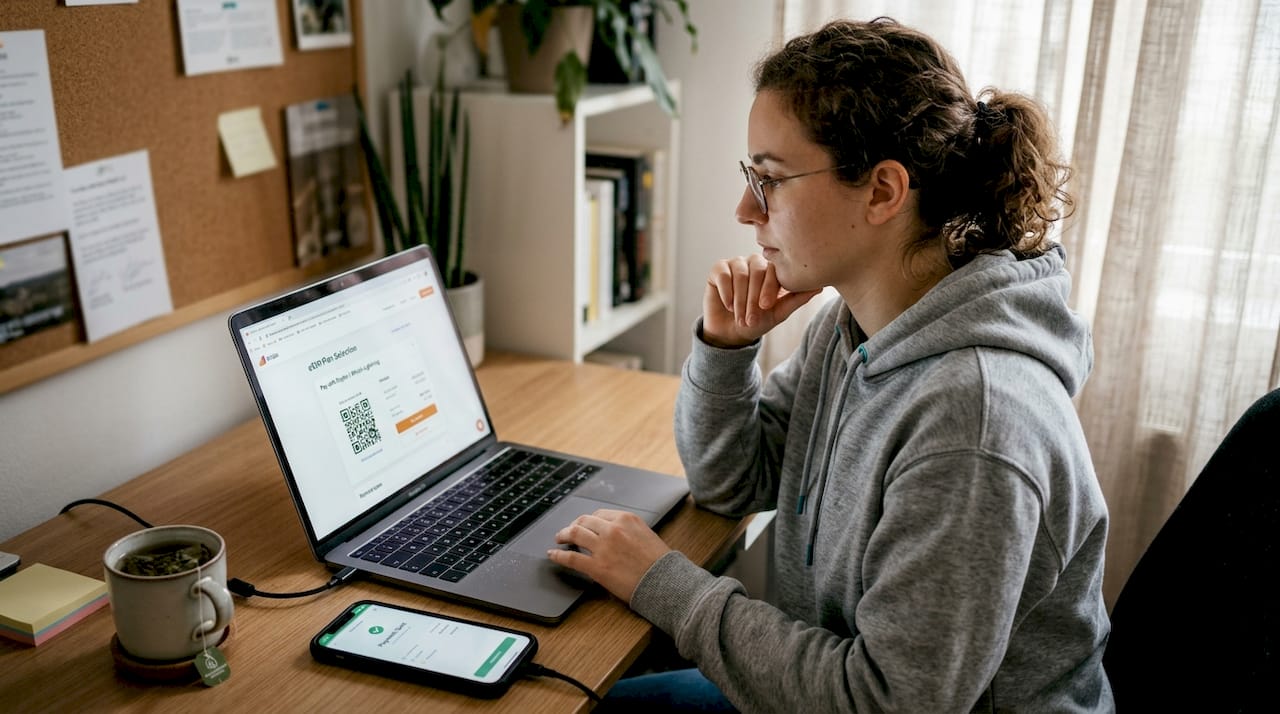
Bitcoin purchases for eSIMs, airtime, and top-ups are now available worldwide, often instantly and usually with no KYC required. Here’s what that looks like in practice:
- eSIM plans for 190+ countries. Buy a digital SIM before or during your trip. Activation typically takes 2 to 5 minutes. No physical card, no carrier store visit. This is the fastest way to get data in a new country.
- Prepaid mobile top-ups. Add airtime or data to your existing prepaid number using Bitcoin. Major resellers and some carriers now accept crypto directly.
- Short-term data packages. Need 3 days of data in Japan? Buy a targeted plan with Bitcoin and activate it immediately. No commitment, no contract.
- Global roaming add-ons. Some platforms let you extend your existing plan’s coverage using crypto, which is useful when your carrier’s roaming rates are punishing.
Pro Tip: When buying eSIM with Bitcoin, always check whether the platform uses a payment processor or accepts on-chain payments. Processor-based platforms activate your eSIM faster because they don’t wait for blockchain confirmations.
For destination-specific planning, best eSIM plans for Europe and Asia breaks down which plans offer the best value per gigabyte. Even AT&T Bitcoin top-ups are now possible through third-party services, showing how mainstream this is becoming.
Pros and cons of using Bitcoin for online purchases
You’re ready to try Bitcoin for your mobile or data needs. But what should you watch out for, and where does it genuinely outperform traditional payment methods?
The upsides are real. Lower fees are the most cited benefit: up to 39% of US merchants now accept Bitcoin, with 88% citing customer demand as the driver. Surveys show 45 to 48% of merchants report faster international settlement as a key advantage. For travelers, that speed matters when you need data now, not tomorrow.
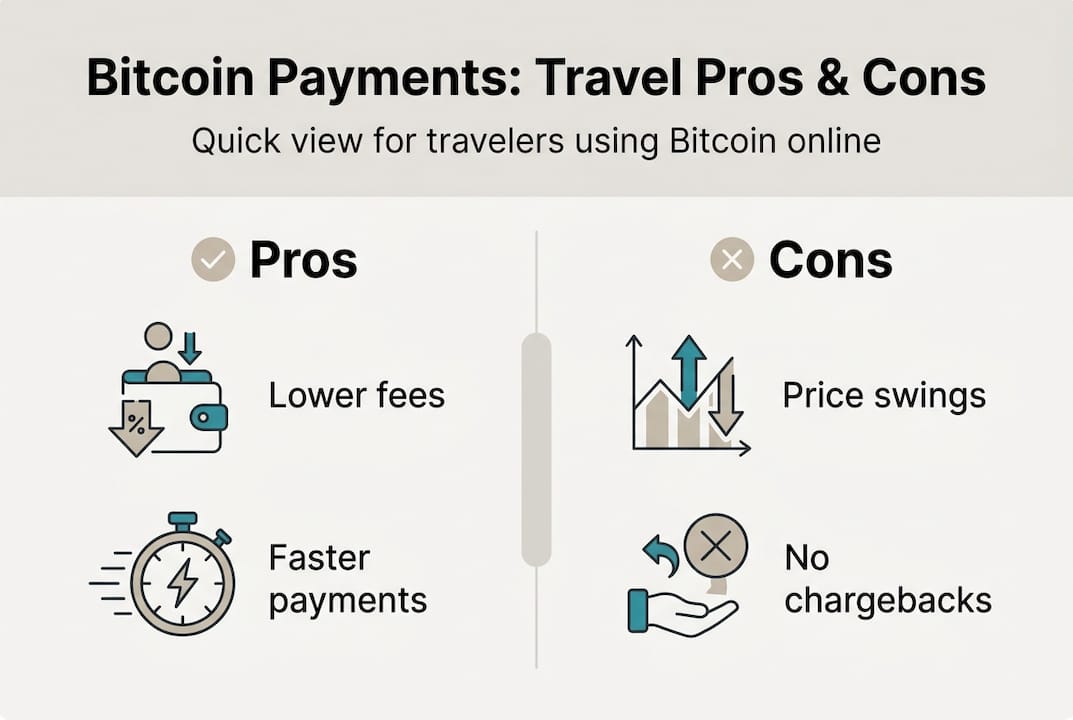
The risks deserve equal attention. Bitcoin payments have no chargebacks. If you send funds to the wrong address or get scammed, there’s no dispute process. Bitcoin payment scams reached $17B in 2025, with average scam payment size up 253%. That’s not a reason to avoid Bitcoin, but it is a reason to use only verified platforms.
Key pros:
- No foreign transaction fees
- Works without a bank account or credit history
- Instant settlement with processors
- Privacy on no-KYC platforms
- Access to services blocked by traditional payment rails
Key cons:
- No fraud reversal or chargeback protection
- Price volatility (mitigated by instant conversion)
- Regulatory uncertainty in some countries (cited by 66% of merchants)
- Still niche: only 2.6% of US consumers used Bitcoin for purchases in 2026
For a deeper look at how this fits your travel setup, the ultimate crypto eSIM guide and the eSIM vs physical SIM comparison both help you build a smarter travel stack. Check Bitcoin adoption trends for the latest data on where usage is growing fastest.
Expert insights and future outlook for Bitcoin payments
We’ve seen the practical pros and cons, but how do experts frame Bitcoin’s emerging role, and what should travelers expect next?
The consensus among payment infrastructure experts is that the Lightning Network aligns almost perfectly with the needs of frequent, global micro-purchases. eSIMs, data top-ups, and prepaid airtime are exactly the kind of transactions LN was designed for: small, fast, borderless, and recurring.
Merchant crypto acceptance has grown 74% among US merchants between 2024 and 2026. Yet end-user adoption remains at just 2.6% of consumers. That gap tells an important story: the infrastructure is ready, but education and habit change are lagging. Digital nomads and international travelers are consistently the first-mover segment, largely because bank restrictions and foreign exchange friction push them toward alternatives faster than domestic users.
“Payment processors now allow merchants to accept Bitcoin while receiving fiat, removing volatility risk entirely. Combined with LN payment volume up 300%, the infrastructure for everyday Bitcoin purchases is genuinely ready.”
Crypto payment usage growth is projected to accelerate as more Bitcoin holders convert from holding to spending. The traveler segment, already comfortable with digital tools and motivated by real pain points like roaming fees and blocked cards, is positioned to lead that shift. For a country-specific example of how this plays out, crypto eSIM Germany shows how local regulations and infrastructure shape the experience.
Security and education remain the two biggest barriers. Scam volumes are high, and many users still don’t know how to verify a platform’s legitimacy before sending funds. The solution isn’t to avoid Bitcoin; it’s to use established platforms with clear track records.
Ready to try Bitcoin for mobile and data while abroad?
You now have a clear picture of how Bitcoin works for online purchases, where it excels, and what to watch out for. The next step is putting it into practice with a platform built specifically for this use case.
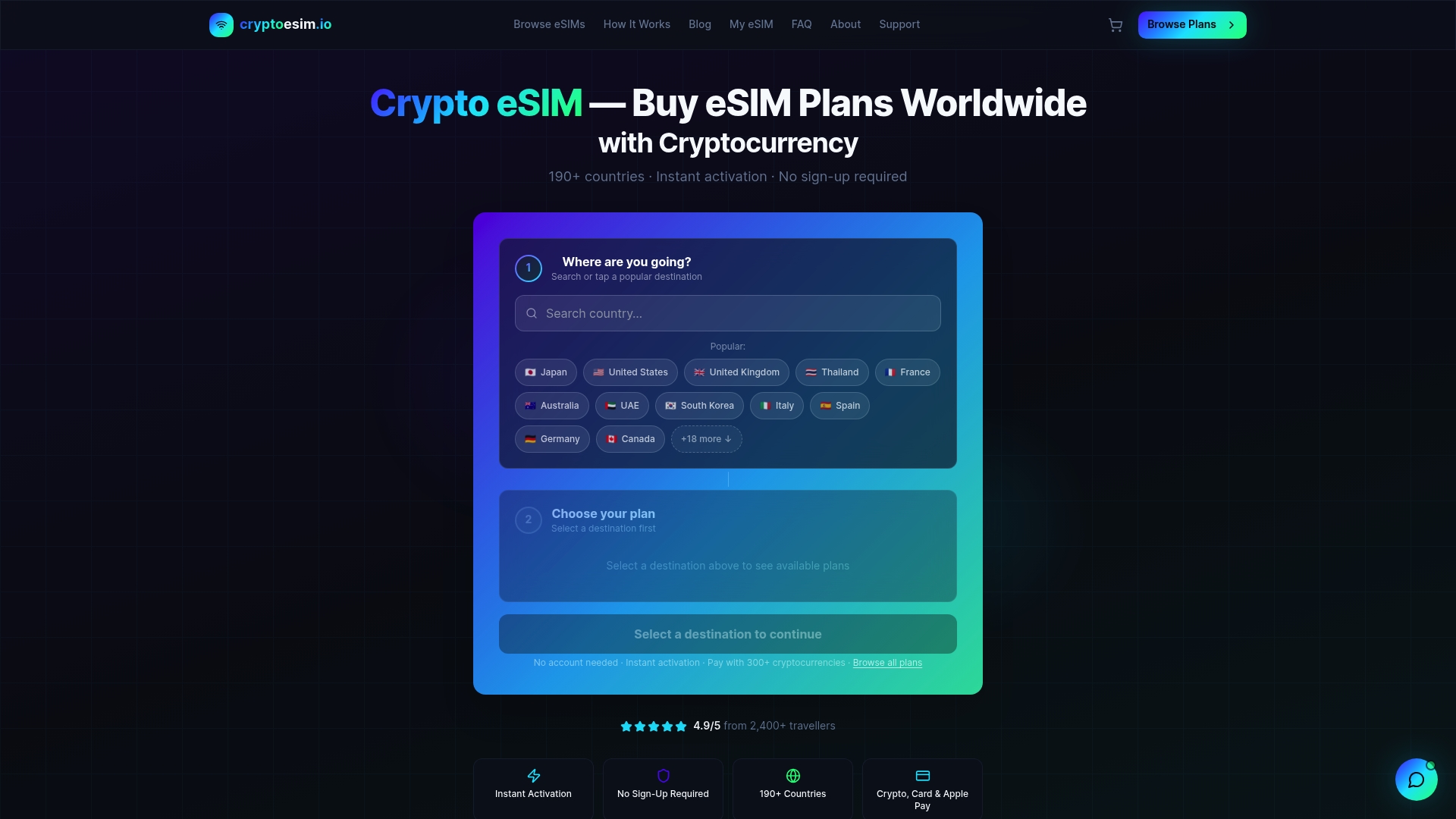
CryptoEsim.io lets you buy eSIM data plans for 190+ countries using Bitcoin, Ethereum, and over 300 other tokens, with no account required and no KYC friction. Plans activate in minutes, not hours. Whether you’re a digital nomad setting up connectivity for a month in Southeast Asia or a traveler who just landed and needs data immediately, the process is straightforward: pick your plan, pay with crypto, scan your QR code, and connect. It’s the kind of seamless experience that makes Bitcoin feel like the obvious choice for mobile data abroad.
Frequently asked questions
Is using Bitcoin for mobile data and telecom safe?
It’s generally safe on verified platforms, but $17B in crypto scams occurred in 2025, so always confirm a site’s legitimacy before sending funds.
Can I buy eSIMs or data top-ups instantly with Bitcoin?
Yes. Many platforms activate eSIMs instantly using Bitcoin with no ID required, typically within 2 to 5 minutes of payment.
Are there extra fees when paying with Bitcoin compared to cards?
Often lower. Lightning Network fees are usually under a cent per transaction, far below typical card foreign transaction fees.
What are the biggest risks of paying with Bitcoin as a traveler?
The main risks are scams, sending to wrong addresses with no chargeback option, and short-term price swings if you don’t use instant conversion.
Do I need to provide ID or banking info to pay with Bitcoin?
Usually not. No-KYC Bitcoin payments are standard on most eSIM and prepaid top-up platforms, making the process fast and private.
Recommended
- CryptoeSIM.io — Buy eSIMs with Crypto | 190+ Countries
- CryptoeSIM.io — Buy eSIMs with Crypto | 190+ Countries
- CryptoeSIM.io — Buy eSIMs with Crypto | 190+ Countries
- CryptoeSIM.io — Buy eSIMs with Crypto | 190+ Countries
- Blockchain-based payment system | Blockchain software development company | Bitecode