How secure are crypto payments for international travelers?

Cryptocurrency payments are surging among international travelers, with adoption climbing by over 40% in the last two years. Yet confusion about their security persists. Many nomads worry about hacks, volatility, and whether crypto transactions are truly safe for purchasing mobile data and other services abroad. This guide cuts through the noise by examining the layered security architecture of crypto payments, identifying real-world risks backed by recent data, and delivering practical protections tailored for tech-savvy travelers who rely on digital currencies for seamless global connectivity.
Table of Contents
- Key takeaways
- Understanding crypto payment security layers
- Common vulnerabilities and real-world risks in crypto payments
- Challenges and considerations for crypto payments in mobile data services
- Protecting your crypto payments while traveling: best practices
- Explore secure crypto eSIM options for seamless global connectivity
- FAQ
Key Takeaways
| Point | Details |
|---|---|
| Layered security approach | Security in crypto payments relies on multiple layers from data and network to user practices, so strong defenses at each level reduce risk. |
| Main loss causes | In 2025 most losses came from access control failures and wallet compromises. |
| Security upgrades with hardware wallets | Using hardware wallets and stablecoins improves security, but merchant adoption remains limited due to volatility and fraud fears. |
| Nomad safety playbook | Travelers should pair crypto purchases with a VPN, secure eSIM, and hardware wallets to enhance payment safety. |
Understanding crypto payment security layers
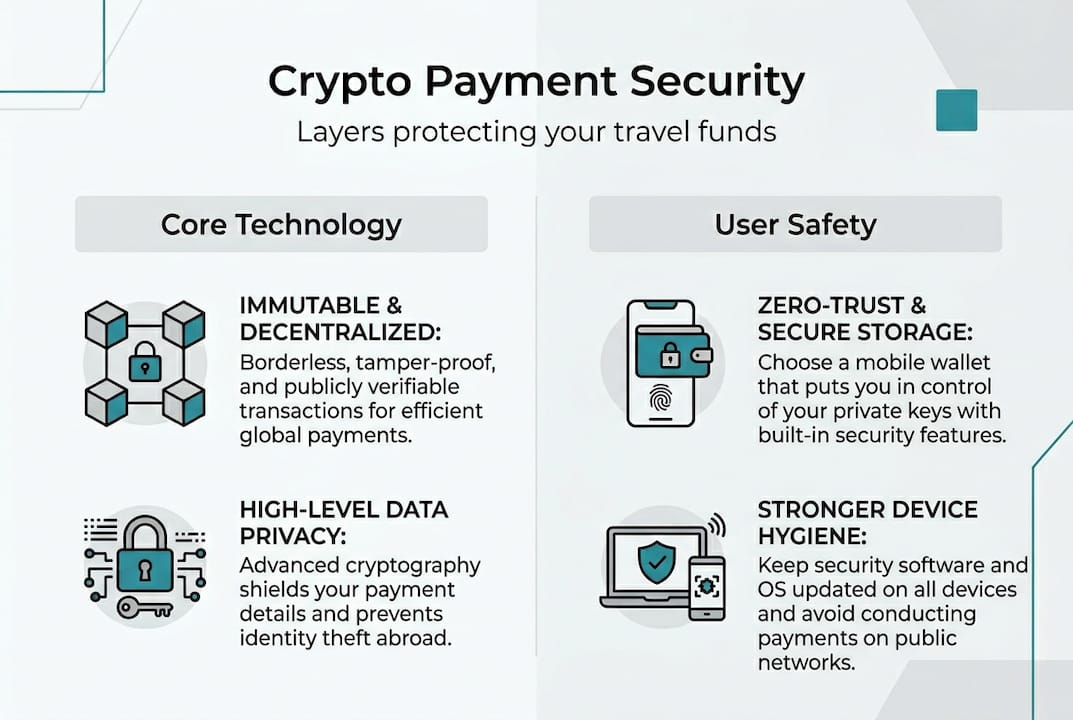
Blockchain technology forms the backbone of cryptocurrency payments through decentralization and cryptographic security. Unlike traditional payment systems controlled by central authorities, blockchain’s distributed ledger resists tampering and single points of failure. However, security challenges arise across multiple technical layers that travelers must understand.
Cryptocurrency payments leverage blockchain’s decentralized nature but face vulnerabilities across data, network, consensus, incentives, and application layers. The data layer handles transaction information and block structure, where issues like double spending can occur if validation fails. Network layer problems include distributed denial of service attacks and eclipse attacks that isolate nodes. Consensus layer threats involve 51% attacks where malicious actors gain majority control, enabling transaction reversals. The incentive layer faces selfish mining strategies that manipulate block rewards. Application layer vulnerabilities include smart contract bugs like reentrancy attacks and front-running exploits.
User endpoints represent the weakest security link despite blockchain’s inherent robustness. Compromised devices, phishing attacks, and insecure wallet management bypass blockchain protections entirely. When you purchase mobile data with crypto while traveling, your security depends not just on blockchain integrity but also on how you manage keys, verify addresses, and protect your device from malware.
Pro Tip: Always verify application sources and updates before installing wallet software or payment apps. Download only from official repositories and enable automatic security updates to patch known vulnerabilities promptly.
Understanding these layers helps you identify where risks concentrate and where your defensive efforts deliver maximum impact. For international travelers, application security and user practices matter most because you control these factors directly.
Common vulnerabilities and real-world risks in crypto payments
Recent security incidents reveal the scale and nature of threats facing crypto payment users. In 2025, 147 crypto security incidents caused $3.22B losses, with access control failures causing 62.8% of losses. The largest hacks involved wallet compromises where attackers gained unauthorized access to private keys or exploited weak authentication systems.
Edge case attacks like address poisoning and phantom signatures have increased dramatically, showing evolving threat sophistication. Address poisoning involves sending tiny amounts of crypto from addresses that visually resemble your frequent contacts, hoping you’ll copy the malicious address from your transaction history. Phantom signatures exploit wallet interfaces to display fake transaction confirmations. Front-running attacks monitor pending transactions and submit competing transactions with higher fees to profit from price movements.
| Vulnerability Type | Impact | Prevalence |
|---|---|---|
| Access control failures | 62.8% of total losses | Most common |
| Wallet compromise | Billions in theft | High |
| Address poisoning | Misdirected payments | Rapidly growing |
| Front-running exploits | Transaction manipulation | Increasing |
| Network congestion failures | Failed transactions | Platform dependent |
Network congestion creates reliability issues beyond security threats. During peak demand, transaction failure rates spike dramatically. Solana experienced 58% transaction failure rates for bot activity during congestion periods, though human transactions fared better. When you’re trying to purchase mobile data at an airport or border crossing, a failed transaction can leave you without connectivity.

The combination of sophisticated attacks and infrastructure limitations means travelers need multiple defensive layers. Single security measures prove insufficient against the diverse threat landscape.
Pro Tip: Use hardware wallets and strong two-factor authentication for all crypto accounts. Avoid blind signing of transactions and never conduct crypto payments over public WiFi without additional protections like VPN and private eSIM connectivity.
- Verify every payment address character by character before confirming transactions
- Monitor wallet activity regularly for unauthorized small transactions indicating poisoning attempts
- Use reputable exchanges and wallet providers with proven security track records
- Keep recovery phrases offline in secure physical locations, never in cloud storage
Challenges and considerations for crypto payments in mobile data services
Using cryptocurrency to pay for mobile data services presents unique obstacles beyond general payment security concerns. Price volatility in cryptocurrencies like Bitcoin creates uncertainty for both buyers and sellers. A data plan priced at 0.001 BTC might cost $60 today but $75 tomorrow due to market fluctuations. Stablecoins mitigate volatility but have reserve risks; only about 10% of merchants accept crypto payments due to concerns over fraud and volatility. The collapse of TerraUSD demonstrated that even stablecoins carry systemic risks when reserve mechanisms fail.
Merchant acceptance remains stubbornly low despite growing consumer interest. Traditional telecom providers avoid crypto payments due to regulatory uncertainty, accounting complexity, and fraud concerns. This forces travelers to rely on specialized platforms that bridge the gap between crypto holdings and mobile connectivity needs. Merchant reluctance persists even as payment infrastructure improves, limiting where you can directly spend crypto for essential travel services.
Crypto eSIM providers offer no-KYC, instant, private payments using BTC, USDT, USDC with VPN and eSIM layers recommended to reduce man-in-the-middle risks. These platforms support 20+ cryptocurrencies and operate in 180+ countries, providing global connectivity without identity verification. The privacy advantage appeals to digital nomads who value financial discretion and want to avoid sharing personal data with multiple telecom providers across different countries.
Combining eSIM with VPN creates layered defense against interception attacks common on public WiFi. When you purchase data plans using crypto over cellular eSIM connectivity instead of hotel or cafe WiFi, you eliminate a major attack vector. Man-in-the-middle attacks that intercept payment information become far more difficult when your connection uses encrypted cellular data rather than shared wireless networks.
| Payment Method | Volatility Risk | Privacy Level | Merchant Acceptance | Transaction Speed |
|---|---|---|---|---|
| Bitcoin | High | High | Low (10%) | 10-60 minutes |
| Stablecoins (USDT/USDC) | Low | High | Low (10%) | 1-5 minutes |
| Credit/Debit Card | None | Low | Very High (95%+) | Instant |
| Bank Transfer | None | Low | High | 1-3 days |
The comparison reveals tradeoffs between payment methods. Crypto offers superior privacy and works across borders without currency conversion, but acceptance remains limited and volatility creates pricing uncertainty. For travelers prioritizing privacy and already holding crypto assets, specialized eSIM platforms provide the best balance of security, convenience, and seamless payment experience.
- Choose stablecoins over volatile cryptocurrencies for predictable pricing on mobile data purchases
- Research crypto-friendly eSIM platforms before traveling to ensure connectivity options exist at your destination
- Calculate total costs including transaction fees, which vary significantly between blockchain networks
- Consider holding small amounts of multiple cryptocurrencies to maintain payment flexibility
Protecting your crypto payments while traveling: best practices
Implementing robust security practices transforms crypto payments from risky to reliable for international travelers. Crypto payments are secure when using stablecoins, hardware wallets, two-factor authentication, and avoiding public WiFi. Layered defenses address vulnerabilities at multiple points in the payment chain, dramatically reducing successful attack probability.
Hardware wallets provide the strongest protection for crypto storage by keeping private keys offline in dedicated secure devices. Unlike software wallets on phones or computers, hardware wallets resist malware and remote attacks. When you need to make a payment, you physically confirm the transaction on the device itself, preventing unauthorized transfers even if your computer is compromised. Leading hardware wallet brands include Ledger and Trezor, with prices starting around $60 for basic models.
Two-factor authentication adds critical protection to exchange accounts and software wallets. Enable authenticator apps like Google Authenticator or Authy rather than SMS-based 2FA, which remains vulnerable to SIM swapping attacks. Travelers should set up 2FA before departing, as some services restrict authentication changes when logging in from new countries or IP addresses.
Avoiding public WiFi for crypto transactions eliminates a major attack vector. Airport, hotel, and cafe networks often lack encryption and allow attackers to intercept traffic. If you must use public WiFi, connect through a reputable VPN service first to encrypt all data. Better yet, purchase eSIM data plans before traveling and use cellular connectivity for all financial transactions. The combination of VPN and eSIM cellular data creates robust protection against interception.
- Install and configure hardware wallet before traveling, transferring crypto you’ll need for payments
- Enable two-factor authentication on all exchange and wallet accounts using authenticator apps
- Purchase eSIM data plan for your destination countries using crypto from a secure network
- Activate VPN on all devices before connecting to any public networks
- Manually verify every payment address character by character before confirming transactions
- Keep software and wallet apps updated with latest security patches throughout your trip
- Store recovery phrases in secure physical locations, never on devices or cloud storage
- Monitor wallet activity daily for suspicious transactions or unauthorized access attempts
Address verification prevents copy-paste attacks and address poisoning. Always check the first and last six characters of payment addresses manually before confirming. Some malware replaces copied addresses with attacker-controlled alternatives, and address poisoning attempts rely on users carelessly copying from transaction history without verification.
Software updates patch known vulnerabilities that attackers actively exploit. Enable automatic updates for operating systems and wallet applications, or manually check for updates daily while traveling. Many successful attacks target outdated software with publicly known security flaws.
Pro Tip: Use multi-signature wallets when possible for enhanced transaction security. Multi-sig requires multiple private keys to authorize transactions, so even if one key is compromised, attackers cannot steal funds. This approach works well for travel partners or families managing shared crypto funds.
- Set transaction limits on hot wallets to minimize potential losses if compromised
- Use separate wallets for large holdings versus daily spending to contain damage from any single breach
- Research local crypto regulations before traveling, as some countries restrict or ban cryptocurrency use
- Keep emergency contact information for wallet providers and exchanges accessible offline
- Consider eSIM versus physical SIM security implications when choosing connectivity options
Explore secure crypto eSIM options for seamless global connectivity
Now that you understand crypto payment security layers and best practices, you’re ready to experience the benefits firsthand. CryptoeSIM.io offers secure, private eSIM purchases using over 20 cryptocurrencies with coverage in 180+ countries. The platform embodies the layered security approach discussed throughout this guide, providing no-KYC transactions that protect your privacy while delivering instant mobile connectivity.
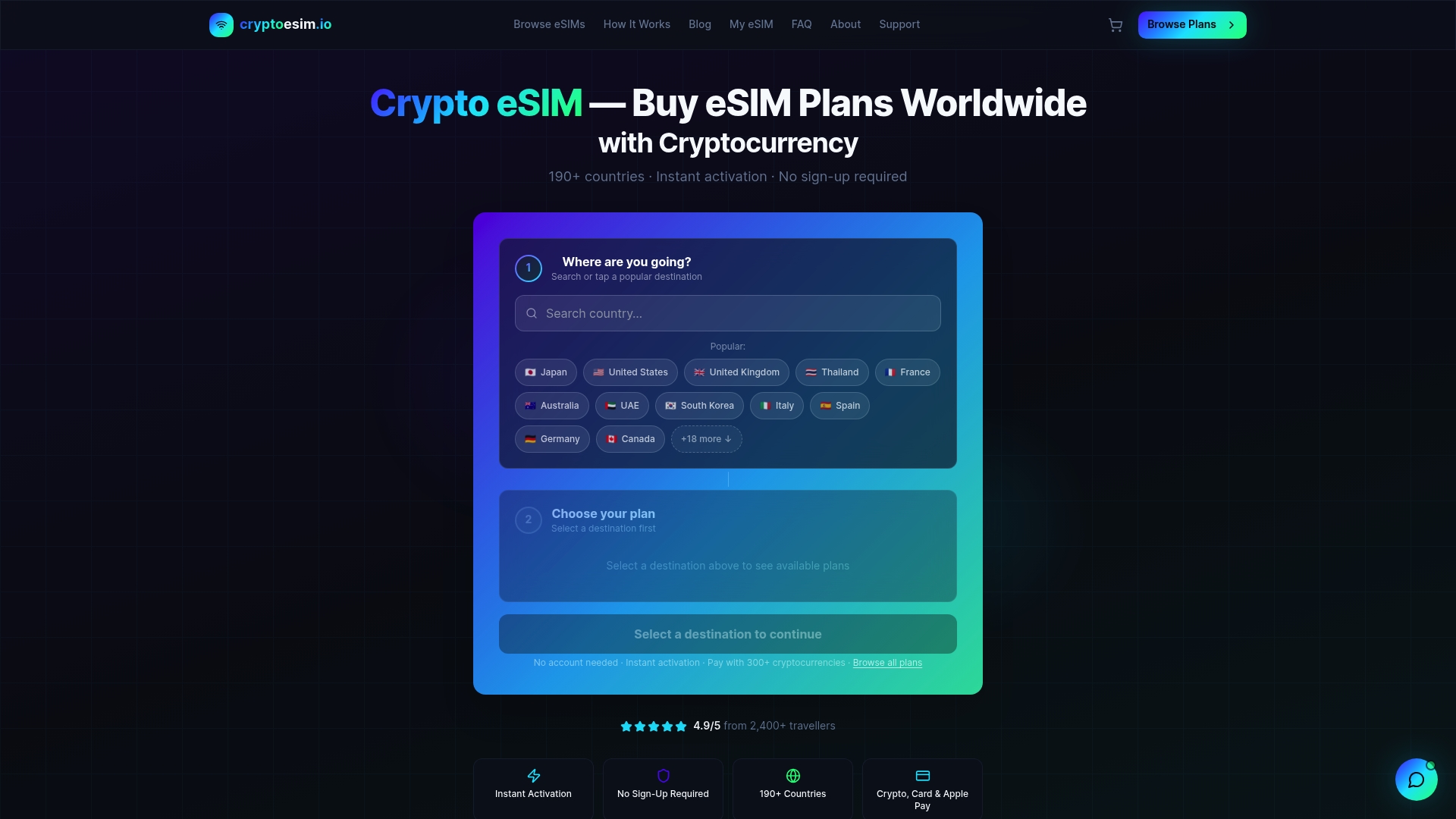
Digital nomads and international travelers gain immediate access to mobile data without sharing personal information or waiting for physical SIM delivery. The service accepts Bitcoin, Ethereum, USDT, USDC, and hundreds of other tokens, giving you payment flexibility regardless of which cryptocurrencies you hold. Combined with VPN and hardware wallet protections, crypto eSIM purchases represent the most secure and private method for maintaining connectivity across borders. Explore the ultimate crypto eSIM guide to maximize your security and convenience while traveling globally.
FAQ
Are crypto-based payments safe for travelers?
Yes, crypto payments can be very safe when you implement proper security measures. Using hardware wallets, stablecoins, and layered defenses like VPNs and eSIM cellular data significantly reduces risk. However, risks remain at user endpoints, and poor security practices like using public WiFi without protection or failing to verify addresses increase vulnerability substantially.
What are the biggest risks when paying with crypto internationally?
Major risks include wallet compromise through malware or phishing, address spoofing attacks that redirect payments, transaction failures due to network congestion, and merchant concerns about volatility. Using insecure public WiFi can enable man-in-the-middle attacks that intercept transaction details. Access control failures caused 62.8% of crypto losses in 2025, highlighting the importance of strong authentication and wallet security.
How can I protect my crypto payments on the go?
Use hardware wallets for storage and enable two-factor authentication on all accounts. Avoid public WiFi entirely or use VPN if necessary, preferably combined with eSIM cellular data for financial transactions. Verify all payment addresses character by character before confirming, keep device software updated with security patches, and prefer stablecoins for payment stability. Multi-signature wallets provide additional protection for larger amounts.
Why do so few merchants accept cryptocurrency payments?
Only about 10% of merchants accept crypto due to concerns over price volatility, fraud risks, regulatory uncertainty, and accounting complexity. The collapse of stablecoins like TerraUSD increased merchant wariness about reserve risks. Traditional businesses also face challenges integrating crypto payment systems with existing financial infrastructure. Specialized platforms like crypto eSIM providers bridge this gap for travelers needing mobile connectivity.
What makes crypto eSIM purchases more secure than traditional methods?
Crypto eSIM purchases eliminate identity verification requirements, protecting your privacy and reducing data breach exposure. Transactions occur over encrypted blockchain networks rather than traditional payment processors vulnerable to centralized attacks. When combined with hardware wallets, VPN, and cellular data connectivity, crypto eSIM purchases create multiple security layers that traditional credit card payments through public WiFi cannot match. The no-KYC model prevents personal data from being stored and potentially compromised by service providers.
Recommended
- CryptoeSIM.io — Buy eSIMs with Crypto | 190+ Countries
- CryptoeSIM.io — Buy eSIMs with Crypto | 190+ Countries
- CryptoeSIM.io — Buy eSIMs with Crypto | 190+ Countries
- CryptoeSIM.io — Buy eSIMs with Crypto | 190+ Countries
- Crypto Payment Gateway Market 2025: Trends, Growth & Future Outlook
- Why Switzerland for International Payments Explained