The Role of Crypto in Fintech Services: 2026 Guide

TL;DR:
- Crypto enhances fintech by providing faster, cheaper cross-border payments through stablecoins and programmable money.
- Institutional adoption is advancing, with leading firms like Fidelity at 71%, while some regional banks remain minimally engaged.
Cryptocurrency is defined as a programmable digital asset that financial technology companies embed directly into payment rails, lending products, and settlement infrastructure. The role of crypto in fintech services goes well beyond speculation. Blockchain technology, stablecoins, and institutional adoption have turned crypto into a functional layer that enables real-time settlement, automated contracts, and borderless money movement. Fidelity, one of the world’s largest asset managers, now scores a 71% Bitcoin adoption rate on industry benchmarks. That number signals a shift from experimentation to infrastructure. Businesses and individuals who understand this shift can make smarter decisions about which financial tools to trust and build on.
What is the role of crypto in fintech services today?
Crypto adoption in financial services has moved from niche to mainstream at a measurable pace. Institutional adoption of Bitcoin and digital assets reached 32% globally by july 2026, with leaders like Fidelity scoring 71% while some regional banks remain at about 13%. That 58-point gap between leaders and laggards shows how unevenly the transition is happening across the industry.
Fintech startups are not waiting for banks to catch up. Crypto-as-a-Service (CaaS) API solutions allow fintechs to embed crypto trading, conversion, and stablecoin payments into platforms without building proprietary infrastructure. A payments startup can now add Bitcoin acceptance or stablecoin settlement to its product in weeks, not years.
The table below shows how crypto integration varies across institution types:
| Institution type | Adoption stage | Primary use case |
|---|---|---|
| Large asset managers | Advanced | Custody, trading, tokenized funds |
| Fintech startups | Active | Stablecoin payments, CaaS APIs |
| Regional banks | Early | Pilot programs, limited custody |
| Central banks | Exploratory | CBDC research, cross-border pilots |
Key adoption patterns shaping the market right now:
- CaaS APIs let fintechs plug crypto rails into existing apps without blockchain expertise
- Stablecoin wallets are replacing pre-funded correspondent accounts in cross-border payments
- Tokenized money market funds are attracting institutional capital as yield-bearing on-chain assets
- Blockchain custody services are becoming a standard offering at major financial institutions
The shift from experimentation to scalable infrastructure is the defining story of crypto in fintech right now.
How does crypto enhance fintech services technically?
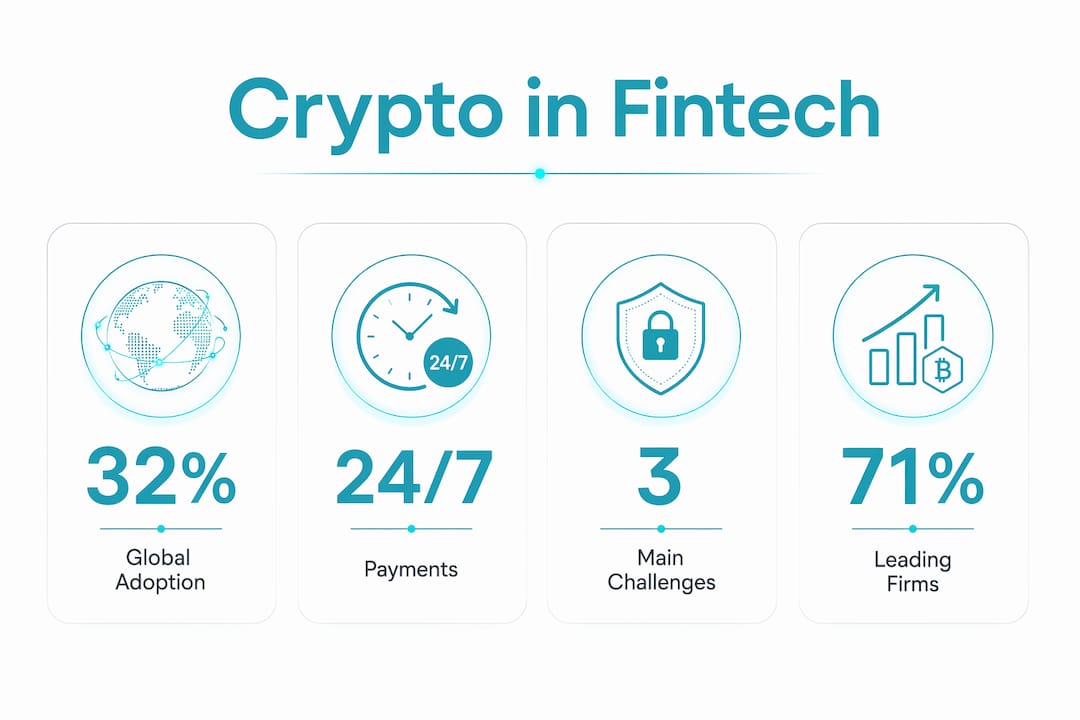
Stablecoins have evolved into a core settlement layer for cross-border fintech payment services, enabling 24/7, programmable, low-cost transfers without traditional pre-funded banking models. That matters because traditional correspondent banking requires banks to hold idle capital in foreign accounts just to process international payments. Stablecoins eliminate that capital drag entirely.

Programmable money takes this further. Smart contracts on networks like Ethereum can automate loan disbursements, trigger payments on delivery confirmation, and manage collateral without human intervention. On-chain credit markets now operate with real-time margin calls and automated liquidations, removing the settlement delays that plague traditional finance.
The practical benefits crypto brings to fintech include:
- 24/7 availability. Blockchain networks do not close on weekends or holidays. A payment sent at 11 PM on a Saturday settles in minutes, not Monday morning.
- Low transaction costs. Stablecoin transfers cost fractions of a cent on many networks, compared to the $25–$45 wire fees common in traditional banking.
- Rapid cross-border payments. A remittance that takes three to five business days through SWIFT can settle in under a minute on a stablecoin rail.
- Programmable automation. Yield-in-transit strategies let funds earn interest while moving between counterparties, a feature impossible in legacy payment systems.
- Interoperability. Blockchain assets move across networks and platforms without the proprietary lock-in that defines traditional financial infrastructure.
Pro Tip: When evaluating a fintech product that claims crypto integration, check whether it uses stablecoin settlement or just crypto-denominated pricing. Stablecoin settlement delivers the real speed and cost benefits; crypto pricing alone does not.
What are the main challenges of integrating crypto with fintech?
Legacy banking systems were not built for blockchain. Architectural incompatibility between legacy banks and blockchain networks is the primary barrier to integration, requiring middleware translation layers as the main engineering challenge. These middleware layers must translate between batch-processing bank systems and real-time blockchain networks, which creates both latency and security risks.
The integration challenges stack up quickly:
- Legacy system incompatibility. Core banking platforms built in the 1970s and 1980s process transactions in batches. Blockchain operates in real time. Bridging these two architectures requires custom middleware that is expensive to build and maintain.
- Compliance and KYC requirements. Regulators require financial institutions to verify customer identities and monitor transactions for suspicious activity. Pseudonymous blockchain addresses complicate this process significantly.
- Security and key management. Losing a private key means losing funds permanently. Institutions must build enterprise-grade key management systems, which most traditional IT departments have no experience operating.
- Smart contract risk. Bugs in smart contract code can result in permanent, irreversible fund loss. Auditing and testing standards are still maturing across the industry.
- Regulatory uncertainty. Rules governing crypto assets differ by jurisdiction and change frequently, making compliance planning difficult for fintechs operating across borders.
The compliance burden is particularly heavy. Financial institutions must satisfy anti-money laundering (AML) rules, sanctions screening requirements, and data privacy regulations simultaneously, all while running on blockchain infrastructure that was originally designed to bypass those controls.
Pro Tip: The most successful crypto fintechs hide blockchain complexity behind familiar interfaces. If your users need to understand what a wallet address is, your UX has already failed.
How are crypto firms and traditional banks competing in fintech?
The early crypto promise was to remove banks from the equation entirely. That vision did not survive contact with regulation. Crypto firms and traditional banks now act as regulated trusted third parties, competing mainly on product features rather than institutional identity. Both sides hold licenses, manage compliance programs, and maintain customer funds under regulatory oversight.
Blockchain changes the competitive dynamic in one critical way. Assets and products can move fluidly across networks, which means a customer is not locked into a single institution’s product catalog. A tokenized bond issued by one platform can be used as collateral on a lending protocol run by a completely different company. That interoperability forces competition on product quality, not distribution control.
The products driving competition right now include:
- Tokenized real-world assets. Stocks, bonds, real estate, and commodities represented as blockchain tokens, enabling fractional ownership and 24/7 trading
- Blockchain-powered custody. Institutional-grade storage of digital assets with insurance, audit trails, and regulatory compliance built in
- Yield-in-transit strategies. Funds earn yield while moving between counterparties, turning payment flows into income-generating assets
- On-chain derivatives. Futures and options markets that settle instantly on-chain, without the two-day settlement delays of traditional exchanges
“Blockchain is reorganizing financial markets around products rather than institutions. The question is no longer which bank you trust. The question is which product delivers the best terms, because the underlying network makes switching costs near zero.”
Financial institutions are shifting from passive crypto holdings to active on-chain market participation involving tokenized assets, yield-in-transit technology, and blockchain collateral management. That shift turns crypto from a speculative asset class into an operational tool.
What does the future of crypto in financial technology look like?
The next phase of crypto in fintech centers on real-world asset tokenization and always-on markets. Institutions are adopting real-time blockchain-based settlement networks and tokenized collateral, reshaping finance toward 24/7 programmable, liquid markets. The boundary between traditional and digital finance is not disappearing overnight, but it is becoming harder to locate.
Key trends defining the next three to five years:
- Real-world asset tokenization at scale. Treasury bills, private credit, and real estate are being tokenized for on-chain trading. Institutional demand is driving this faster than retail interest.
- Blockchain-based derivatives and prediction markets. On-chain options and futures markets are maturing, with settlement times measured in seconds rather than days.
- Cross-border payment infrastructure. Major financial markets players are building prototype blockchain-based multi-currency cross-border payment platforms that meet policy, legal, and regulatory requirements, though production deployment challenges remain.
- Embedded crypto in consumer apps. Stablecoin payments and crypto rewards are becoming standard features in consumer fintech apps, invisible to users who never think about blockchain.
- Decentralized identity and compliance. On-chain identity solutions are emerging that satisfy KYC requirements without centralizing personal data, which could resolve one of the biggest regulatory friction points in crypto fintech.
The direction is clear. Finance is moving on-chain, and the institutions that build the infrastructure now will define the competitive landscape for the next decade.
Key Takeaways
Crypto’s role in fintech is structural, not speculative. The most durable advantage comes from stablecoin settlement rails, programmable automation, and interoperable asset infrastructure, not from price appreciation.
| Point | Details |
|---|---|
| Institutional adoption is real | 32% global adoption by mid-2026, with leading firms like Fidelity at 71%. |
| Stablecoins replace old rails | Stablecoin settlement eliminates pre-funded correspondent accounts and cuts cross-border costs sharply. |
| Legacy systems are the main barrier | Middleware translation layers are required to connect batch-processing banks with real-time blockchains. |
| Competition shifted to products | Crypto firms and banks now compete on features, not institutional identity, thanks to blockchain interoperability. |
| Tokenization defines the future | Real-world asset tokenization and 24/7 on-chain markets are the next major phase of crypto in fintech. |
Why I think most businesses are still missing the point on crypto in fintech
Most businesses treat crypto adoption as a binary choice: either go all-in on blockchain or ignore it entirely. That framing is wrong, and it costs companies real money.
The pragmatic path is to adopt crypto where it solves a specific, measurable problem. Stablecoin settlement for cross-border payments is a clear win. It cuts costs, speeds up settlement, and requires no customer education because the experience looks identical to a normal bank transfer. That is where I would start.
What I find underappreciated is the compliance angle. Regulation-compliant crypto integration is not a constraint on innovation. It is the foundation that makes institutional adoption possible. The firms winning right now are not the ones moving fastest. They are the ones building compliance into the architecture from day one, not bolting it on afterward.
The legacy compatibility problem is real but solvable. Middleware layers are not elegant, but they work. The mistake is treating them as a permanent solution rather than a bridge to full on-chain infrastructure. Build the bridge, use it, and plan your migration while the business runs on it.
Crypto in fintech is evolutionary, not a sudden replacement of everything that came before. The businesses that will benefit most are the ones that treat it as a new set of tools, apply those tools to specific problems, and build toward a more capable architecture over time.
— Mohammed
Cryptoesim and the practical side of crypto-powered fintech
Cryptoesim operates at the exact intersection where crypto payments meet real-world financial services. The platform lets you buy an eSIM with crypto across 190+ countries, accepting Bitcoin, Ethereum, and over 300 other tokens, with no account creation and no KYC required.
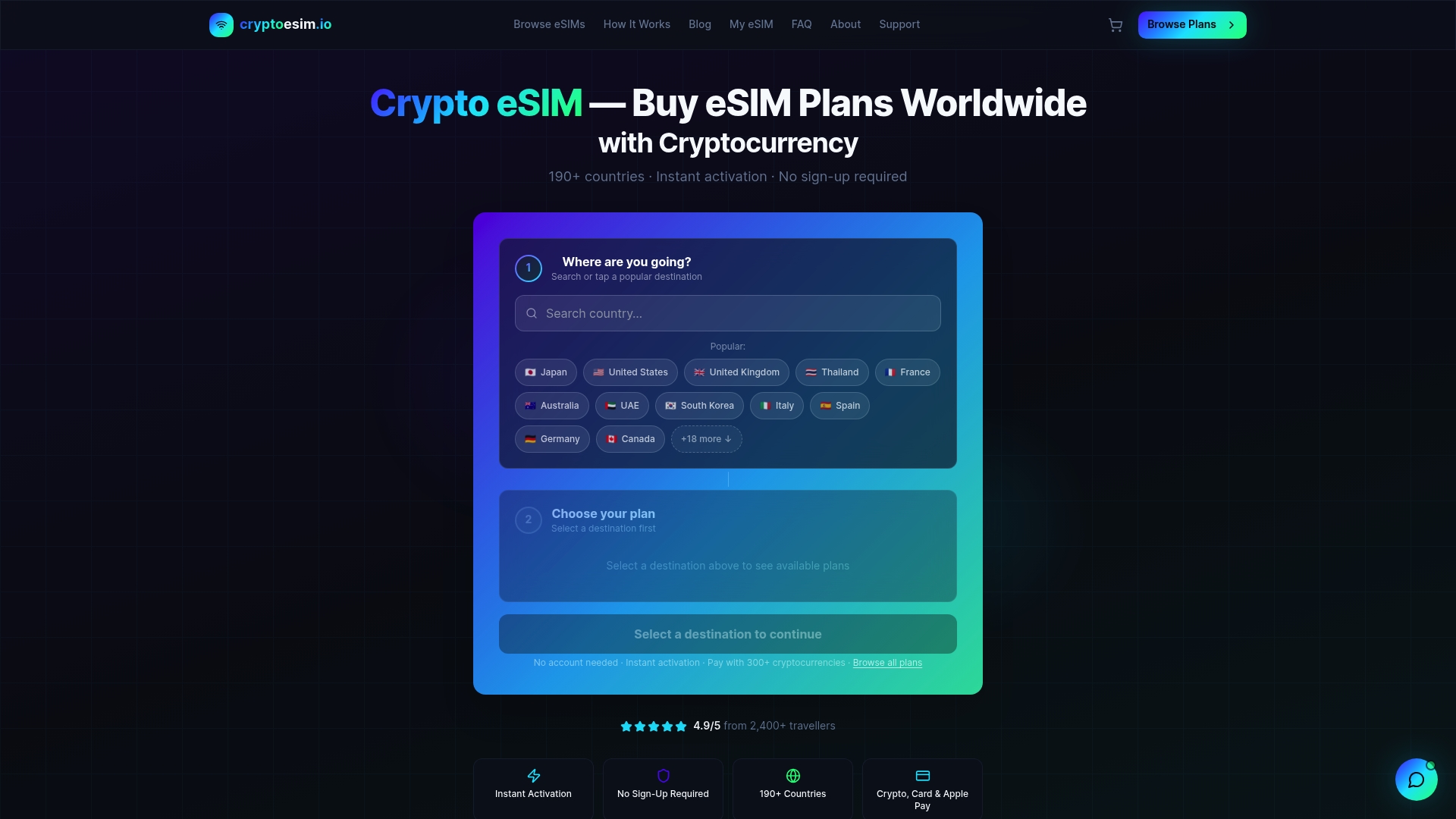
That model is a working example of the fintech principles covered in this article. Programmable money enables instant activation. Crypto payment rails remove the friction of currency conversion and international card fees. The crypto-enabled connectivity Cryptoesim provides is exactly the kind of embedded, invisible crypto integration that defines where fintech is heading. If you want mobile data in 190+ countries paid for with crypto in under two minutes, Cryptoesim is the direct route.
FAQ
What is the role of crypto in fintech services?
Crypto serves as a programmable settlement layer within fintech, enabling faster payments, lower costs, and automated financial products through blockchain technology and stablecoins.
How does crypto adoption in financial services compare across institutions?
Institutional adoption reached 32% globally by mid-2026, with leading firms scoring as high as 71% and some regional banks still at around 13%, showing wide variation across the industry.
What are the biggest challenges of crypto in fintech?
Legacy system incompatibility, compliance requirements, and private key security are the three primary barriers. Middleware layers bridge the gap between batch-processing bank systems and real-time blockchain networks.
How do stablecoins benefit fintech payment services?
Stablecoins replace pre-funded correspondent banking accounts, enabling 24/7 cross-border transfers at a fraction of traditional wire costs without the settlement delays of legacy systems.
What is the future of crypto in financial technology?
Real-world asset tokenization, on-chain derivatives markets, and always-on programmable finance are the next major developments, with the line between traditional and digital finance continuing to narrow.