Crypto Nomad Essentials: Top eSIMs, Tips & Secure Travel

TL;DR:
- Finding reliable mobile data abroad with crypto payment options is challenging for digital nomads seeking privacy and connectivity.
- Most should carry both mainstream and crypto-enabled eSIMs on every trip to ensure speed, privacy, and backup solutions in diverse regions.
Finding reliable mobile data abroad is hard enough. Finding it with crypto payment options while maintaining your privacy? That’s where most digital nomads hit a wall. Whether you’re closing client calls from Lisbon or filing invoices from Chiang Mai, unstable connectivity is the fastest way to tank your reputation and your workflow. This guide cuts through the noise and gives you a criteria-driven framework for evaluating eSIMs, a clear-eyed comparison of mainstream and crypto-friendly options, and the exact strategies that seasoned nomads use to stay connected, private, and productive across borders.
Table of Contents
- How to choose an eSIM for crypto nomads
- Top mainstream eSIMs for digital nomads
- Crypto eSIMs: Payment-friendly options for privacy
- eSIM comparison for crypto nomads: Mainstream vs. crypto-focused
- Why most nomads get eSIM decisions wrong (and how to fix it)
- Get started with seamless, crypto-friendly eSIM plans
- Frequently asked questions
Key Takeaways
| Point | Details |
|---|---|
| Coverage and reliability matter | Mainstream eSIMs offer stronger coverage and support but rarely accept crypto. |
| Crypto payment options exist | Specialty eSIMs let you buy data with crypto and maximize privacy for nomads. |
| Redundancy is essential | Always travel with two eSIMs—a mainstream for work and a crypto-friendly backup. |
| Plan for censorship | VPN bundles and regional/global plans are a must in high-censorship countries. |
| Test before you travel | Check device compatibility and activate your eSIMs before departing. |
How to choose an eSIM for crypto nomads
Now that you’re clear about why conventional options are rarely nomad-ready, here’s how to set your essentials checklist.
Picking an eSIM is not just about finding the cheapest plan. For crypto nomads, the decision involves a specific set of requirements that typical travelers never even think about. You need to ask: Does this provider accept crypto? What’s their KYC (Know Your Customer) policy? Does their coverage hold up in Southeast Asia or Latin America, not just Western Europe? These questions separate a good eSIM choice from a frustrating one.
Here are the core criteria every crypto nomad should evaluate before purchasing:
- Global coverage: Look for providers covering 150 or more countries. The more your itinerary shifts, the more you need broad, regional, or global plans rather than country-specific ones.
- Network speed and reliability: Not all “4G LTE” claims are equal. Check which local carriers a provider partners with. A well-known local carrier partner usually means faster, more stable speeds.
- Crypto payment support: This is a dealbreaker for many nomads. Verify which tokens are accepted and whether the checkout flow actually works without requiring fiat backup.
- No-KYC or minimal KYC: For users who prioritize privacy with mobile crypto transactions, finding a provider that does not demand passport scans or email verification is a significant advantage.
- Dual-SIM capability: Many modern smartphones support dual-SIM or eSIM plus physical SIM simultaneously. This lets you keep a local SIM for calls while running an international eSIM for data, which is incredibly useful.
- VPN-ready bundles: If you’re traveling to censored countries like China, Iran, or Russia, some eSIM plans restrict or block VPN traffic. Always check this before you travel and prioritize providers that leave VPN ports open.
- App-based usage monitoring: Your phone’s built-in data counter is notoriously inaccurate for eSIMs. Pre-buy regional plans, test compatibility, and monitor via app rather than relying on the phone’s system counter to avoid surprises mid-trip.
Some mainstream eSIMs offer excellent speed and reliability but lack both crypto payment options and privacy-friendly policies. That doesn’t automatically rule them out. If your primary concern is work reliability during a critical project sprint, a mainstream provider may be the smart choice. The key is knowing what you’re optimizing for at any given time.
Pro Tip: Always test your eSIM on your specific device model before leaving home. Not every eSIM is compatible with every phone, even if the device is theoretically eSIM-capable. A two-minute check before your flight saves hours of frustration at the airport.
Top mainstream eSIMs for digital nomads
With your evaluation criteria set, let’s look at which mainstream eSIM brands currently lead for nomads.

Mainstream providers have invested heavily in carrier partnerships, customer support, and app infrastructure. Their platforms are polished, their coverage maps are detailed, and their Trustpilot scores reflect mainstream eSIMs ranking between 4.3 and 4.7 on average, which is genuinely strong for a telecom product. The tradeoff is that none of these platforms support crypto payments natively, and most require at least an email address or account creation.
Here are the three platforms that nomads most consistently recommend:
- Saily: Widely considered the best overall value in the mainstream segment. Plans start at $3.99 and cover 150 or more countries. Their app is intuitive, installation is smooth, and their support team responds quickly. If you’re budget-conscious and need dependable mid-range coverage, Saily is worth bookmarking.
- Airalo: The most recognized name in consumer eSIMs. They cover over 200 countries and offer a marketplace-style interface that lets you compare regional and local plans side by side. Pricing sits in the mid-tier range. Coverage depth is impressive, though it varies significantly by country.
- Holafly: The go-to for heavy data users. Holafly’s unlimited data plans run between $69 and $90 per month depending on region, which sounds steep but can be excellent value if you’re streaming, on video calls constantly, or uploading large files. They do not support crypto payments, but their speed and reliability for power users is hard to beat.
| Provider | Coverage | Starting Price | Crypto Payments | Best For |
|---|---|---|---|---|
| Saily | 150+ countries | $3.99 | No | Budget-conscious nomads |
| Airalo | 200+ countries | $5.00+ | No | Wide destination variety |
| Holafly | 170+ countries | $19.90+ | No | Unlimited data power users |
Understanding the differences between eSIM and physical SIM formats can also help you decide whether to go all-in on eSIM or maintain a hybrid setup with a local SIM card for certain destinations.
Pro Tip: For mission-critical work travel, go with a mainstream provider as your primary eSIM and keep backup payment methods ready. Crypto wallets can sometimes have delays during network congestion, and you don’t want a payment failure standing between you and your mobile data.
Crypto eSIMs: Payment-friendly options for privacy
Mainstream brands dominate reliability, but if you’re committed to crypto payments or privacy, here’s how specialized eSIMs stack up.
A crypto-friendly eSIM is not just a novelty. For nomads who receive income in Bitcoin or Ethereum, paying for data with the same currency removes a frustrating friction point. You avoid fiat conversion fees, sidestep issues with international card transactions being declined, and keep your spending patterns more private. The process for buying eSIMs with crypto is increasingly streamlined, but it’s worth understanding how the landscape actually breaks down.
What separates a genuinely crypto-friendly eSIM from one that just advertises it:
- Accepts BTC and ETH at minimum: Some providers claim crypto support but only accept one or two obscure tokens. Look for platforms that accept major coins and ideally stablecoins like USDT or USDC for price stability.
- Minimal or no KYC: The privacy value of crypto payments is severely diluted if the provider demands a government ID. Genuine privacy-focused, no-KYC eSIMs allow you to purchase, activate, and use data without handing over personal documents.
- No account required: Some platforms let you complete the entire transaction without creating a user profile, which means no email list, no data broker exposure, and no risk of your contact information being compromised in a breach.
- Transparent carrier partnerships: Smaller crypto-focused providers sometimes use less established carriers in emerging markets. Always check whether you can verify the underlying carrier network before committing to a plan.
The honest tradeoff is that crypto-focused eSIM providers sometimes lag behind mainstream ones on network reliability and customer support quality. That’s not a universal rule, but reliable mainstream networks like Saily and Airalo have simply been tested across more devices, more regions, and more use cases over a longer period. Crypto-native providers are improving fast, but it’s fair to do your due diligence.
“Heavy users prefer Holafly unlimited despite no crypto. The reliability gap still matters when your livelihood depends on stable connectivity.”
For nomads who value secure global data with crypto payments, the practical advice is to use a crypto eSIM for day-to-day browsing, personal communications, and privacy-sensitive tasks. Then keep a mainstream eSIM as a backup or primary option for client-facing work where dropped calls or buffering are simply not acceptable.
eSIM comparison for crypto nomads: Mainstream vs. crypto-focused
To make your decision easier, here’s how the top mainstream and crypto eSIMs compare at a glance.
| Feature | Mainstream eSIMs | Crypto eSIMs |
|---|---|---|
| Global coverage | 150 to 200+ countries | 50 to 190+ countries |
| Network reliability | High, well-tested carriers | Varies by provider |
| Crypto payments | Not supported | Yes, BTC/ETH and more |
| Privacy/KYC | Requires account or email | Minimal to no KYC |
| Price range | $3.99 to $90/month | Varies widely |
| Customer support | Dedicated app and team | Often limited |
| Best use case | Work reliability, speed | Privacy, crypto payments |
Understanding this split gives you a concrete framework for decision-making. Here’s a step-by-step process you can use right now to decide which type fits your next trip:
- Identify your destination’s infrastructure: Research which carriers operate in your target country. If the crypto eSIM’s underlying carrier is strong in that market, the reliability gap narrows significantly.
- Assess your data needs: Light browsing and messaging? A crypto eSIM is likely fine. Constant video calls and large file uploads? Lean toward a mainstream provider or Holafly’s unlimited plan.
- Check your payment situation: If your income is primarily in crypto, reducing the friction of converting to fiat for a data plan is a real quality-of-life improvement. Factor in currency conversion fees when comparing total costs.
- Decide your privacy threshold: If you’re traveling to regions with heavy surveillance or data retention laws, the no-KYC advantage of crypto eSIMs becomes more than a preference. It becomes a practical necessity.
- Plan your backup: No matter what you choose as your primary eSIM, always have a secondary option ready. The crypto payments in telecoms space is evolving quickly, and even the best providers have occasional outages.
The smart move for reliable nomad work travel is to mix and match. Use a mainstream eSIM as your workhorse and a crypto eSIM for privacy tasks and as a geographic backup in regions where its carrier happens to be stronger.
Why most nomads get eSIM decisions wrong (and how to fix it)
Now that you have the facts, here’s an insider perspective on choosing and using your eSIMs on the road.
The most common mistake we see is optimizing for a single variable. A nomad decides they want the cheapest plan, buys a $2 eSIM from a provider they’ve never heard of, and then spends their first morning in a new city troubleshooting a plan that barely connects to 3G. Or they go all-in on a privacy-focused crypto eSIM without verifying carrier strength in their destination and end up with a beautiful no-KYC setup that loads web pages at a crawl.
Price and payment method are inputs to the decision, not the decision itself. The actual question is: will this eSIM let me work, communicate, and operate normally in the specific places I’m going? Everything else is secondary.
Seasoned nomads treat connectivity like flight insurance. You don’t buy the cheapest possible policy and hope nothing goes wrong. You buy the right coverage, test it before you need it, and keep a backup. That means activating your eSIM at home before you depart, verifying it actually connects, and understanding how to contact support if something breaks. Using crypto for eSIM data is increasingly practical, but you still need to build redundancy into your setup.
Our firm recommendation: carry both a mainstream and a crypto eSIM on every trip. Use the mainstream one for your primary work connection and client calls. Use the crypto one for personal browsing, privacy-sensitive tasks, and as a geographic failsafe. This two-eSIM approach eliminates almost every connectivity nightmare scenario that nomads typically complain about.
Pro Tip: Redundancy beats regret. Have at least two eSIMs activated and ready before every trip. The cost difference is trivial compared to a missed deadline or a dropped interview because your single plan had an outage.
Get started with seamless, crypto-friendly eSIM plans
Ready to apply these tips to your next journey? Here’s one of the easiest ways to get started right now.
CryptoEsim.io offers instant eSIM activation across 190 or more countries, with support for Bitcoin, Ethereum, and over 300 other tokens at checkout. No account required, no KYC headaches, and no waiting for a physical SIM to arrive in the mail.
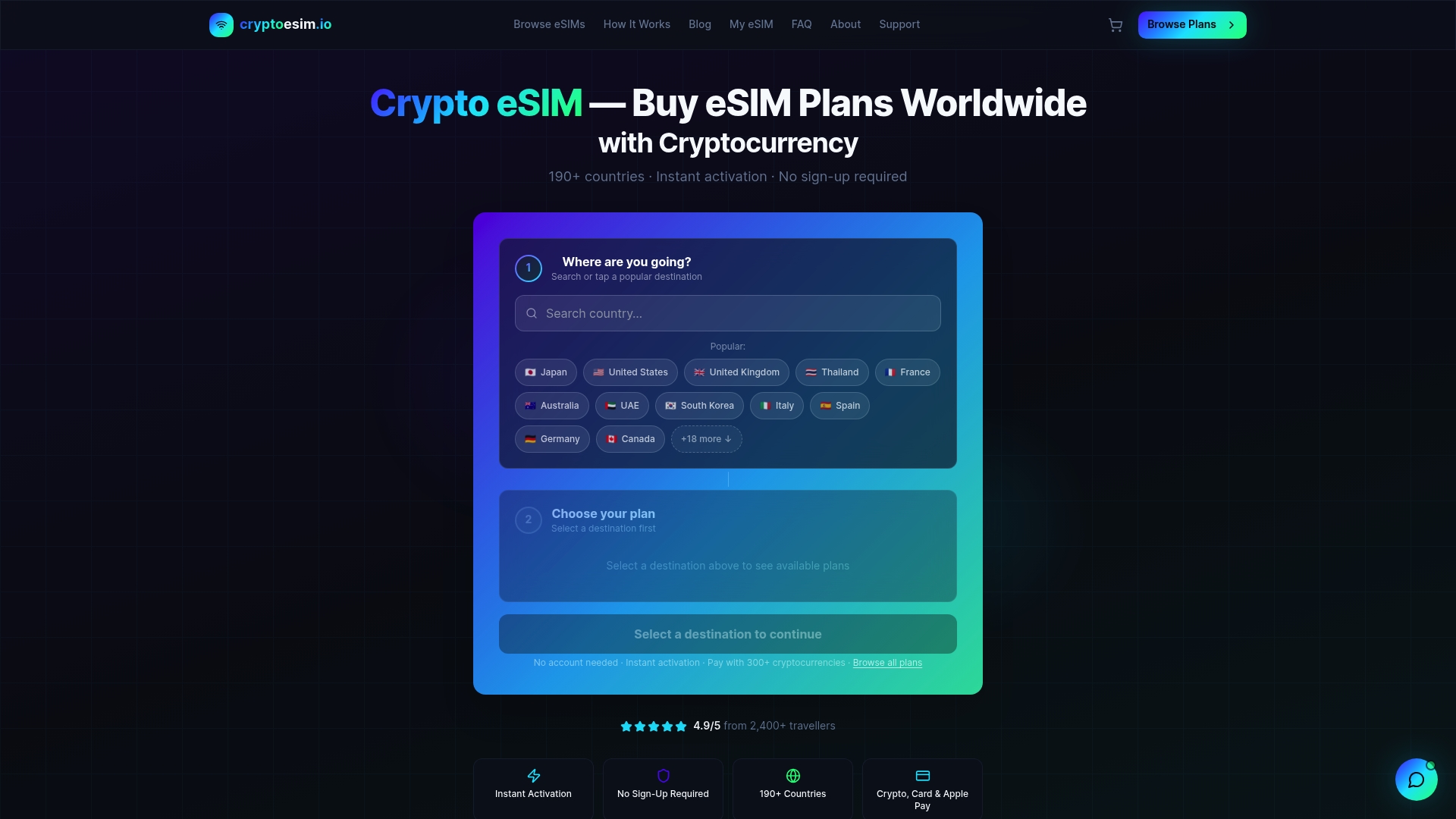
You can browse coverage by country, compare plan sizes, and complete your purchase in minutes using your preferred crypto wallet, a credit card, or Apple Pay. Every plan activates instantly via QR code, which means you can be connected before your flight even boards. For nomads who want to combine speed, privacy, and the ability to pay without touching fiat, it’s built exactly for your workflow. Explore plans now at CryptoEsim.io and see what genuine crypto-native connectivity looks like.
Frequently asked questions
Can I pay for eSIM data plans with Bitcoin or other cryptocurrencies?
Yes, several crypto-oriented eSIM providers accept Bitcoin and other major cryptocurrencies, though most mainstream eSIMs like Saily, Airalo, and Holafly do not currently support crypto payments at checkout.
Is using an eSIM with crypto payment safer for privacy?
Yes, crypto payments significantly enhance privacy, especially when paired with no-KYC eSIM providers, since you avoid linking your personal identity to your connectivity purchases. Mainstream providers typically require account registration, which reduces that anonymity.
Which eSIM is best for unlimited data while traveling?
Holafly is consistently rated as the top choice for unlimited data plans, with pricing between $69 and $90 per month depending on region, though it does not accept crypto payments.
How can I ensure my eSIM works in censored countries?
Pre-purchase global or regional plans before you arrive and pair your eSIM with a trusted VPN, since some countries block VPN traffic at the carrier level and you need to verify your provider keeps those ports open.
Should I use more than one eSIM for backup?
Absolutely. Maintaining both a mainstream and a crypto-focused eSIM gives you reliability from one and privacy or payment flexibility from the other, ensuring you stay connected even if one plan has a regional outage.