Top eSIM Features for Travelers: 2026 Comparison Guide

What are the best eSIM providers for international travelers?
The best eSIM for international travel in 2026 depends on what you actually need: unlimited data, the widest country coverage, travel perks, or the ability to pay without a bank account. Here is the full picture across 17 providers, with the features that matter most laid out in one place.
eSIMs activate in 1–5 minutes, store up to 8–10 profiles on a single device, and reduce travel data costs to as low as $4.50 per GB compared to $10–$50 for physical SIMs at airport kiosks. Frequent travelers who switch to eSIM save $500–$1000 per year by avoiding roaming fees and eliminating the scramble for local SIM cards at every border.
| Provider | Best For | Coverage | Plan Types | Unique Features | Payment Options |
|---|---|---|---|---|---|
| CryptoEsim.io | Crypto users, privacy-focused travelers | 190+ countries | Prepaid data plans | 300+ crypto tokens, no account required, no KYC | Crypto (BTC, ETH, 300+ tokens), card, Apple Pay |
| Saily | Security-conscious travelers, Europe | 200+ destinations | Capped, unlimited, global | Built-in VPN, ad blocker, web protection, eSIM transfer | Card |
| Holafly | Heavy data users, unlimited plans | 160+ destinations | Unlimited only | Always On 1GB/month baseline, no data tracking | Card |
| Roamless | Flexible, frequent travelers | Global | Pay-as-you-go, fixed | In-app calling, credit never expires on Flex plan | Card |
| Jetpac | Frequent flyers, perks seekers | 200+ destinations | Capped, unlimited | SmartDelay lounge access, apps work after data runs out | Card |
| Sim Local | Budget travelers, specific regions | Regional/country | Per-GB, unlimited | Affordable plans, easy activation | Card |
| Airalo | Multi-country itineraries | 200+ destinations | Capped, unlimited, monthly, annual | Discover+ global phone number, AirMoney loyalty credits | Card |
| Truely | Flexibility, global roaming | 190+ countries | Capped, unlimited | Switchless global eSIM, 700+ local network partners | Card |
| aloSIM | North American travelers needing a number | 200+ destinations | Prepaid, fixed, unlimited | Free international number via Hushed, 5% credit back | Card |
| ETravelSim | Prepaid plan users, calling needs | Regional/global | Regional packages | Local number on some plans, hotspot supported | Card |
| MobiMatter | Value seekers, wide coverage | Global | Prepaid | Pricing transparency | Card |
| Nomad | Budget travelers, first-timers | 190+ countries | Daily, 30-day, regional, global | Free 1GB trial for new users (80+ destinations) | Card |
| Maya Mobile | Budget multi-country travelers | Regional/global | Flexible packages | Plan variety | Card |
| FlexiRoam | Frequent international travelers | Global | Flexible top-ups | Roaming-friendly top-ups | Card |
| Simify | Convenience seekers | Regional/global | Prepaid | Fast activation, simple setup | Card |
| Drimsim | Occasional travelers | Worldwide | Pay-as-you-go | No contract required | Card |
| Sim Local (SimLocal) | Short trips, budget travelers | Regional/country | Per-GB, unlimited | Regional and country-specific plans | Card |
Table of Contents
- How do leading eSIM providers actually compare?
- How to choose the best eSIM for your trip
- What makes modern eSIM management different in 2026?
- Key Takeaways
- The eSIM market is maturing faster than most travelers realize
- Cryptoesim covers 190+ countries with no account required
How do leading eSIM providers actually compare?
The table above gives you the skeleton. What it cannot show is where each provider genuinely pulls ahead in real use.
Saily and Holafly: the security and unlimited specialists
Saily was built by the team behind NordVPN, and that lineage shows up in every plan. Every Saily eSIM includes an ad blocker, web protection against malicious sites, and a virtual location feature running in the background at no extra cost. On public hotel Wi-Fi or airport networks, those are not marketing extras. Saily’s unlimited plans deliver 5GB per day at full speed, then continue at 1Mbps, with fully unlimited hotspot and no daily cap. The Saily Ultra subscription adds airport lounge access, priority support, and the full Nord Security suite (NordVPN, NordPass, NordLocker) for travelers already paying for a VPN separately.

Holafly takes the opposite approach to complexity: every plan is unlimited, you pick a duration (1–90 days), and you never think about gigabytes again. The standout feature is Always On, which gives every installed Holafly eSIM 1GB of free monthly data refreshing every 30 days across 70+ countries. That baseline keeps you connected between trips without repurchasing. The tradeoff is price: Holafly runs noticeably higher than most competitors, and hotspot is capped at 500MB–1GB per day depending on the country.
Airalo and Jetpac: coverage depth and travel perks
Airalo’s Discover+ Global plan is the only option in this comparison that includes a real US-based phone number (+1), letting you make and receive calls and SMS across 137 countries. That fills a gap that pure data eSIMs cannot: bank verification texts, two-factor authentication codes, and incoming calls all work. The AirMoney loyalty system earns credits on every purchase, and top-ups are available in-app, though availability varies by destination.
Jetpac’s SmartDelay feature is genuinely unusual. Register your flight in the app at least 24 hours before departure, and if it delays by 60 minutes or more, you and up to five travel companions receive a free LoungeKey airport lounge voucher automatically. No other provider on this list does anything like it. Jetpac also keeps WhatsApp, Uber, Google Maps, and Grab running even after your data runs out, which matters when you are navigating somewhere unfamiliar.

Pro Tip: Before buying a Jetpac plan, register your outbound flight in the app. The SmartDelay lounge benefit only activates if the flight is pre-registered at least 24 hours before departure.
Roamless and aloSIM: calling and flexibility
Roamless is the clearest choice for travelers who need to call landlines or local numbers without a separate phone plan. In-app calling works globally for a few cents per minute, and the Flexible plan credit never expires, so unused data does not disappear after a trip. The Fixed plan option reduces the per-GB cost for single-destination travel; combining both is the practical approach for multi-country trips.
aloSIM pairs every eSIM with a free international phone number through its Hushed integration, which is unusual for a data-only provider. The included $3 Hushed credit covers occasional calls; you top up if you need more. The app is clean, QR code or in-app activation takes a few minutes, and aloSIM users earn 5% back in credits on every purchase toward future top-ups.
Truely, Nomad, and the rest
Truely’s “Switchless” model is worth understanding: one eSIM stays active across 190+ countries without swapping profiles, powered by 700+ local network partners. Speeds run at full LTE on local networks rather than roaming fallback, though real-world tests show it can run slightly slower than a local SIM in some markets.
Nomad offers a free 1GB trial eSIM for new users, valid for three days across 80+ destinations including Germany, South Korea, and China. That makes it the lowest-risk entry point for first-time eSIM users. Daily plans (1–10 days) and 30-day plans give budget travelers precise control over what they spend.
ETravelSim stands out for including a local phone number with select packages, one of the few data-focused providers to do so. Regional packages for Southeast Asia, Europe, and Africa are well-structured, and hotspot is supported on most plans.
MobiMatter, Maya Mobile, FlexiRoam, Simify, and Drimsim each cover global or regional connectivity with prepaid or pay-as-you-go structures. Drimsim requires no contract, which suits occasional travelers who want a single worldwide plan without ongoing commitment. Simify and Sim Local (SimLocal) both emphasize fast activation and straightforward setup for travelers who want minimal friction.
Pro Tip: Leading eSIM providers offer in-app management that lets you purchase, top up, and track usage without needing mobile data or Wi-Fi. Set up your eSIM and download the provider app before you leave home.
How to choose the best eSIM for your trip
The right eSIM comes down to five practical questions. Answer them before you open any provider’s website.
Is your device unlocked? Apple’s support guidance is direct: your iPhone cannot use a third-party eSIM if it is carrier-locked. Check Settings > General > About > Carrier Lock on iPhone, or contact your carrier. A locked device gets none of the flexibility that makes eSIMs worth using.
How many countries are you visiting? Single-destination travelers get the best per-GB value from country-specific plans (Sim Local, Nomad, aloSIM). Multi-country itineraries favor regional plans (Saily, Airalo, Roamless Flex) or global plans (Truely, Holafly Global). Buying individual country plans at each border costs more and adds friction.
How much data do you actually use? Heavy users on video calls, streaming, or frequent hotspot should go unlimited (Holafly, Saily). Light users checking maps and messaging save money on capped plans from Nomad, Airalo, or Jetpac. The math is simple: if you would need more than two or three top-ups on a capped plan, unlimited is cheaper.
Do you need a phone number? Most eSIMs are data-only. If you need to receive SMS verification codes or make calls to landlines, look at Airalo Discover+, aloSIM with Hushed, ETravelSim, or Roamless in-app calling. Saily now offers an optional US +1 number as a monthly add-on inside the app.
What payment method do you need? Most providers accept standard cards. Cryptoesim is the exception: it accepts Bitcoin, Ethereum, and 300+ other cryptocurrency tokens, plus cards and Apple Pay, with no account creation and no KYC required. For travelers who prioritize financial privacy, that combination is not available anywhere else in this comparison.
Key selection factors at a glance:
- Device compatibility: iPhone XS or newer, Galaxy S20 or newer for full eSIM support; dual SIM capability lets you keep your home number active while using a travel eSIM for data
- Plan flexibility: pay-as-you-go suits irregular travelers; unlimited suits heavy users; daily plans suit short trips
- Security features: Saily’s built-in VPN and ad blocker are the only provider-level security stack in this comparison
- Top-up convenience: Ubigi tops up without Wi-Fi; most others require a connection
- Hotspot support: Holafly caps hotspot; Saily and Jetpac allow unlimited hotspot on most plans
- Data rollover: most plans do not roll over; Roamless Flex credit never expires
- Typical data pricing: Travel data costs as low as $4.50 per GB with eSIM versus $10–$50 at airport SIM kiosks
- Annual savings: Frequent travelers can save $500–$1000 per year using eSIM over traditional roaming.
What makes modern eSIM management different in 2026?
The gap between a good eSIM provider and a frustrating one comes down to how the profile is managed after purchase, not just how it activates.
How activation actually works
Installation happens one of two ways: scan a QR code sent by email, or tap through an in-app flow that installs the profile automatically. Both take 1–5 minutes on a supported device with a Wi-Fi connection. Apple’s iOS 26 adds a new layer: if you purchase a travel eSIM before departure, your iPhone can automatically switch to that eSIM when you land and revert to your home line when you return, depending on your region.
A single device can store up to 8–10 eSIM profiles simultaneously, though only one or two can be active at a time depending on the model. iPhone 13 and newer support two active lines at once (one physical SIM plus one eSIM outside the US; dual eSIM in the US). That means you can keep your home number live for calls and SMS while routing all data through a travel eSIM, with no SIM swapping and no missed messages.
Security advantages that physical SIMs cannot match
eSIM profiles use hardware-level encryption that makes unauthorized cloning nearly impossible. A thief who steals your phone cannot eject the eSIM and drop it in a burner device the way they can with a physical SIM card. You can also shut down the number remotely through your carrier account. For travelers moving through crowded airports or high-theft areas, that combination of physical permanence and remote control is a real structural advantage.
Saily adds a software layer on top: its built-in VPN, ad blocker, and web protection run across all connections, not just cellular. That matters most when you are on public Wi-Fi at a hostel or airport lounge, where unencrypted traffic is a genuine risk. For travelers who want to understand the full picture of mobile data security abroad, the combination of eSIM hardware security and a provider-level VPN covers most threat scenarios.
Features that separate the top tier from the rest
- Always On (Holafly): 1GB of monthly data refreshes automatically on every installed eSIM, keeping you connected between trips at no extra cost
- SmartDelay (Jetpac): automatic lounge access when a registered flight delays by 60+ minutes, extending to five travel companions
- Switchless roaming (Truely): one profile stays active across 190+ countries without manual profile switching
- In-app calling (Roamless): global voice calls from within the app, with credit that never expires on the Flex plan
- Discover+ phone number (Airalo): a real US +1 number for calls, SMS, and two-factor authentication across 137 countries
- Data sharing: some providers support hotspot; check the specific plan, since restrictions vary by destination and provider
- Crypto payment (Cryptoesim): 300+ cryptocurrency tokens accepted with no account or KYC required, the only provider in this comparison with that combination
Key Takeaways
The strongest eSIM for international travel in 2026 is the one that matches your specific usage: unlimited data, a phone number, travel perks, or crypto-native payment without an account.
| Point | Details |
|---|---|
| Activation speed | eSIMs activate in 1–5 minutes and store up to 8–10 profiles on one device. |
| Cost advantage | Travel data costs as low as $4.50 per GB via eSIM versus $10–$50 at airport kiosks. Frequent travelers can save $500–$1000 per year using eSIM over traditional roaming. |
| Security edge | Hardware-level encryption prevents eSIM cloning; stolen devices cannot have the SIM removed. |
| Plan matching | Heavy users choose unlimited (Holafly, Saily); light users save with capped plans (Nomad, Airalo). |
| Cryptoesim advantage | Cryptoesim covers 190+ countries with crypto payment (300+ tokens), no account, and no KYC required. |
The eSIM market is maturing faster than most travelers realize
The conventional wisdom is that eSIMs are a convenience upgrade over physical SIMs. That framing undersells what has actually changed in 2026. The real shift is that eSIM providers are now competing on features that have nothing to do with connectivity itself: lounge access, built-in VPNs, loyalty credits, phone numbers, and crypto-native payment. That is a fundamentally different market than it was three years ago.
What most travelers still get wrong is treating the eSIM decision as purely a coverage question. Coverage is largely solved. Every major provider on this list reaches 160–200+ destinations, and the underlying networks are the same local telcos in most countries. The real differentiators are the features layered on top: what happens when your flight is delayed, whether your data is protected on public Wi-Fi, whether you can receive a bank verification text, and whether you can pay without handing over your identity.
The crypto payment angle deserves more attention than it typically gets. Most eSIM buyers do not think about financial privacy until they are in a country where card transactions are flagged, blocked, or simply inconvenient. Having the option to pay with Bitcoin or Ethereum and activate instantly, with no account and no KYC, is not a niche feature for crypto enthusiasts. It is a practical fallback for any traveler who has had a card declined abroad.
The smartest setup for most international travelers is not choosing one eSIM provider and sticking with it. Keep your home physical SIM active for calls and SMS, layer a travel eSIM for local data, and match the provider to the trip: Holafly for a long beach vacation where you will stream constantly, Jetpac for a business trip with tight flight connections, Roamless for a multi-country backpacking route where you need occasional voice calls. The combined cost is lower than roaming on your home plan, and the flexibility compounds with every trip.
Cryptoesim covers 190+ countries with no account required
Most eSIM providers ask you to create an account, verify your email, and link a card before you can buy a plan. Cryptoesim skips all of that. You pick a plan for any of 190+ countries, pay with Bitcoin, Ethereum, or 300+ other cryptocurrency tokens (or a card or Apple Pay if you prefer), and receive your eSIM instantly. No account. No KYC. No waiting.
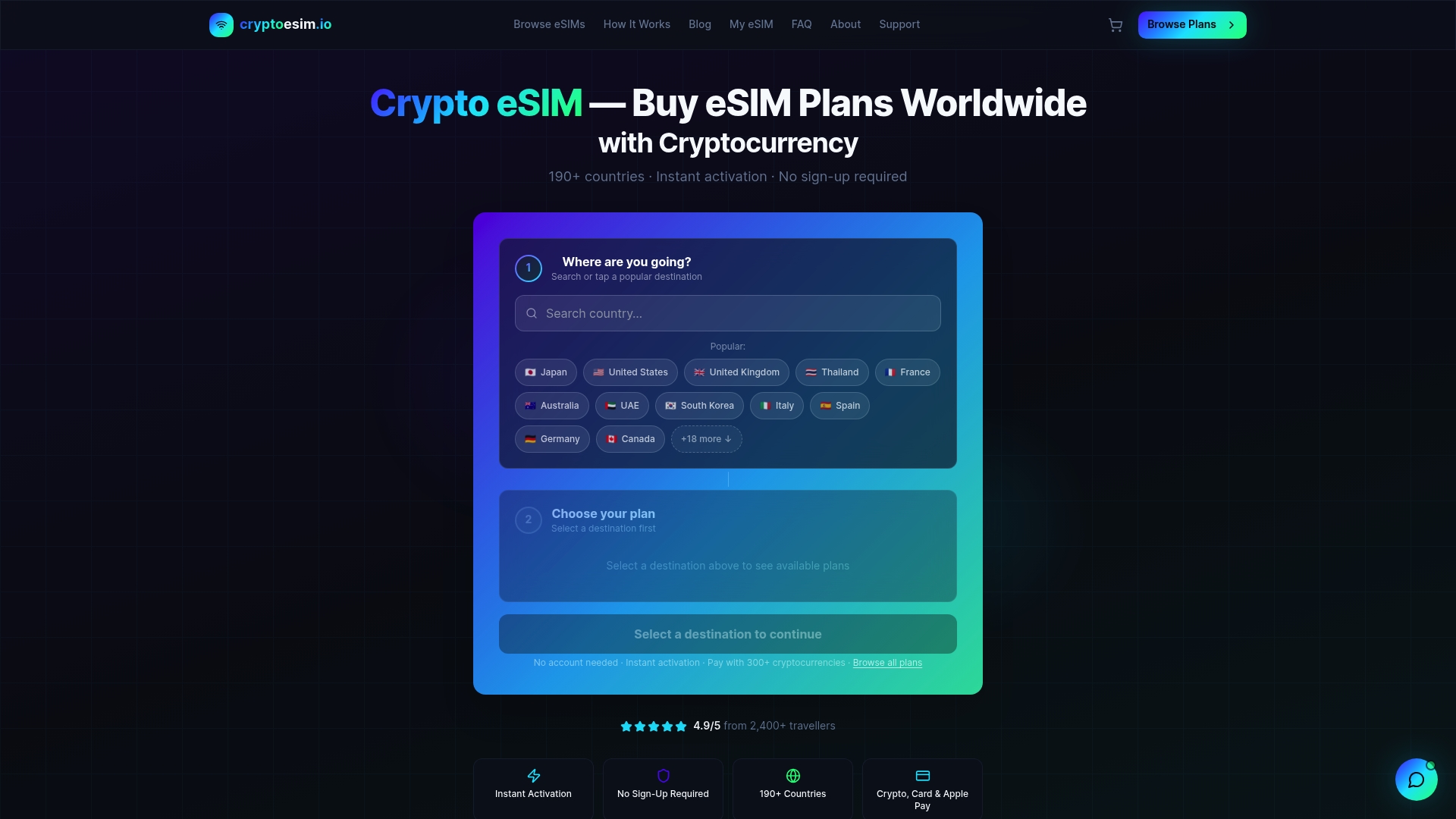
That matters most for travelers who want to keep their purchase private, who have had cards blocked abroad, or who simply want the fastest possible path from “I need data” to “I am online.” The platform sits at the intersection of telecom and crypto-native finance, which is a combination no traditional eSIM provider offers. If you want to buy an eSIM with crypto and activate before your next flight, Cryptoesim is the direct route. Visit cryptoesim.io to browse plans by country and pay the way you prefer.