What Is a Virtual Telecom? A Clear 2026 Guide

TL;DR:
- Virtual telecom providers do not own physical networks but lease access or use software-defined infrastructure. They include MVNOs that resell network capacity and use virtualization technology like NFV and SDN to replace hardware with software. The choice between these models affects control, cost, and service flexibility, with connection quality depending on infrastructure investments.
A virtual telecom is a communications provider that delivers phone, data, and messaging services without owning the physical network infrastructure those services run on. The industry term most people encounter first is MVNO, or Mobile Virtual Network Operator. MVNOs lease network capacity from traditional carriers and resell it under their own brand, pricing, and service terms. Alongside MVNOs, a second category of virtual telecom exists: providers that use network virtualization technologies like NFV (Network Functions Virtualization) and SDN (Software-Defined Networking) to replace physical hardware with software. Understanding both models is the foundation for anyone researching how modern telecommunications actually works.
What is a virtual telecom and how does it differ from traditional telecom?
A traditional telecom owns its towers, cables, switches, and routers. It spends billions building and maintaining that physical infrastructure before a single customer makes a call. A virtual telecom skips that entirely. It either leases access to an existing network or runs its services through software on shared computing infrastructure.

The practical result is a much lower barrier to entry. A company can launch a mobile service brand, set its own pricing, and serve customers in a specific niche without ever touching a cell tower. Budget carriers targeting travelers, IoT device managers, and regional business phone services all operate this way. The virtual model makes those niche offerings economically viable.
The key distinction is ownership. Traditional telecoms own the radio access network (RAN). Virtual telecoms do not. That single difference shapes everything from cost structure to service flexibility to regulatory obligations.
How does virtual telecom work?
Virtual telecom services operate through two distinct mechanisms that are often confused: the MVNO business model and network virtualization technology. They solve different problems, but both eliminate the need for a provider to own full physical infrastructure.
The MVNO model
An MVNO leases capacity from a Mobile Network Operator (MNO), which is the company that actually owns the towers and spectrum. The MVNO then packages that capacity into its own plans, sets its own prices, and manages its own customer relationships. Between MNOs and MVNOs, a layer of intermediaries called MVNEs (Mobile Virtual Network Enablers) and MVNAs (Mobile Virtual Network Aggregators) often provides the technical platforms that make the arrangement work.
- MNO: Owns spectrum licenses, towers, and core network hardware
- MVNE/MVNA: Provides billing systems, SIM management, and operational platforms
- MVNO: Handles branding, pricing, customer service, and retail
Network virtualization: NFV and SDN
NFV and SDN replace physical telecom hardware with software running on standard servers. NFV virtualizes specific network functions like firewalls and routers. SDN separates the control layer from the data layer, giving operators centralized, real-time control over traffic routing. Together, they let operators deploy new services faster and at lower cost than traditional hardware-based networks allow.
Virtual phone numbers and VoIP
A virtual phone number is a cloud-based number that routes calls over the internet using VoIP (Voice over Internet Protocol). It is not tied to a physical SIM card or a landline. You can receive calls on any device, from any location, using a number that appears local to the caller’s region.
Pro Tip: If you use a virtual phone number for business, choose a provider that routes through multiple PSTN paths. Single-path routing is the most common cause of dropped calls on virtual numbers.
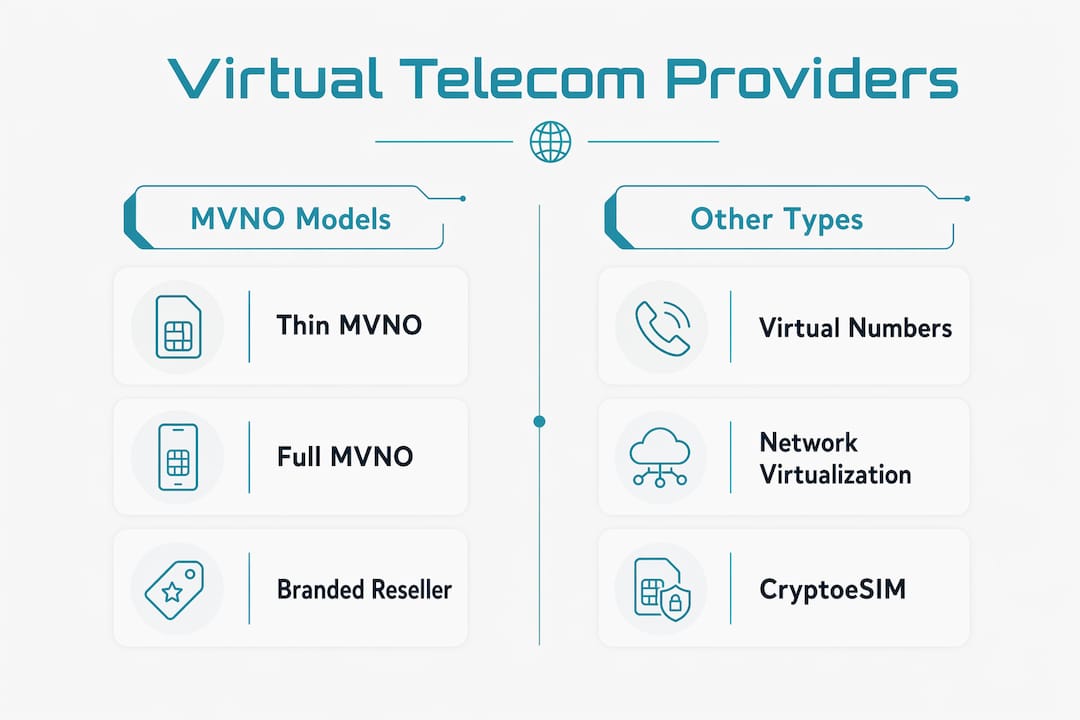
What are the main types of virtual telecom providers?
Virtual telecom is not one single model. The category covers several distinct provider types, each with different levels of control, cost, and technical complexity.
| Provider type | Control level | Key characteristic |
|---|---|---|
| Thin MVNO | Low | Relies on host carrier for billing, SIM management, and core network |
| Full MVNO | High | Operates own core network and billing; leases only the radio access network |
| Virtual phone number provider | Medium | Delivers cloud-based numbers via VoIP; no mobile network involvement |
| Telecom-as-a-Service (TaaS) platform | Variable | API-driven communication services for developers and businesses |
Thin MVNOs depend heavily on the host carrier for technical operations. They get to market faster and spend less upfront, but they have limited ability to differentiate their service. Full MVNOs manage their own billing, roaming agreements, SIM provisioning, and service design. They lease only the radio access network from the MNO. That independence costs more but gives the full MVNO far greater control over the customer experience.
Virtual phone number providers sit in a different category entirely. They do not operate mobile networks at all. They deliver numbers through VoIP and integrate with tools like CRM platforms for call logging, analytics, and team routing. Telecom-as-a-Service platforms go one step further, exposing communication functions through APIs so developers can embed calling, SMS, and data features directly into applications.
What are the benefits and challenges of virtual telecom services?
Virtual telecom services offer real advantages for both consumers and businesses, but the model carries trade-offs that matter in practice.
Core benefits
- Lower cost: No infrastructure ownership means lower overhead, which typically translates to cheaper plans for consumers.
- Geographic flexibility: Virtual numbers enable local presence across multiple regions without physical offices or local SIM cards.
- Faster deployment: New services launch in weeks, not years, because software updates replace hardware rollouts.
- Multi-device access: VoIP-based services work on smartphones, laptops, and tablets simultaneously.
Real challenges to understand
The biggest technical challenge is latency. Voice packet latency must stay below 150ms for a call to sound natural. No amount of software quality compensates for poor routing. If the underlying internet path is congested or poorly optimized, call quality degrades regardless of the provider’s marketing claims.
Security is the second major concern. Virtual services route calls and data through shared cloud infrastructure. That creates exposure to interception risks that do not exist on dedicated physical circuits. Businesses handling sensitive communications need to verify encryption standards before committing to a virtual telecom provider.
Vendor lock-in is the third challenge. Switching from one virtual telecom platform to another can be complex, especially when number porting, billing integrations, and API dependencies are involved.
Virtual telecom services mask enormous routing complexity behind simple interfaces. That complexity does not disappear. Intelligent traffic resolution across redundant PSTN paths is what keeps calls connected when individual routes fail. Providers that invest in that infrastructure deliver reliable service; those that do not will drop calls under load.
Pro Tip: Before signing with any virtual telecom provider, ask specifically how many redundant routing paths their network uses. A provider with a single upstream carrier is a single point of failure.
What are the practical applications and future trends of virtual telecom?
Virtual telecom is not a niche technology. It already underpins a wide range of everyday communication scenarios, and its role is expanding as 5G and IoT adoption accelerate.
-
Remote work communication: Distributed teams use virtual phone numbers and VoIP platforms to maintain a unified business presence across time zones. A team member in Austin and one in Berlin can share the same company number and call queue.
-
Global business presence: A business can acquire local virtual numbers in dozens of countries without opening offices. Customers call a local number; the call routes to wherever the team actually is.
-
IoT device connectivity: Virtual mobile numbers and eSIM-enabled devices allow IoT deployments, from fleet trackers to smart meters, to connect across borders without physical SIM management at scale.
-
5G service delivery: NFV and SDN are the core technologies enabling 5G network slicing, where operators carve out dedicated virtual network segments for specific use cases like autonomous vehicles or industrial automation.
-
eSIM and crypto-payment integration: The convergence of eSIM technology with digital payment methods is creating a new category of virtual telecom access. Travelers and digital nomads can now activate data plans in over 190 countries instantly, pay with Bitcoin, Ethereum, or other tokens, and never touch a physical SIM card. Cryptoesim operates at exactly this intersection, combining software-based connectivity with crypto-native payment options.
The Telecom-as-a-Service model is growing fastest among developer-focused businesses. Communication features are becoming embedded in applications rather than delivered through separate phone systems. That shift moves telecom from a utility into a software layer, which is where the most significant structural change in the industry is happening.
Key Takeaways
A virtual telecom delivers communication services through leased network access or software-defined infrastructure, not through physical network ownership, and that distinction drives every advantage and trade-off in the model.
| Point | Details |
|---|---|
| Virtual telecom definition | Providers deliver services by leasing infrastructure or using NFV/SDN, not by owning physical networks. |
| MVNO model structure | MNOs own the network; MVNEs enable operations; MVNOs control pricing, branding, and customers. |
| Call quality threshold | Voice latency must stay below 150ms; routing quality determines call reliability, not software alone. |
| Provider types vary widely | Thin MVNOs offer speed to market; full MVNOs offer control; TaaS platforms offer API-driven flexibility. |
| eSIM expands the model | eSIM technology extends virtual telecom to instant, software-only connectivity across 190+ countries. |
Why the MVNO vs. virtualization confusion actually matters
Most articles on virtual telecom treat MVNOs and NFV/SDN as interchangeable concepts. They are not, and conflating them leads to bad decisions.
When I look at how businesses evaluate virtual telecom options, the ones that understand the difference make smarter choices. An MVNO relationship is a commercial arrangement. You are buying access to someone else’s network under your own brand. NFV and SDN are engineering choices about how to build or operate a network. A company can be an MVNO without using any virtualization technology. A carrier can deploy NFV without being a virtual operator in any commercial sense.
The second thing I would push back on is the assumption that virtual always means cheaper quality. Call quality on a well-run virtual network is indistinguishable from a traditional carrier. The variable is routing infrastructure, not the virtual model itself. Providers that invest in redundant PSTN paths and distributed routing deliver reliable service. Those that cut corners on routing infrastructure will disappoint you, regardless of how their pricing looks on paper.
My honest advice: before choosing any virtual telecom service, test it under realistic conditions. Make calls during peak hours. Test from the regions where you actually need coverage. The technology works. The question is always whether a specific provider has built it correctly.
— Mohammed
Cryptoesim and software-based global connectivity
Virtual telecom’s biggest promise is connectivity without physical constraints. Cryptoesim delivers exactly that for travelers, remote workers, and digital nomads who need reliable data access across borders.
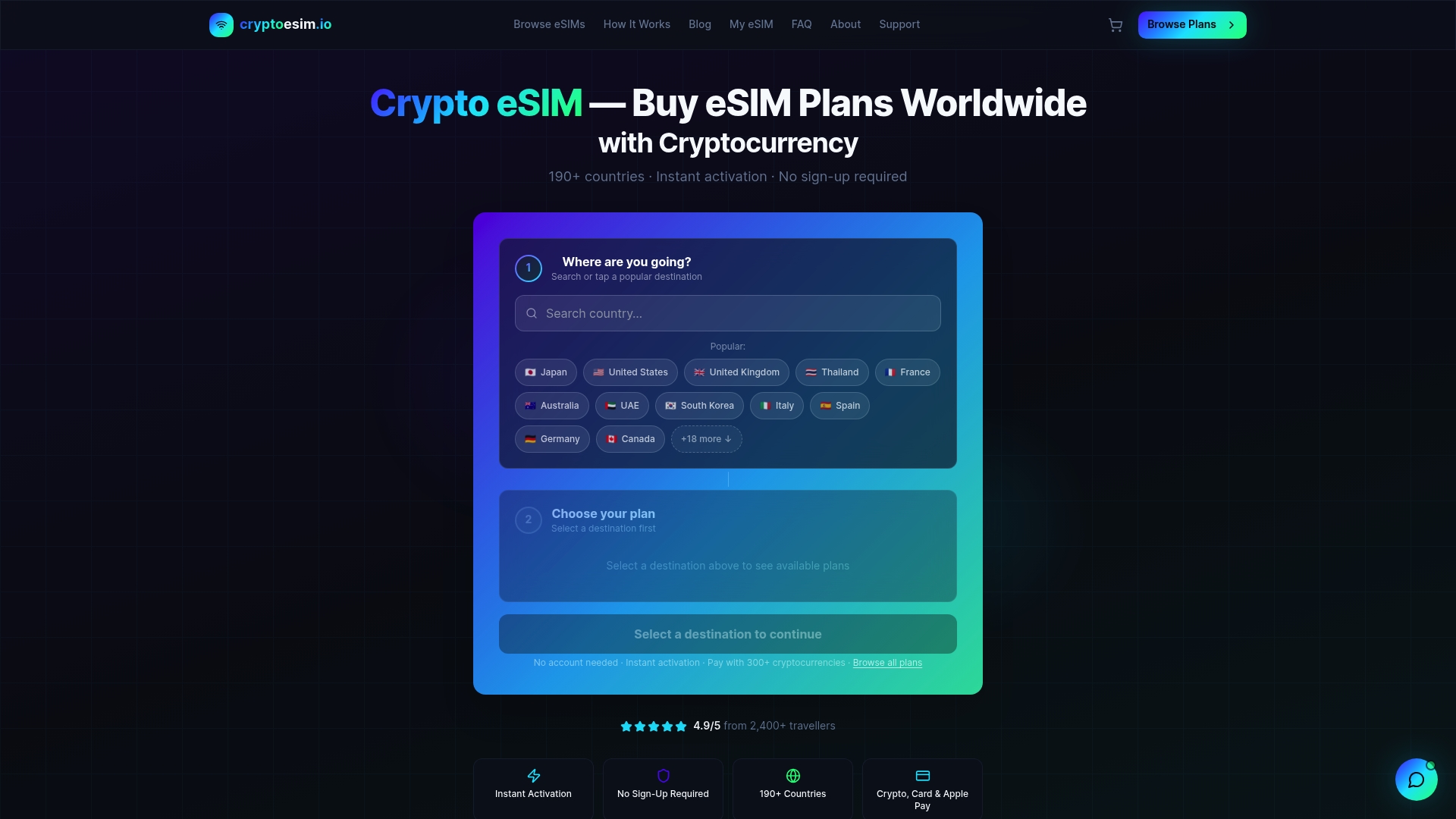
Cryptoesim offers instant eSIM activation in over 190 countries, with no account creation required and no physical SIM card to manage. You can pay with Bitcoin, Ethereum, or more than 300 other tokens, as well as credit cards or Apple Pay. That combination of software-based connectivity and crypto-native payments puts global mobile data access in a category most traditional carriers cannot match. Browse global eSIM packages and activate your plan in minutes, wherever you are headed next.
FAQ
What is a virtual telecom in simple terms?
A virtual telecom is a communications provider that delivers phone, data, or messaging services without owning the physical network infrastructure. It either leases network access from a traditional carrier or runs services through software on shared infrastructure.
What is the difference between an MVNO and network virtualization?
An MVNO is a business model where a company leases mobile network capacity from a carrier and resells it under its own brand. Network virtualization (NFV and SDN) is a technology approach that replaces physical hardware with software-defined functions. The two concepts are related but distinct.
How does a virtual phone number work?
A virtual phone number routes calls over the internet using VoIP. It is not tied to a physical SIM or landline, so it can receive calls on any internet-connected device from any location.
What is the biggest challenge with virtual telecom services?
Latency is the primary technical challenge. Voice calls require packet latency below 150ms to sound natural. Poor routing infrastructure degrades call quality regardless of the software platform a provider uses.
How does eSIM relate to virtual telecom?
eSIM is a software-based SIM standard that eliminates the need for a physical SIM card. It extends the virtual telecom model to instant, over-the-air connectivity, allowing users to activate data plans in multiple countries without swapping hardware.