What Is Instant Crypto Settlement? A 2026 Guide

TL;DR:
- Instant crypto settlement enables near-instant transfer of digital assets on a blockchain, often within seconds. However, on-chain finality does not equate to legal settlement, which depends on off-chain agreements and regulatory recognition.
Instant crypto settlement is defined as the near-instantaneous confirmation and transfer of digital assets on a blockchain, finalizing transactions within seconds rather than days. Modern high-throughput blockchains like Solana and Base achieve settlement in under 2 seconds, compared to the 2–5 business days typical of traditional banking. The industry term for this process is “on-chain finality,” and understanding the gap between that technical term and the marketing phrase “instant settlement” is the most valuable thing a financial professional can take from this article. Cryptoesim, which processes crypto payments for eSIM activations across 190+ countries, depends on exactly this mechanism to deliver service within seconds of payment.
What is instant crypto settlement, and how does it differ from traditional banking?
Traditional bank settlement runs on a T+2 cycle. That means a trade executed today clears two business days later, after matching, netting, and reconciliation across multiple intermediaries. Stablecoin settlements occur on-chain in minutes or less, bypassing every one of those intermediary steps. The practical difference is not just speed. It is structural.

Crypto settlement transfers value directly between wallets on a shared ledger. No correspondent bank, no clearinghouse, no cutoff window. Crypto settlement operates 24/7/365, which matters enormously for cross-border payments where time zones create bottlenecks in traditional systems. A payment sent from Tokyo to São Paulo on a Saturday clears on-chain in seconds. The same payment through SWIFT may not settle until Tuesday.
The table below compares the two systems across five operational dimensions.
| Attribute | Traditional banking | Crypto settlement |
|---|---|---|
| Speed | 1–3 business days (T+2) | Seconds to minutes |
| Operating hours | Business hours, weekdays | 24/7/365 |
| Reversibility | Possible via intermediaries | Irreversible after finality |
| Intermediaries | Multiple (banks, clearinghouses) | None (direct on-chain) |
| Settlement finality | Legal and operational | Cryptographic and on-chain |
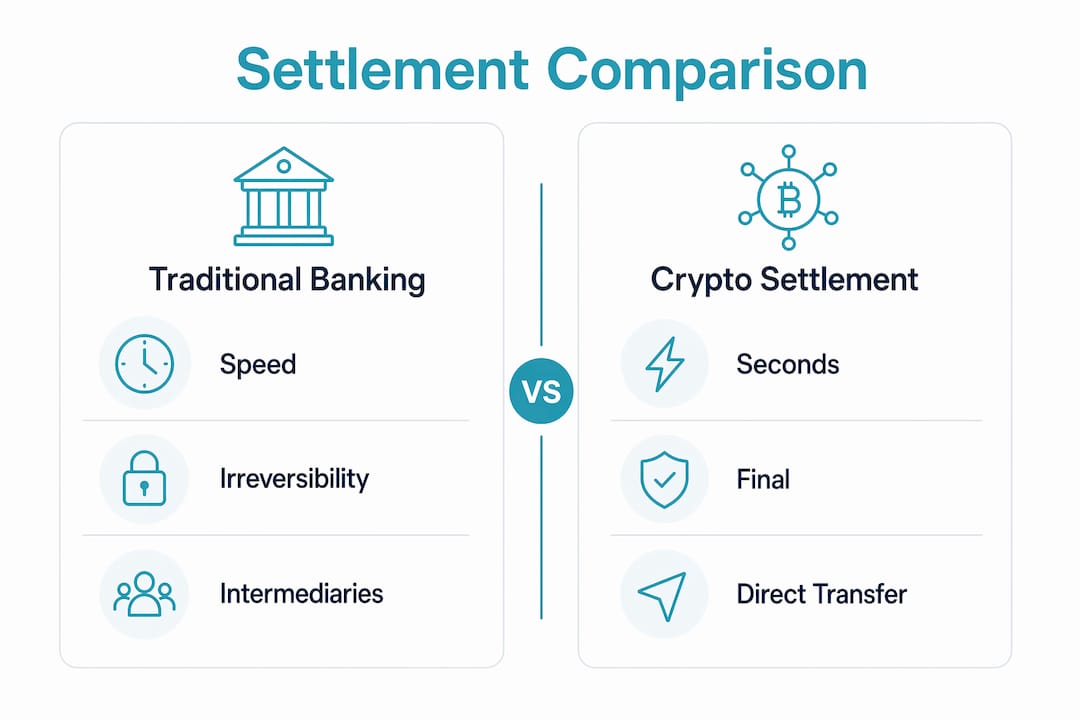
The irreversibility column deserves attention. Traditional systems allow chargebacks and reversals. Crypto does not. That is a feature for merchants protecting against fraud, and a risk for senders who make errors. Financial professionals need to build pre-send verification into any crypto payment workflow.
What technical processes enable real-time crypto transaction settlement?
On-chain settlement follows four distinct stages. Understanding each one prevents the most common misconceptions about what “instant” actually means.
- Transaction broadcast: The sender signs and broadcasts a transaction to the network’s mempool, where validators or miners pick it up.
- Block inclusion: A validator includes the transaction in a block. This is the first confirmation. On Solana, this takes under one second.
- Block confirmation: Subsequent blocks build on top of the transaction’s block, increasing the probability that the transaction cannot be reversed.
- Deterministic finality: The protocol mathematically guarantees the transaction cannot be reversed. This is true finality.
The gap between block inclusion and true finality varies dramatically by network. Ethereum requires approximately 12.8 minutes for economic finality, while networks like Aptos and Sui reach deterministic finality in under one second. Solana lands around 12.8 seconds for full economic finality. These are not marketing numbers. They are protocol-level benchmarks that determine real operational risk.
Probabilistic finality, used by Bitcoin, means the transaction becomes more secure with each additional block but is never mathematically guaranteed. Deterministic finality, used by newer proof-of-stake chains, provides a protocol-level guarantee after a defined confirmation window. For treasury operations, that distinction changes how you model settlement risk.
Pro Tip: When a blockchain project claims “instant settlement,” ask specifically whether they mean block inclusion or deterministic finality. Those two events can be separated by 12 minutes or more on major networks.
The signal-based trading environment in 2026 makes finality speed even more consequential. Traders executing on price signals cannot afford to wait 12 minutes for settlement confirmation before their next move.
What are the practical nuances and limitations of instant crypto settlement?
On-chain finality and legal settlement are not the same thing. Public blockchains cannot provide legal settlement finality without off-chain agreements. A transaction confirmed on Ethereum is cryptographically final, but it carries no legal weight in a jurisdiction that has not recognized blockchain records as binding. Accounting teams still need off-chain documentation to book the transaction.
Exchanges add another layer of delay. Exchange policies require 12–32 confirmations before crediting a deposit as a usable balance. A transaction confirmed in one block on Ethereum may still sit in “pending” status on an exchange for 20 minutes. The blockchain settled. The exchange has not.
Cross-chain settlement introduces the longest delays of all. Optimistic rollups require up to 7 days for finality on native bridges due to challenge periods. Any business model that depends on cross-chain instant settlement is accepting either significant delay or significant risk.
Common misconceptions financial professionals encounter in this space:
- “Confirmed means settled.” Block confirmation is not finality. Finality requires additional confirmations or protocol guarantees.
- “Instant settlement is free.” Providers who advance funds before clearance charge 2–3% in premium fees to cover liquidity risk.
- “All chains are equally fast.” Finality times range from under one second on Aptos to 12+ minutes on Ethereum.
- “Cross-chain is the same as on-chain.” Bridge protocols introduce challenge periods that can extend settlement by days.
- “Legal and on-chain finality are equivalent.” They are not. Legal recognition requires off-chain processes.
Pro Tip: For any payment workflow involving cross-chain transfers, model the worst-case bridge delay, not the best-case block time. Build that buffer into your liquidity planning.
Ultra-fast finality chains also shift security responsibility to the sender. When a transaction is irreversible in under one second, pre-send controls, address verification, and amount confirmation must happen before broadcast, not after.
How do businesses use instant crypto settlement, and what trade-offs exist?
Businesses rarely use instant settlement for every transaction. The cost structure makes that impractical. Instant settlement fees run 2–3%, representing the liquidity risk a provider accepts by advancing funds before full clearance. Standard settlement waits for on-chain finality and charges no premium. The choice between them is a cash flow decision, not a technology preference.
Businesses use instant settlement strategically for high-velocity events where delayed access to funds creates operational problems. The most common use cases:
- Product launches: High transaction volume in a short window requires immediate liquidity to fund fulfillment.
- Payroll: Contractors in multiple countries need funds available at a specific time, not after a 2-day clearance window.
- Marketplace payouts: Sellers expect same-day access to proceeds, especially in competitive platforms.
- Event-driven trading: Price-sensitive positions require immediate settlement to execute the next trade.
- Cross-border supplier payments: Eliminating correspondent banking delays reduces supply chain friction.
Treasury teams model payout cycles and dispute rates before choosing settlement tiers. A business with low dispute rates and predictable cash flow rarely needs instant settlement. A business running flash sales or managing global payroll does.
| Settlement tier | Speed | Fee | Best use case |
|---|---|---|---|
| Standard | Minutes to hours | Minimal | Routine payments, low urgency |
| Instant | Seconds | 2–3% premium | Payroll, launches, time-sensitive payouts |
The digital wallet infrastructure underlying these payments matters as much as the settlement tier. A wallet that supports multiple chains and stablecoins gives treasury teams more flexibility in choosing the right settlement path for each transaction type.
Crypto’s core advantage over correspondent banking is replacing slow, multi-hop ledger updates with a single shared ledger that all parties can verify in real time. That structural shift reduces the settlement risk window from days to seconds, which has direct implications for working capital efficiency.
My honest read on instant settlement’s hype and reality
The marketing around instant crypto settlement is years ahead of the operational reality. I have watched projects announce “sub-second finality” while their exchange partners still require 32 confirmations before crediting a deposit. The blockchain settled. The user waited 40 minutes.
The gap is not a technology failure. It is a policy and infrastructure lag. Exchanges, custodians, and payment processors have risk models built around traditional settlement timelines. Updating those models takes time, compliance review, and capital commitment. The chain moves faster than the institutions built around it.
What I find genuinely exciting is the trajectory. Networks like Aptos and Sui have demonstrated that deterministic finality under one second is achievable at scale. As institutional infrastructure catches up, the policy delays will compress. The 32-confirmation requirement will drop to 6, then to 1, as risk models mature.
For financial professionals evaluating settlement products right now, the right question is not “how fast is the chain?” It is “how fast does the receiving institution credit the funds?” Those two numbers are rarely the same. Evaluate the full stack, not just the protocol. The eSIM connectivity model that Cryptoesim uses is a good real-world example: crypto payment confirmed in seconds, service activated immediately, no intermediary delay. That is what the full stack looks like when it works correctly.
— Mohammed
Cryptoesim and the practical value of fast crypto payments
Cryptoesim puts instant crypto settlement to work in a straightforward way. You pay with Bitcoin, Ethereum, or any of 300+ supported tokens, and your eSIM activates immediately for mobile data in 190+ countries. No account creation, no KYC, no waiting for a bank to process your payment.
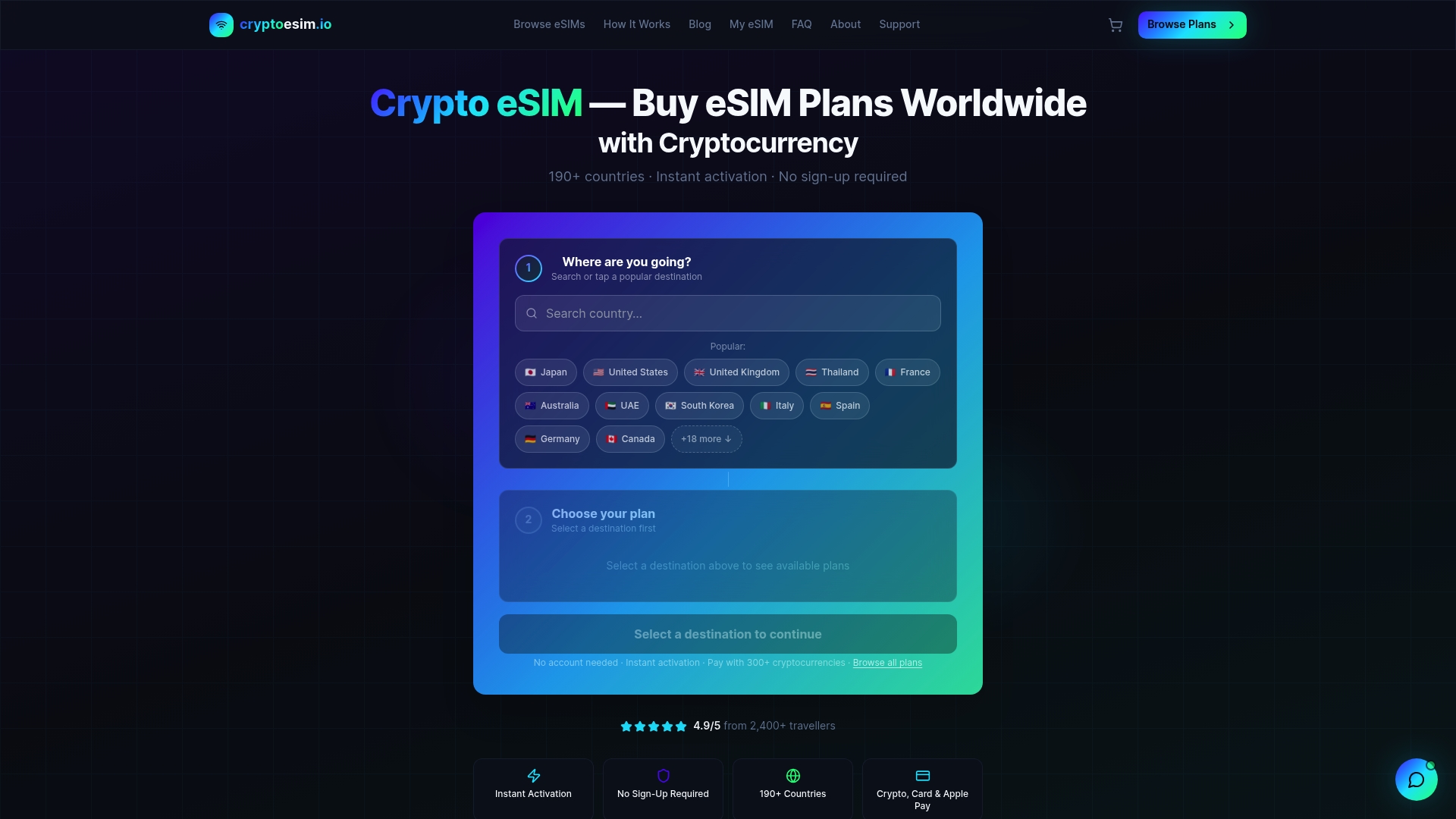
The speed advantage is real here. Traditional payment rails would add 1–3 days of clearing time to what should be a simple connectivity purchase. Crypto settlement removes that friction entirely. Travelers, remote workers, and digital nomads who need data connectivity now, not in two days, get exactly that. Cryptoesim also accepts credit cards and Apple Pay, but the crypto payment option consistently delivers the fastest activation path for users who hold digital assets.
Key takeaways
Instant crypto settlement delivers real speed advantages over traditional banking, but the gap between block confirmation and true legal or operational finality is where most professionals get caught off guard.
| Point | Details |
|---|---|
| On-chain finality vs. legal settlement | Blockchain confirmation is cryptographic, not legal. Off-chain agreements are still required for accounting and regulatory purposes. |
| Finality times vary by network | Ethereum takes ~12.8 minutes for economic finality; Aptos and Sui reach it in under one second. |
| Exchange policies add delay | Exchanges require 12–32 confirmations before crediting deposits, adding minutes to hours beyond block confirmation. |
| Instant settlement carries a fee | Providers charge 2–3% to advance funds before full clearance. Use it selectively for high-urgency transactions. |
| Cross-chain bridges are not instant | Optimistic rollup bridges require up to 7 days for finality. Model worst-case delays, not best-case block times. |
FAQ
What does instant crypto settlement mean?
Instant crypto settlement refers to the near-immediate confirmation and transfer of digital assets on a blockchain, typically within seconds of broadcast. The standard industry term is “on-chain finality,” and it differs from legal or accounting settlement, which requires additional off-chain processes.
How fast is crypto settlement compared to bank transfers?
Modern blockchains like Solana and Base settle transactions in under 2 seconds. Traditional bank transfers run on T+2 cycles, meaning settlement takes 1–3 business days after the transaction is initiated.
Why do exchanges take longer to credit crypto deposits?
Exchanges apply internal confirmation policies requiring 12–32 block confirmations before marking a deposit as usable. This protects against chain reorganizations and adds minutes to hours beyond the blockchain’s own finality time.
Is instant crypto settlement always free?
No. Providers who advance funds before full on-chain clearance charge 2–3% in premium fees to cover their liquidity risk. Standard settlement, which waits for full confirmation, carries no such premium.
What is the difference between block confirmation and finality?
Block confirmation means a transaction has been included in a block. Finality means the protocol guarantees the transaction cannot be reversed. On Ethereum, those two events are separated by approximately 12.8 minutes. On Aptos or Sui, they occur within one second.