Why Crypto for Private Purchases: A 2026 Guide

TL;DR:
- Crypto offers the most direct way to protect financial privacy during private purchases by avoiding traditional payment records. Privacy depends on the chosen cryptocurrency and operational discipline, with privacy coins like Monero providing the highest anonymity. Using peer-to-peer methods, no-account platforms, and privacy-focused networks enhances privacy while avoiding linkages to personal identities.
Using cryptocurrency for private purchases is the most direct method consumers have today to protect financial privacy beyond what traditional payment systems offer. Credit cards and bank transfers create a permanent, linked record of every transaction. Crypto payments, by contrast, require no personal information at the point of sale. The degree of privacy you get depends heavily on which cryptocurrency you use and how you use it. This guide breaks down the real privacy advantages of crypto, the practical tools available in 2026, and the common mistakes that expose buyers even when they think they are protected.
Why crypto for private purchases works differently than cash or cards
Cryptocurrency is defined as a decentralized digital currency recorded on a public ledger called a blockchain. Crypto transactions are pseudonymous, meaning no personal information is required to send or receive funds, but every transaction is visible on the public ledger. That distinction matters. Pseudonymous is not the same as anonymous. A Bitcoin address does not display your name, but every payment you make from that address is permanently recorded and publicly viewable.

Traditional payment systems work in the opposite direction. Your bank knows your name, address, income, and spending habits. Every card swipe feeds that data to processors, merchants, and data brokers. Crypto removes that intermediary layer entirely. The National Crypto Association’s 2026 report finds that 77% of digital asset users report a positive life impact from using crypto, with feelings of greater security and control cited as primary drivers. That sense of control is grounded in a real structural difference: no third party holds your transaction history.
The privacy gap between crypto and traditional payments is widest at the point of purchase. When you pay with crypto directly, no merchant database stores your card number. No payment processor profiles your behavior. The transaction settles between two addresses on a blockchain, and that is the full record.
What privacy features do different cryptocurrencies offer?
Not all cryptocurrencies provide the same level of privacy. Bitcoin and Ethereum use transparent public ledgers. Every wallet balance and transaction is visible to anyone with an internet connection. Chain analysis firms can map those transactions to real-world identities, especially when a wallet has ever touched a regulated exchange that collected your ID.
Privacy coins like Zcash and Monero are built differently. Zcash enables shielded pools that prevent public observers from tracking wallet balances or transaction amounts. Monero uses ring signatures and stealth addresses to obscure sender, receiver, and amount by default. These are protocol-level privacy protections, not optional add-ons.
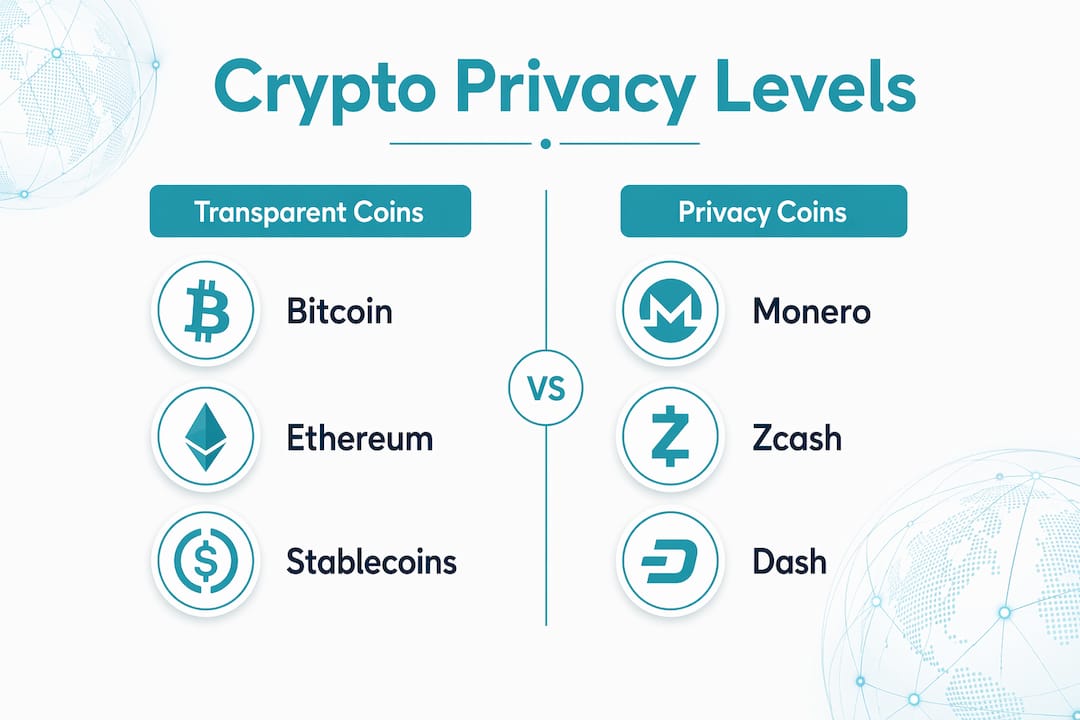
| Cryptocurrency type | Ledger visibility | Privacy level | Best use case |
|---|---|---|---|
| Bitcoin, Ethereum | Fully public | Low | General payments |
| USDT, USDC (stablecoins) | Fully public | Low | Stable-value spending |
| Zcash (shielded) | Hidden | High | Private purchases |
| Monero | Hidden by default | Very high | Anonymous transactions |
One underappreciated factor is the anonymity set. When only a small number of users activate privacy features, those users stand out. Mandatory privacy protocols strengthen overall privacy because every transaction looks the same. Opt-in privacy, by contrast, flags the users who choose it. Monero’s mandatory privacy model is stronger for this reason.
Pro Tip: Always use a privacy-focused network connection, such as Tor or a trusted VPN, when sending crypto transactions. Your IP address can link a transaction to your physical location even when the blockchain record itself reveals nothing.
How does crypto fit into everyday purchases in 2026?
Crypto spending has moved well past speculation and into daily life. 53% of all US cryptocurrency payment transactions cover everyday categories: restaurants, fast food, gas stations, and groceries. That figure shows crypto is no longer a niche payment method reserved for tech purchases or online services.
Stablecoins drive most of this volume. Stablecoins account for 64% of US crypto payment volume, with USDT at 42% and USDC at 22%. Stablecoins eliminate price volatility at checkout, which was the biggest practical barrier to using crypto for everyday goods. You know exactly what you are spending because the value is pegged to the dollar.
Crypto cards have closed the remaining gap between crypto wallets and physical stores. Stablecoin-linked card programs process approximately $18 billion in annualized payments, working at traditional point-of-sale terminals without requiring new merchant integrations. You hold funds on-chain and spend them anywhere Visa or Mastercard is accepted. The crypto-to-fiat conversion happens instantly at the point of sale, with no manual steps.
Key advantages of crypto for everyday spending over cash and cards:
- No bank account required to send or receive payments
- No merchant database stores your payment credentials
- Borderless by design, with no currency conversion fees for international purchases
- Transactions settle in minutes, not business days
- No chargebacks or payment reversals initiated by third parties
- Crypto gift cards extend spending to retailers that do not accept crypto directly
Pro Tip: For the best combination of privacy and convenience, consider using signal-based crypto tools to manage your holdings efficiently before converting to spending wallets. Keeping your trading activity separate from your spending activity reduces the risk of linking your financial profile.
What are the privacy pitfalls when using crypto for purchases?
The biggest misconception about crypto is that all of it is anonymous. It is not. Transparent ledger transactions are traceable and can be linked to real identities through chain analysis, exchange records, and IP logging. Buying Bitcoin on Coinbase and then spending it at a vendor creates a chain of evidence that connects your verified identity to every downstream purchase.
Exchange linkage is the most common privacy failure. When you buy crypto with a credit card or bank transfer on a regulated exchange, that exchange holds your KYC data. Any wallet funded from that exchange is now linked to your identity, regardless of how many hops the funds take afterward. Chain analysis tools are sophisticated enough to follow those hops.
Network-level exposure is the second major risk. Your IP address is logged by nodes when you broadcast a transaction. Even with a privacy coin, broadcasting from your home internet connection can reveal your location. Operational discipline requires securing the network environment, not just choosing the right coin.
The third risk is mixing privacy tools with non-private behavior. Using Monero for one purchase and then sending funds back to a KYC exchange for another creates a linkage point. Privacy is only as strong as the weakest step in the chain.
Pro Tip: Treat your privacy setup like a chain: identify the weakest link first. If you use a privacy coin but broadcast from your home IP and cash out through a KYC exchange, the coin’s privacy features provide little real protection. Fix the network and exit strategy before focusing on coin selection.
How can you practically use crypto for private purchases today?
The most direct method is paying vendors who accept privacy coins natively. A growing number of online merchants accept Monero and Zcash directly. This approach requires no conversion and leaves no exchange record if you acquired the coins peer-to-peer. The privacy-first web ecosystem is expanding to support these payment methods across digital goods and services.
Crypto gift cards are the most practical off-ramp for purchases at mainstream retailers. Services that convert crypto to gift cards let you spend at thousands of retailers without those retailers ever touching a blockchain. Gift cards act as privacy-preserving bridges for goods and services where native crypto acceptance is low. The privacy level depends on how you acquired the crypto used to buy the card.
Crypto cards offer convenience but carry a privacy trade-off. Most crypto card programs require KYC verification during signup. Once you verify, the card issuer links your identity to your spending. The merchant sees only a card transaction, which is a privacy gain over a bank card, but the card issuer holds a complete record.
| Off-ramp method | Privacy level | KYC required | Merchant compatibility |
|---|---|---|---|
| Direct privacy coin payment | Very high | No | Limited to crypto-accepting vendors |
| Crypto gift cards | High | Varies by platform | Wide, includes major retailers |
| Crypto card (KYC) | Medium | Yes | Universal |
| Stablecoin direct payment | Low | No | Growing, mostly online |
For travelers and digital nomads, crypto payments for digital services like mobile data are one of the cleanest use cases. No physical exchange, no foreign bank, and no currency conversion. Cryptoesim lets you buy eSIM plans with crypto across more than 190 countries without creating an account, which removes the KYC step entirely for connectivity purchases.
Privacy and crypto: what I’ve actually learned from watching this space
The conversation around crypto privacy tends to split into two camps. One side treats all crypto as anonymous and acts accordingly. The other dismisses crypto privacy as a myth because Bitcoin is traceable. Both positions miss the real picture.
What I’ve observed is that the technology for genuine financial privacy exists and works. Zcash’s shielded pools and Monero’s default privacy are not theoretical. They function. The barrier is not the coin. The barrier is operational discipline. Most people who want privacy with crypto fail at the network and exit steps, not the transaction itself.
The 76% of crypto holders who want integrated bank-crypto management but only a third of whom use crypto for everyday goods tells you something important. The desire is there. The friction is in the practical steps. Crypto cards are closing that gap faster than any other tool, but they come with the KYC trade-off that serious privacy users cannot accept.
My honest prediction: privacy coin adoption will grow among consumers who understand the distinction between pseudonymity and anonymity. The consumers who read past the headline and understand how chain analysis works will drive demand for Monero and Zcash at the point of sale. The rest will use stablecoin cards and accept the trade-off. Both are valid choices. The key is knowing which one you are making.
— Mohammed
Cryptoesim: private crypto payments for global connectivity
Cryptoesim sits at the intersection of crypto payments and practical privacy. The platform sells eSIM data plans for over 190 countries and accepts Bitcoin, Ethereum, and more than 300 other tokens, with no account creation required.
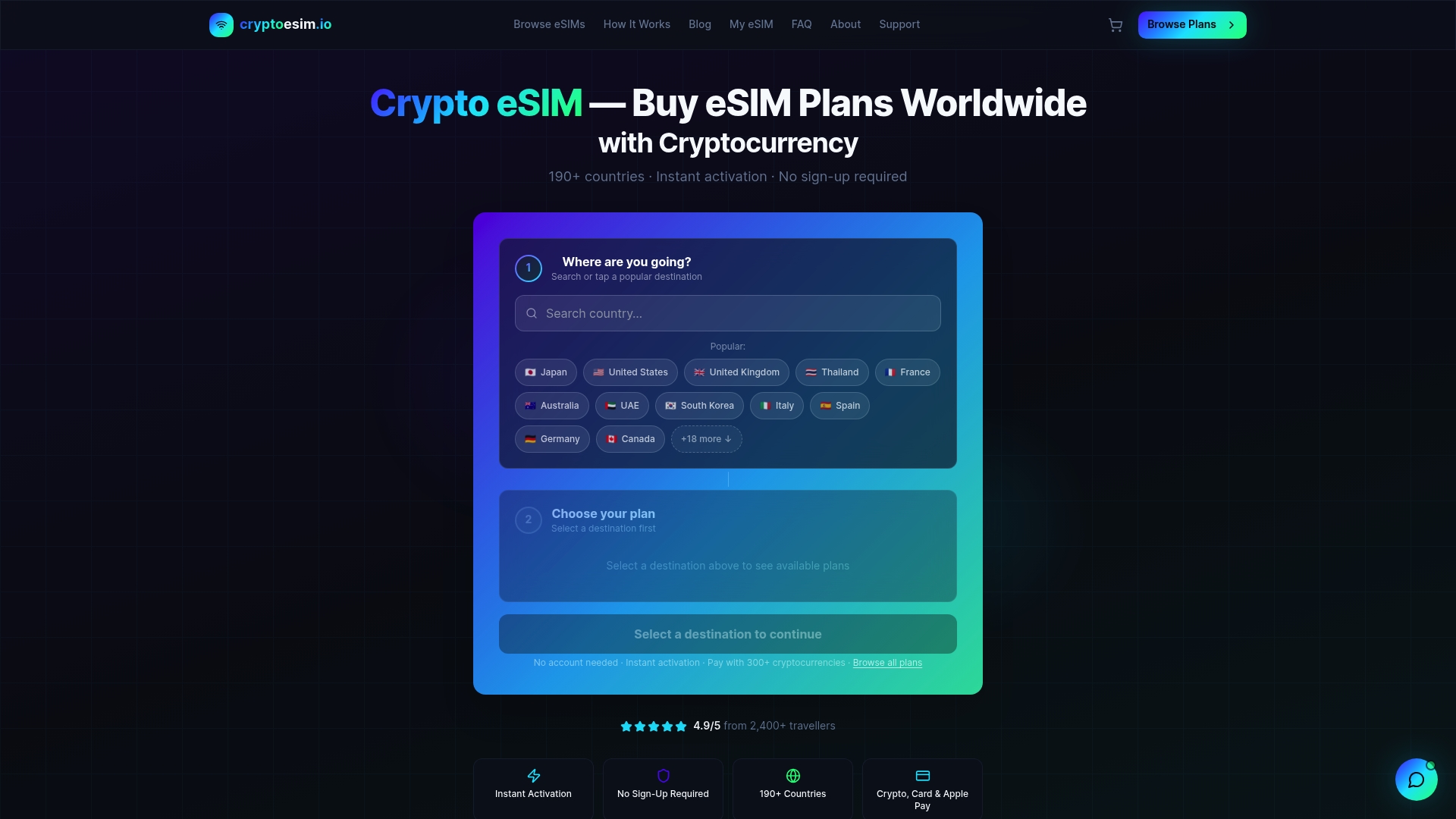
That no-account model matters for privacy-conscious consumers. No KYC, no stored profile, no transaction history tied to your identity. You pay with crypto, receive your eSIM instantly, and connect anywhere in the world. For travelers and remote workers who want private eSIM access without the usual data trail, Cryptoesim is a direct solution. Visit cryptoesim.io to browse plans and pay privately with the crypto of your choice.
FAQ
Is all cryptocurrency anonymous for private purchases?
No. Most cryptocurrencies, including Bitcoin and Ethereum, use transparent public ledgers where transactions are visible to anyone. True anonymity requires privacy coins like Monero or Zcash with shielded transactions.
What is the most private cryptocurrency for everyday purchases?
Monero provides the highest default privacy because its protocol hides sender, receiver, and transaction amount for every transaction. Zcash offers similar protection when users opt into shielded pools.
Do crypto cards protect my privacy at checkout?
Crypto cards protect your payment credentials from merchants, but the card issuer holds a complete record of your spending. Most crypto card programs require KYC verification, which links your identity to your transaction history.
Can I use crypto for private purchases without a crypto exchange account?
Yes. Peer-to-peer acquisition of privacy coins, combined with direct vendor payments or crypto gift cards, allows purchases without a KYC exchange account. Platforms like Cryptoesim also accept crypto without requiring account creation.
What is the biggest mistake people make when using crypto for privacy?
The most common mistake is using a transparent coin like Bitcoin purchased from a KYC exchange and assuming the transaction is private. Chain analysis can trace those funds back to your verified identity regardless of how many wallet hops occur.
Key takeaways
Crypto provides genuine financial privacy only when consumers choose the right coin, secure their network, and avoid linking their identity through exchanges or card programs.
| Point | Details |
|---|---|
| Pseudonymous is not anonymous | Bitcoin transactions are public and traceable; true privacy requires protocol-level tools like Monero or Zcash. |
| Stablecoins dominate everyday spending | USDT and USDC account for 64% of US crypto payment volume, making them the practical choice for daily purchases. |
| Crypto cards trade privacy for convenience | Card programs require KYC, so the issuer holds your spending record even though merchants do not. |
| Operational discipline is non-negotiable | Network security and avoiding KYC exchange linkages matter as much as coin selection for maintaining anonymity. |
| No-account platforms maximize privacy | Services like Cryptoesim that accept crypto without account creation eliminate the KYC data trail entirely. |