Why Crypto Payments Are Borderless: A 2026 Guide

TL;DR:
- Crypto payments on blockchain networks enable fast, low-cost, borderless transactions without intermediaries. They use stablecoin sandwich models to simplify user experience by transacting in local currency while transferring value seamlessly across borders. Despite regulatory and conversion challenges, the infrastructure is rapidly growing, driving significant market expansion.
Crypto payments are borderless financial transactions executed on decentralized blockchain networks, enabling direct value transfers across countries without traditional banking intermediaries. Global cryptocurrency ownership reached 741 million people in 2025, growing 12.4% annually. That scale reflects a fundamental shift in how money moves internationally. Regulatory frameworks like the US GENIUS Act and the EU’s MiCA are now formalizing the rules around payment stablecoins, signaling that borderless crypto payments are no longer a fringe concept. They are becoming infrastructure.
Why crypto payments are borderless: the blockchain explanation
The core reason crypto payments cross borders without friction is blockchain’s decentralized ledger. No single bank, government, or clearinghouse controls it. Anyone with internet access can send value directly to anyone else, anywhere in the world.

Traditional international wire transfers depend on a correspondent banking model. Your bank contacts an intermediary bank, which contacts another, which finally reaches the recipient’s bank. Each hop adds a fee and a delay. The total wait runs 2–5 business days, and fees stack up at every step.
Blockchain eliminates those intermediaries entirely. A sender broadcasts a transaction to a peer-to-peer network, validators confirm it, and the recipient’s balance updates. Blockchain networks like XRP settle cross-border payments in approximately four seconds, compared to 2–5 business days for traditional wires. Four seconds versus four days is not a marginal improvement. It is a structural change.
Blockchain settlement runs 24/7/365 with no cutoff times or bank holidays. A payment sent at 11:00 PM on a Sunday in Lagos reaches a recipient in Seoul just as fast as one sent on a Tuesday morning in New York.
Traditional wire vs. blockchain: a direct comparison
| Feature | Traditional wire transfer | Blockchain payment |
|---|---|---|
| Settlement time | 2–5 business days | Seconds to minutes |
| Intermediaries | Multiple correspondent banks | None |
| Operating hours | Business hours only | 24/7/365 |
| Typical cost | $25–$50 per transfer + FX markup | Flat network fee |
| Chargebacks | Possible | Not applicable |
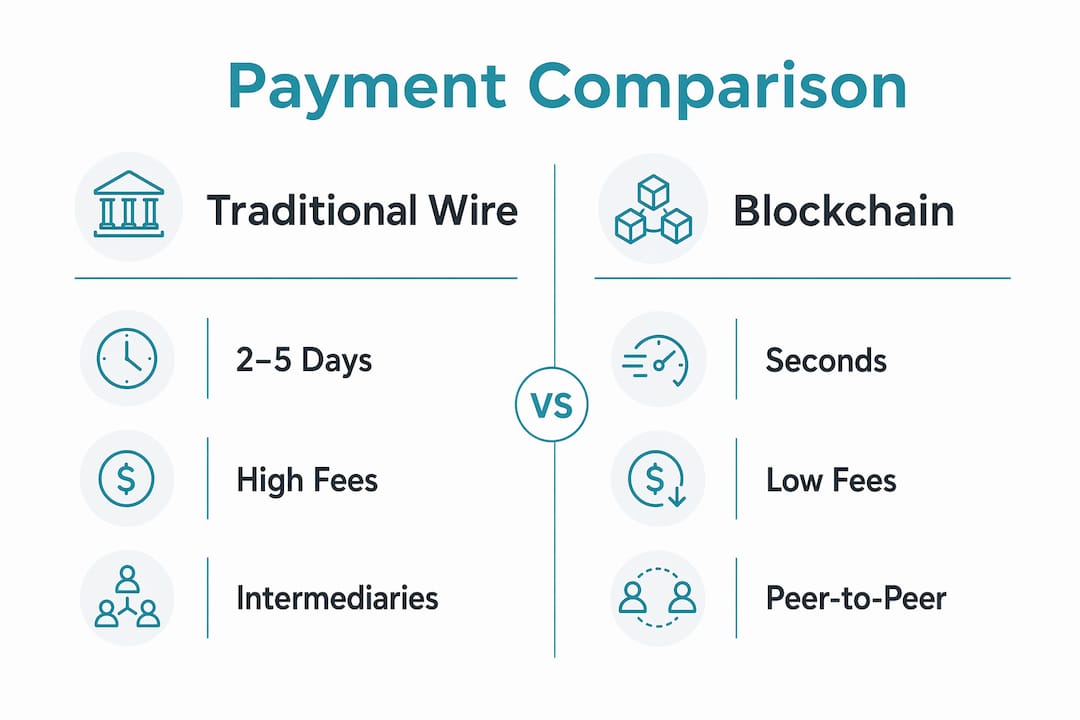
The table above shows why the phrase “borderless” applies. Every friction point in the traditional model, time, cost, and intermediary dependency, disappears on a blockchain network.
How does the stablecoin sandwich model work?
Most people assume using crypto for payments means managing Bitcoin wallets and watching exchange rates. The stablecoin sandwich model proves that assumption wrong.
The stablecoin sandwich enables cross-border payments where the sender and recipient transact in local fiat currency while stablecoins move value between them invisibly on the blockchain. The user experience looks identical to a normal bank transfer. The crypto layer is entirely behind the scenes.
The three-step process works like this:
- Convert to stablecoin. The sender’s local currency (say, US dollars) converts to a stablecoin like USDC or USDT at the point of payment. This happens automatically through an on-ramp provider.
- Transfer on blockchain. The stablecoin moves across the blockchain network in seconds, bypassing every correspondent bank in the traditional system.
- Convert to local currency. An off-ramp provider on the recipient’s end converts the stablecoin back into local currency, whether that is Nigerian naira, Brazilian reais, or Philippine pesos.
The recipient never holds crypto. The sender never manually manages a wallet. Most users don’t directly manage crypto wallets in cross-border payments. The stablecoin infrastructure abstracts all of that complexity. This model also eliminates the need for businesses to pre-fund foreign accounts, which traditionally ties up large amounts of working capital.
Stablecoins provide crucial utility in inflation-prone and restrictive banking countries, where local currencies lose value rapidly. For recipients in those markets, receiving a stablecoin-backed payment preserves purchasing power in a way a local bank transfer cannot.
Pro Tip: When evaluating a crypto payment provider for cross-border use, prioritize those with strong on-ramp and off-ramp integrations in your target markets. The blockchain leg of the transaction is fast everywhere. The fiat conversion legs are where speed differences actually show up.
What are the practical benefits of borderless crypto payments?
The advantages of borderless payments go beyond speed. They affect cost, fraud exposure, and market access in ways that compound over time.
Lower fees
Crypto payment gateways typically charge flat processing fees around 1%, while standard credit card cross-border fees range from 3.20% to 4.50%. For a business processing $100,000 per month in international sales, that difference saves between $2,200 and $3,500 every month. Annually, that is a meaningful budget line.
Faster cash flow
Near-instant settlement changes how businesses manage working capital. A supplier in Vietnam does not wait five days to confirm payment from a buyer in Germany. Funds arrive in minutes, not days. That speed reduces the need for credit lines and improves financial planning across the supply chain.
No chargebacks
Blockchain transactions are mathematically final and irreversible once confirmed, which eliminates chargebacks entirely. Chargebacks cost merchants time, fees, and lost inventory. With crypto, payment finality is built into the protocol. A confirmed transaction cannot be reversed by a third party.
Expanded market access
Crypto payments open doors to the underbanked populations that traditional financial systems exclude. Roughly 1.4 billion adults globally lack a bank account, according to World Bank estimates. A smartphone and a crypto wallet give those individuals access to global commerce for the first time.
Key benefits at a glance:
- Cost: Flat 1% processing fees vs. 3.20%–4.50% for cross-border card payments
- Speed: Settlement in seconds, not business days
- Finality: No chargebacks, no reversals, no disputes
- Availability: Payments work on weekends, holidays, and across time zones
- Access: Reaches customers without traditional bank accounts
What challenges come with adopting borderless crypto payments?
Crypto payments solve real problems, but they introduce new ones. Understanding those trade-offs helps you adopt them responsibly.
On-ramp and off-ramp bottlenecks
The blockchain leg of a stablecoin payment is fast. The fiat conversion legs are not always. The ultimate speed of a cross-border crypto payment depends on the efficiency of on-ramp and off-ramp providers, which vary significantly by market. In markets with limited banking infrastructure, converting stablecoins back to local currency can take hours or even a full business day. That gap is closing as more fintech providers build local off-ramp networks, but it remains a real constraint in some regions.
Regulatory variation
Regulations like the US GENIUS Act and EU MiCA are creating formal legal frameworks for payment stablecoins. That is good news for long-term adoption. The short-term reality is that compliance requirements differ by jurisdiction. A payment flow that is fully compliant in the European Union may require additional licensing or reporting in Southeast Asia or Latin America. Businesses operating across multiple regions need to map their regulatory exposure before deploying crypto payment infrastructure.
Transaction irreversibility
Blockchain finality is a feature for merchants. It is a risk for senders who make errors. Sending crypto to a wrong address is permanent. There is no customer service line to call. Best practices include double-checking recipient addresses before confirming, using address book features in payment platforms, and sending a small test transaction before large transfers.
Pro Tip: Always verify wallet addresses character by character before confirming a large crypto transfer. Address poisoning attacks, where bad actors insert near-identical addresses into your clipboard, are a real threat. Paste, then verify manually.
Cross-border B2B stablecoin payment volume grew 733% year over year heading into 2026. That growth rate shows the market is moving fast despite these challenges. The infrastructure is maturing quickly, and the friction points are shrinking.
You can also explore multi-currency payment options that pair crypto payments with practical travel tools, which shows how these systems work in everyday, real-world scenarios.
Key Takeaways
Crypto payments are borderless because blockchain’s decentralized ledger removes correspondent banks, cuts fees to around 1%, and settles transactions in seconds across any time zone.
| Point | Details |
|---|---|
| Blockchain removes intermediaries | Direct peer-to-peer transfers eliminate correspondent banks, cutting cost and time. |
| Stablecoin sandwich hides complexity | Users transact in local fiat while stablecoins handle the cross-border transfer invisibly. |
| Fees drop significantly | Crypto gateways charge around 1% vs. 3.20%–4.50% for cross-border card payments. |
| Settlement is final | Blockchain transactions are irreversible, eliminating chargebacks and fraud disputes. |
| On/off ramps are the real bottleneck | Blockchain speed is consistent; fiat conversion speed varies by market and provider. |
The part most articles skip about borderless payments
The 733% year-over-year growth in B2B stablecoin payments heading into 2026 is the number I keep coming back to. That is not a niche experiment. That is a structural shift in how businesses move money internationally.
What I find most interesting is how invisible the best implementations are. The stablecoin sandwich model is the right template for mass adoption precisely because it does not ask users to change their behavior. You pay in dollars. Your supplier receives pesos. The blockchain does the work in between, and nobody has to understand it.
The regulatory picture is also more mature than most people realize. MiCA in the EU and the GENIUS Act in the US are not roadblocks. They are the legal scaffolding that will let institutional money flow into this infrastructure with confidence. Compliance is a short-term cost and a long-term accelerant.
The one thing I would caution against is treating speed as the only metric. The blockchain leg is always fast. The fiat conversion legs are where real-world performance diverges. If you are evaluating a crypto payment solution for international use, test the full round trip, not just the on-chain confirmation time. That is where you will find the actual user experience. For practical guidance on using crypto for global data access, the applications extend well beyond finance into everyday connectivity.
— Mohammed
Cryptoesim makes borderless crypto payments practical
Cryptoesim puts borderless crypto payments to work in a concrete, everyday context: buying mobile data for travel in over 190 countries.
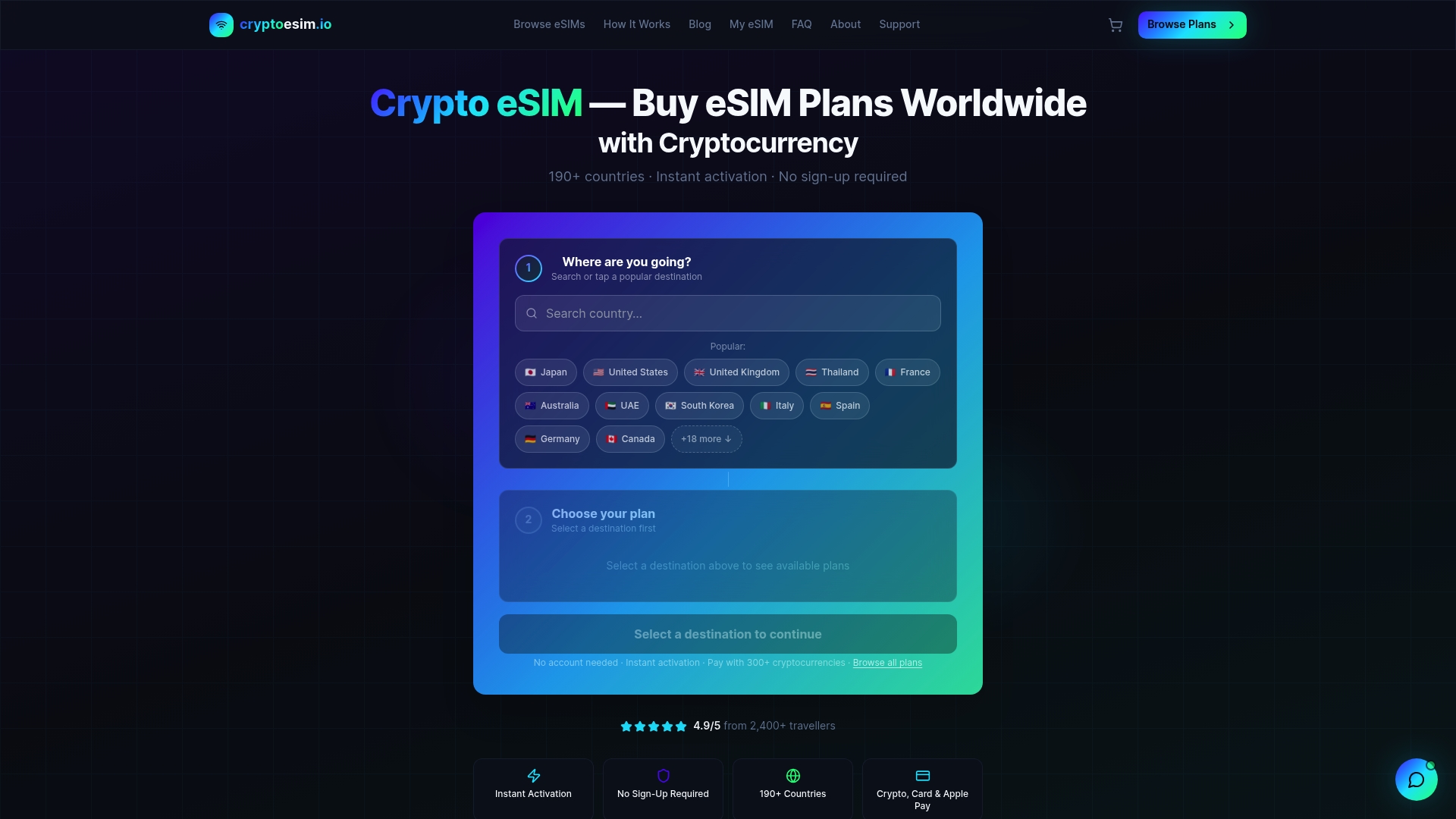
You can buy a global eSIM with crypto using Bitcoin, Ethereum, or more than 300 other tokens, with no account creation and no KYC requirements. The purchase is instant and fully digital. No physical SIM card, no waiting, no bank transfer delays. Cryptoesim accepts credit cards and Apple Pay as well, but for travelers who already hold crypto, paying directly with digital assets is the fastest path to connectivity. It is a real-world example of why borderless payments matter: one transaction, any country, any token, done in seconds.
FAQ
Why are crypto payments considered borderless?
Crypto payments run on decentralized blockchain networks that no single country or bank controls. Any two parties with internet access can transact directly, regardless of geography.
Do I need to manage a crypto wallet to use borderless crypto payments?
No. Most modern crypto payment systems use a stablecoin sandwich model where users pay and receive in local fiat currency. The crypto layer operates entirely behind the scenes.
How fast are cross-border crypto payments compared to wire transfers?
Blockchain networks like XRP settle in approximately four seconds. Traditional wire transfers take 2–5 business days, depending on the correspondent banking chain involved.
What are the main risks of borderless crypto payments?
The biggest risk is transaction irreversibility. Sending to a wrong address is permanent. Always verify recipient addresses manually before confirming any transfer.
How do regulations like MiCA and the GENIUS Act affect borderless crypto payments?
The EU’s MiCA and the US GENIUS Act create formal legal frameworks for payment stablecoins. They add compliance requirements but also provide the legal clarity that encourages broader institutional adoption.