Step-by-step crypto payment tutorial for eSIMs abroad

Picture this: you’ve just landed in a new country, your phone is searching for signal, and your bank card gets blocked the moment you try to buy a local data plan. Or worse, the provider wants a full ID check just to get online. Crypto payments cut through all of that. Privacy-first purchases require only an email address, no KYC, no foreign exchange fees, and no waiting for bank approval. This guide walks you through every step: which providers accept crypto, how to complete the payment, what fees to expect, and how to activate your eSIM the moment it arrives.
Table of Contents
- Why use crypto to buy eSIMs?
- What you need for crypto eSIM payments
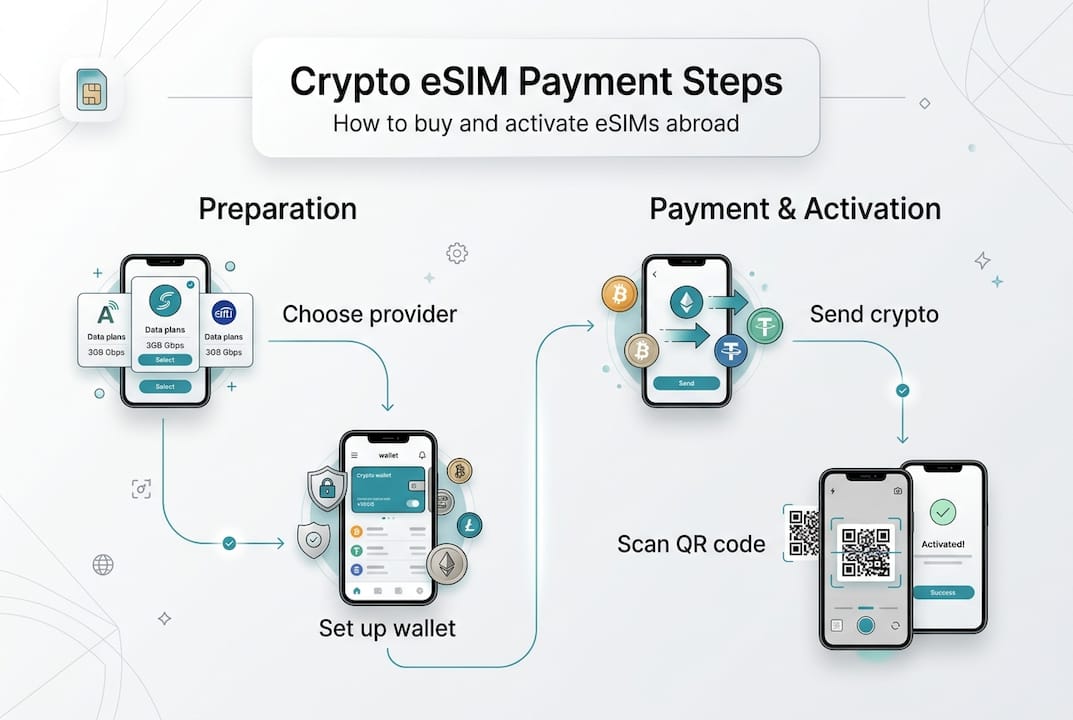
- How to pay for an eSIM with crypto: Step-by-step
- Troubleshooting, security, and common mistakes
- What to expect after payment: Receiving and activating your eSIM
- Get started with crypto-friendly eSIMs today
- Frequently asked questions
Key Takeaways
| Point | Details |
|---|---|
| Privacy advantage | Crypto payments for eSIMs let you avoid KYC and protect your identity while traveling. |
| Lower payment fees | You only pay small network fees, skipping the 3% card charges—saves money on every top-up. |
| Fast global access | Buy and activate eSIMs from anywhere in minutes with crypto, bypassing card and bank issues. |
| Simple setup | All you need is a funded crypto wallet and an email address—no paperwork or phone store visits. |
Why use crypto to buy eSIMs?
Most travelers don’t realize how many friction points exist with traditional eSIM purchases. Providers like Airalo, Holafly, and Ubigi do not accept crypto at all, which means you’re stuck relying on credit cards that may get flagged for foreign transactions, PayPal accounts that require identity verification, or payment processors that tack on a 3% foreign exchange fee every single time.
Crypto removes those barriers entirely. Payments are borderless and private, meaning you can buy a data plan at 2 a.m. from any country without touching a bank. You only need an email address to receive your eSIM. No passport scans, no billing address, no declined transactions.
“Crypto-native eSIM stores require only an email. No ID, no KYC, no FX fees. For nomads who move fast and value privacy, that’s a game-changer.”
Here’s a quick summary of why crypto works so well for eSIM purchases:
- Privacy: Only your email is needed. Explore the full privacy benefits of crypto eSIM purchases.
- Instant payments: Transactions settle in minutes, 24 hours a day, 7 days a week.
- Borderless access: Works from any country, any time. See how global access changes the travel experience.
- No bank restrictions: Zero risk of card blocks or foreign transaction declines.
- Lower costs: No processor fees or FX markups eating into your budget.
Now that we understand why crypto is appealing, let’s look at what you’ll need to get started.
What you need for crypto eSIM payments
The setup is simpler than most people expect. You don’t need a special account or a complicated wallet. Here’s what you actually need:
- A funded crypto wallet (MetaMask, Coinbase Wallet, Trust Wallet, or any mobile wallet work fine)
- Supported coins: stablecoins like USDT or USDC are ideal, but BTC, ETH, and SOL are widely accepted
- An email address to receive your eSIM QR code
- A device with eSIM capability (most modern iPhones and Android flagships qualify)
Pro Tip: Use stablecoins like USDT or USDC whenever possible. Their value doesn’t fluctuate between the moment you initiate payment and when it confirms, so you always pay exactly what the plan costs.
Several key providers accept crypto for eSIM purchases, including Cryptorefills, SIMPM, BitJoy, NXTL, eSIMX, and Uquid. Here’s how they compare:
| Provider | Supported cryptos | Countries covered | KYC required | Rechargeable |
|---|---|---|---|---|
| CryptoEsim.io | BTC, ETH, 300+ tokens | 190+ | No | Yes |
| Uquid | 100+ cryptos | 150+ | No | Yes |
| SIMPM | BTC, ETH, USDT | 100+ | No | No |
| eSIMX | BTC, ETH, USDC | 80+ | No | Limited |
| Cryptorefills | BTC, ETH, LTC | 70+ | No | No |
For a deeper look at your options, the complete crypto eSIM guide covers every major provider in detail. If you specifically want to pay with Bitcoin, the Bitcoin payments guide walks through that process step by step.
With your wallet and chosen provider ready, you’re set to start the payment process. Let’s break down the steps.
How to pay for an eSIM with crypto: Step-by-step
The process is straightforward once you’ve done it once. Here’s exactly what happens:
- Go to the provider’s website and browse available eSIM plans by country or region.
- Choose your data plan based on how much data you need and how long you’ll be traveling.
- Select “Pay with crypto” at checkout. You’ll see a list of accepted coins and networks.
- Copy the receiving wallet address or scan the QR code shown on screen.
- Send the exact amount from your wallet, making sure to select the correct network (more on this below).
- Wait for confirmation, which typically takes 5 to 10 minutes depending on network congestion.
- Check your email for the eSIM QR code, which arrives automatically once payment confirms.
Pro Tip: Always double-check the network before sending. Sending USDT over ERC-20 when the provider expects BEP-20 can result in lost funds. The network label (BEP-20, ERC-20, Solana, TRC-20) must match exactly on both ends.
Here’s how stablecoin payments compare to volatile crypto for this use case:
| Factor | Stablecoin (USDT/USDC) | Volatile crypto (BTC/ETH) |
|---|---|---|
| Price stability | Fixed to USD | Can shift during confirmation |
| Speed | Fast (varies by network) | Moderate to fast |
| Network fees | As low as $0.01 (BEP-20) | Higher on Ethereum |
| Availability | Widely accepted | Accepted at most providers |
One of the biggest advantages here is cost. Network gas fees on USDT via BEP-20 run as low as $0.01, and Solana transactions cost around $0.30. Compare that to a 3% credit card processing fee on a $30 plan, which adds $0.90 every single time. Over months of travel, crypto saves 20 to 30% compared to card payments. For the basics of how crypto transactions work, the crypto payment basics guide is a solid starting point. And if you’re still deciding between eSIM and a physical SIM, eSIM vs SIM breaks down the real differences.

Understanding each step helps, but what if something goes wrong? Let’s cover troubleshooting and security.
Troubleshooting, security, and common mistakes
Most problems with crypto eSIM payments come down to a handful of avoidable errors. Here are the most common issues:
- Wrong network selected: Sending USDT on TRC-20 to an ERC-20 address is the most frequent mistake. Always verify the network label before confirming.
- Insufficient funds for gas: Your wallet balance needs to cover both the plan price and the network fee. Keep a small buffer.
- Delayed confirmations: High network congestion can slow things down. Bitcoin transactions can take longer during peak periods.
- Email typos: A wrong email means your eSIM QR goes nowhere. Triple-check it before submitting.
On the security side, follow these rules every time:
- Never share your private wallet key or seed phrase with anyone, including support staff.
- Verify the provider’s URL carefully before sending funds. Phishing sites mimic real providers.
- Always copy wallet addresses rather than typing them manually.
- Use a hardware wallet or reputable mobile wallet for larger balances.
Caution: All crypto transactions are final and irreversible. There is no chargeback option. If you send funds to the wrong address or wrong network, recovery is extremely unlikely.
The good news is that crypto lets travelers avoid bank restrictions with just an email, no KYC or ID checks required. That minimal data footprint also means less personal information at risk if a provider ever has a security issue. For a broader look at how this fits into modern travel, seamless payments covers the evolving landscape in 2026.
After following these steps and avoiding common pitfalls, here’s what you can expect when your crypto eSIM payment succeeds.
What to expect after payment: Receiving and activating your eSIM
Once your transaction confirms on the blockchain, the fulfillment process is automatic. Here’s the sequence:
- Receive your eSIM QR code by email, typically within 5 to 15 minutes after payment confirmation.
- Open your phone’s eSIM settings (Settings > Cellular > Add eSIM on iPhone, or the equivalent on Android).
- Scan the QR code using your phone’s camera within the eSIM setup screen.
- Confirm the installation when prompted. Your phone will download the eSIM profile.
- Test your connection before leaving WiFi to make sure data is live and the plan is active.
The success rate for immediate activation is above 95% when the correct QR is scanned on a compatible, unlocked device. If something doesn’t work, support is typically handled by email, and you won’t be asked for ID or personal documents to get help.
Many providers also offer a data dashboard where you can monitor usage and recharge your plan with crypto using the same process. That means you can top up your data from a cafe in Bangkok or a hostel in Lisbon without ever touching a bank app. For recommendations on which plans work best by region, best eSIM plans covers Europe, Asia, and beyond.
Now that you see how easy and smooth the crypto eSIM payment process can be, you’re ready for the road.
Get started with crypto-friendly eSIMs today
If you’ve made it through this guide, you already know more about crypto eSIM payments than most travelers ever will. Fast, private, and genuinely borderless connectivity is no longer a niche concept. It’s a practical reality for anyone willing to spend five minutes setting up a wallet.
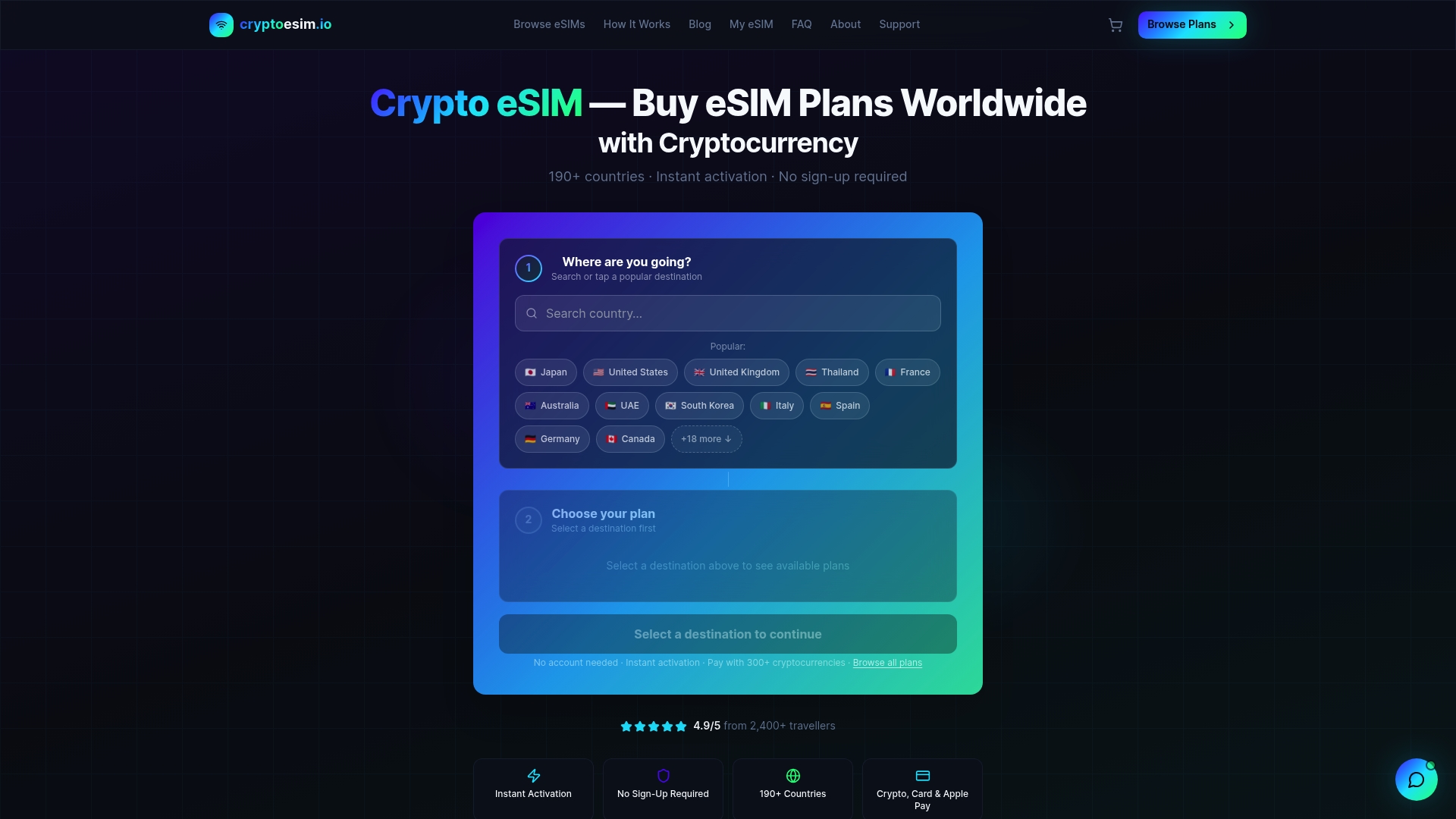
CryptoEsim.io makes the whole process even simpler. You can browse crypto-friendly eSIMs for over 190 countries, pay with Bitcoin, Ethereum, or more than 300 other tokens, and receive your eSIM QR by email in minutes. No account creation, no ID checks, no FX fees. Just pick your plan, pay with crypto, and connect. Whether you’re heading to Southeast Asia for three months or hopping between European cities for a week, the right data plan is a few clicks away.
Frequently asked questions
Which crypto coins can I use to buy eSIM data plans?
Most crypto eSIM providers accept BTC, ETH, and stablecoins like USDT and USDC. Some go further: Uquid supports 100+ cryptos, making it one of the most flexible options available.
How fast is crypto payment confirmation for eSIMs?
Most orders confirm in 5 to 15 minutes. eSIM QR delivery happens automatically by email once the blockchain confirms your transaction, so speed depends mostly on which network you use.
Do I need ID or KYC to buy an eSIM with crypto?
No. Most crypto-focused providers only require an email address. SIMPM is fully decentralized with no KYC, and most crypto-native stores follow the same approach.
Are there any extra fees for paying with crypto?
You pay the listed plan price plus a small network gas fee. USDT on BEP-20 costs around $0.01 in gas, which is far less than the 3% fee most credit card processors charge.
Can I recharge my eSIM with crypto later?
Yes. Uquid and several other providers offer rechargeable eSIM plans where you can top up data using crypto through the same straightforward process.