What is eSIM? A 2026 guide for travelers & nomads

You’re standing at the airport, ready to board a flight to Tokyo, and suddenly realize you forgot to buy a local SIM card. The panic sets in as you imagine navigating a foreign city without mobile data. But what if physical SIM cards were no longer necessary? With eSIM technology, you can download a carrier profile instantly and connect to local networks before your plane even lands. This guide explains what eSIM is, why it’s revolutionizing connectivity for international travelers and digital nomads, and how crypto payments make purchasing plans borderless and seamless.
Table of Contents
- What Is An Esim And How Does It Work?
- Why Esim Matters For International Travelers And Digital Nomads
- Security, Regulatory Concerns, And Evolving Esim Technology
- How To Use Esim With Crypto Payments For Seamless Global Connectivity
- Explore Crypto-Friendly Esim Plans For Global Connectivity
- Frequently Asked Questions About Esim
Key takeaways
| Point | Details |
|---|---|
| Digital SIM technology | eSIM is a reprogrammable chip embedded in devices, eliminating physical card swaps |
| Perfect for global travelers | Instantly switch carriers across 190+ countries without hunting for local SIM vendors |
| Dual number capability | Keep work and personal lines active simultaneously on one device |
| Crypto payment support | Purchase plans with Bitcoin or 300+ tokens, bypassing banking fees and restrictions |
| Enhanced security | Encrypted profiles reduce theft risk and enable remote management |
What is an eSIM and how does it work?
An eSIM is an embedded SIM, a reprogrammable digital chip soldered into devices like smartphones, allowing remote download and switching of carrier profiles without physical cards. Unlike traditional SIM cards you insert into a tray, eSIMs live permanently inside your phone, tablet, or smartwatch. You activate them by scanning a QR code or using a carrier app, downloading a profile directly to the chip.
The technology supports storing multiple carrier profiles simultaneously, typically between 5 and 10 depending on your device. You can switch between these profiles through your settings menu without touching any hardware. This means you could have a home carrier profile for your primary number, a work profile from another provider, and several travel profiles for different countries, all managed digitally.
Most modern smartphones support dual SIM functionality, combining one physical SIM slot with the embedded eSIM. This setup lets you maintain two active numbers at once. You might keep your home number on the physical SIM while activating a local eSIM profile when traveling. Profiles are stored and managed according to GSMA standards, ensuring compatibility across carriers and devices globally.
The activation process is remarkably simple. After purchasing a plan, you receive a QR code via email. Open your phone’s cellular settings, select “Add eSIM,” and scan the code. Within minutes, your new profile downloads and activates. The difference between crypto eSIM and regular eSIM lies primarily in payment methods and privacy features, not the underlying technology.
Pro Tip: Keep your work and personal numbers on separate profiles for easier management and privacy. You can customize which profile handles calls, texts, and data independently.
Why eSIM matters for international travelers and digital nomads
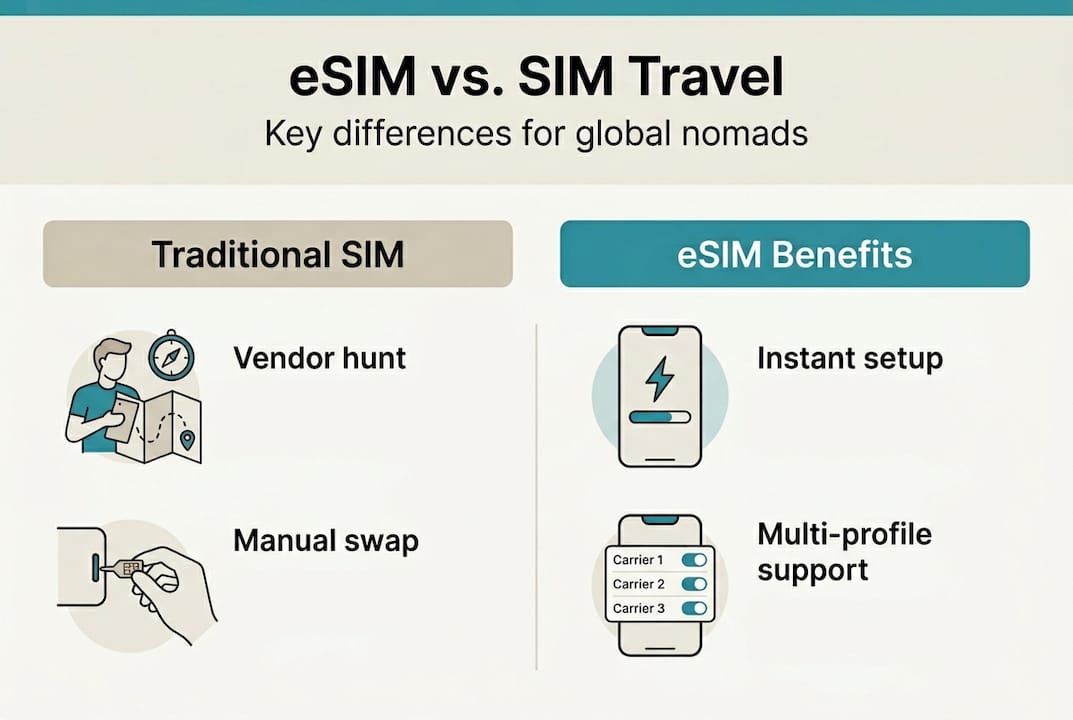
Crossing borders with traditional SIM cards means hunting for local vendors, dealing with language barriers, and swapping tiny cards that inevitably get lost. eSIM eliminates this hassle entirely. Download a local profile before departure or immediately upon landing, and you’re connected without leaving the airport.
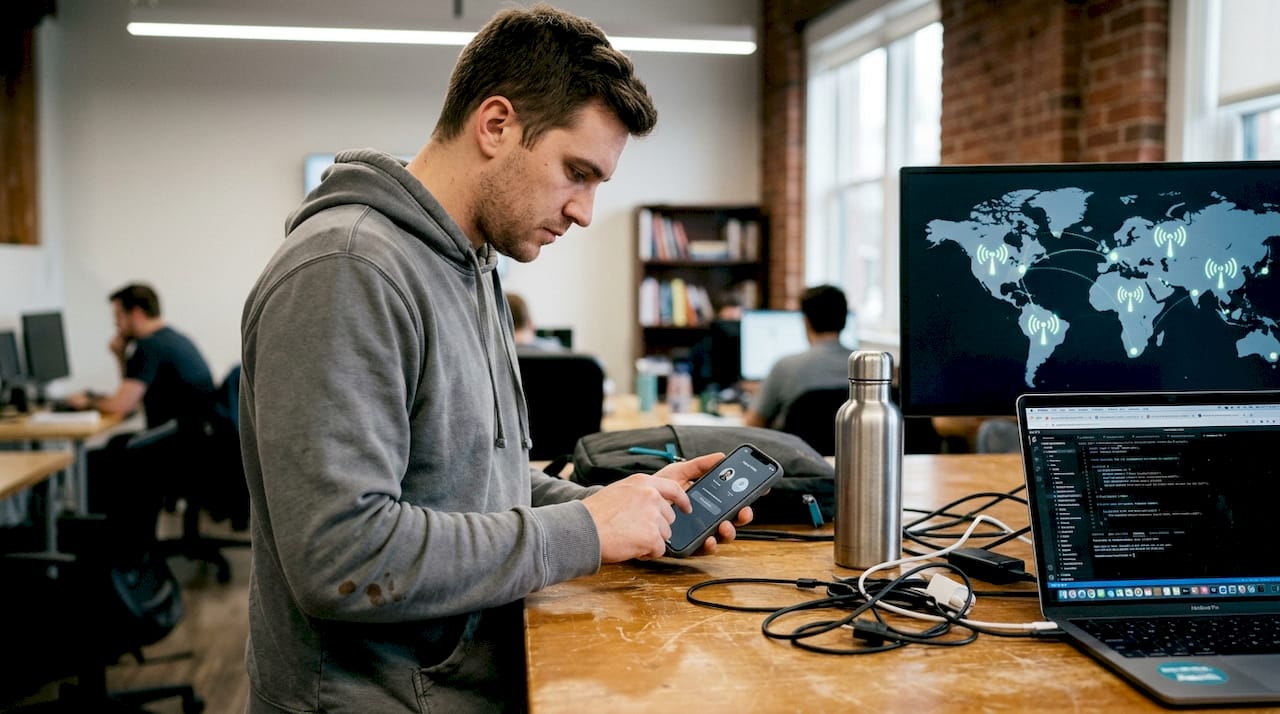
The dual SIM capability becomes invaluable for remote workers managing international clients. Keep your primary business number active on one profile while using local data plans on another. Clients reach you on your usual number, but you avoid expensive roaming charges by routing data through affordable local networks. This separation also helps maintain work boundaries when you’re technically “off the clock” in a different time zone.
Ideal for remote workers and nomads, dual SIM keeps work and home lines separate, while crypto payments enable borderless, fee-free purchases of global plans that reduce constant swapping. Traditional banking often blocks international transactions or applies hefty foreign exchange fees. Cryptocurrency bypasses these restrictions entirely, letting you purchase connectivity anywhere without currency conversion headaches.
Access to regional and global data plans transforms how you manage connectivity. Instead of buying separate SIMs in Thailand, Vietnam, and Cambodia, download one Southeast Asia regional plan covering all three. Many providers offer global plans spanning 100+ countries, perfect for multi-destination trips.
| Feature | Traditional SIM | eSIM | | — | — | | Activation time | 30-60 minutes (find vendor, purchase, swap) | 2-5 minutes (scan QR, download profile) | | Physical handling | Required (risk of loss/damage) | None (fully digital) | | Carrier switching | Buy new card, physically swap | Download new profile instantly | | Multi-country coverage | One SIM per country | Regional/global plans available | | Dual number support | Requires two physical slots | One physical + one eSIM |
The convenience factor extends beyond just activation speed. Lost your phone? Your eSIM profiles are tied to your account, not a physical card you might never recover. Many providers let you transfer profiles to a new device remotely. Compare this to eSIM versus physical SIM for international travel, and the digital option wins on nearly every practical measure.
Cost savings add up quickly. Airport SIM vendors charge premium prices for tourist plans with limited data. Online eSIM providers offer competitive rates, and the best eSIM plans for Europe and Asia travel often cost 50-70% less than airport kiosks. You’re buying directly from aggregators with bulk carrier agreements, not paying airport retail markups.
Pro Tip: Always check local eSIM coverage and compatible plans before you travel to avoid connectivity gaps. Not all carriers support eSIM in every country, and some regions have better provider options than others.
Security, regulatory concerns, and evolving eSIM technology
Security represents one of eSIM’s strongest advantages. Physical SIM cards can be stolen, cloned, or damaged. Someone snatching your phone at a cafe can’t simply pop out the SIM and use it in another device. eSIM profiles are encrypted and tied to your device’s hardware, making unauthorized access significantly harder.
Yet contrasting views exist on eSIM security and convenience. While more secure against theft, potential carrier lock-in concerns some users. If a provider refuses to unlock your eSIM profile, switching becomes difficult. Setup complexity also challenges less tech-savvy users who find QR codes and profile management confusing compared to inserting a physical card.
Regulatory frameworks are still catching up with the technology. Governments require carriers to provide emergency number access (911, 112, etc.) regardless of account status. With eSIM, ensuring this access across multiple downloaded profiles and international roaming scenarios creates technical and legal complexity. User portability regulations, which let you keep your number when switching carriers, must adapt to digital profile transfers.
Data privacy laws vary dramatically by country. European GDPR protections differ from Asian or American standards. When you download an eSIM profile from a foreign carrier, which jurisdiction’s privacy rules apply? These questions remain partially unresolved as of 2026, though industry standards are emerging.
GSMA specifications ensure interoperability between carriers and devices, creating a foundation for global eSIM adoption. The future points toward iSIM (integrated SIM), where the SIM functionality embeds directly into the device’s main processor chip rather than a separate component. This integration promises even better security and efficiency, though regulatory concerns about emergency access and user portability require ongoing attention.
| Technology | Physical Location | Security Level | Flexibility | Adoption Status |
|---|---|---|---|---|
| Traditional SIM | Removable card | Medium (theft risk) | Low (manual swap) | Universal (legacy) |
| eSIM | Embedded chip | High (encrypted profiles) | High (remote download) | Growing (70% of flagships) |
| iSIM | Integrated in processor | Very high (hardware-level) | Very high (fully digital) | Emerging (limited devices) |
Maximizing eSIM security and regulatory compliance requires proactive steps:
- Verify your carrier supports profile unlocking before committing to long-term contracts
- Enable two-factor authentication on accounts managing your eSIM profiles
- Understand which country’s data privacy laws govern your chosen provider
- Test emergency number access after activating new profiles, especially when traveling
- Keep backup documentation of your profile QR codes in secure cloud storage
- Research local regulations if you’re staying in a country long-term with an eSIM
The privacy advantages of crypto eSIM with no KYC requirements appeal to users concerned about data collection. Traditional carriers often require government ID and address verification. Some eSIM providers accepting cryptocurrency skip these requirements, offering anonymous connectivity for privacy-focused travelers.
Pro Tip: When switching providers digitally, confirm unlocking and emergency services compatibility beforehand. A five-minute verification call can prevent hours of troubleshooting later.
How to use eSIM with crypto payments for seamless global connectivity
Purchasing and activating an eSIM with cryptocurrency eliminates banking restrictions and currency conversion fees. Crypto payments enable borderless, fee-free purchases of eSIM plans, ideal for nomads and international travelers who move frequently between countries.
Here’s the step-by-step process:
- Choose a crypto-compatible eSIM provider supporting your destination countries
- Select your data plan based on duration and coverage area
- Proceed to checkout and select cryptocurrency as your payment method
- Send the exact amount of Bitcoin, Ethereum, or other supported tokens to the provided wallet address
- Wait for blockchain confirmation (typically 2-15 minutes depending on the cryptocurrency)
- Receive your eSIM QR code and activation instructions via email
- Open your device settings, navigate to cellular or mobile data options
- Select “Add eSIM” or “Add Cellular Plan”
- Scan the QR code with your camera or enter the activation code manually
- Label your new profile (e.g., “Japan Travel” or “Work Line”)
- Configure which profile handles calls, texts, and data
- Activate the profile and confirm connectivity
The advantages extend beyond convenience. Traditional payment processors often flag international transactions as suspicious, freezing accounts until you verify your travel plans. Cryptocurrency transactions process regardless of your location. You’re in Bali buying a plan for your next stop in Singapore? No problem. No bank calls, no frozen cards, no currency exchange spreads eating into your budget.
Device compatibility checking prevents activation headaches. Before purchasing, verify your phone supports eSIM technology. Most flagship devices from 2020 onward include eSIM capability, but budget models and older phones may not. Check your manufacturer’s specifications or look for the eSIM option in your cellular settings. If it’s there, you’re good to go.
Backing up eSIM profiles digitally protects against device loss or damage. Many providers let you re-download profiles to new devices using your account credentials. Screenshot your QR codes and store them in encrypted cloud storage. If your phone dies mid-trip, you can activate the same plan on a replacement device without repurchasing.
Best practices for managing multiple plans and switching providers:
- Name each profile clearly to avoid confusion when selecting which to use
- Set data limits on individual profiles to prevent overage charges
- Disable profiles you’re not actively using to preserve battery life
- Review your active profiles monthly and delete expired ones
- Keep a spreadsheet tracking which profiles cover which regions and their expiration dates
- Test new profiles immediately after activation to confirm they work before you depend on them
Integration with popular crypto wallets streamlines the payment process. Many eSIM providers accept payments directly from MetaMask, Trust Wallet, or hardware wallets like Ledger. You’re not copying and pasting addresses or worrying about sending to the wrong chain. Connect your wallet, confirm the transaction, and you’re done.
Mobile device integration continues improving. Some providers now offer dedicated apps that manage your eSIM profiles, track data usage, and let you top up with crypto directly from the interface. You can buy eSIM with Bitcoin and manage everything from one dashboard rather than juggling emails and QR codes.
The broader trend toward seamless crypto payments in telecoms for 2026 suggests this integration will only deepen. As cryptocurrency adoption grows, expect more carriers to accept digital payments natively, reducing friction further.
Pro Tip: Use trusted eSIM providers supporting multiple cryptocurrencies for the best experience. Provider diversity means you’re not locked into Bitcoin if Ethereum offers better transaction speeds that day.
Explore crypto-friendly eSIM plans for global connectivity
Ready to experience the freedom of borderless connectivity? CryptoeSIM.io offers eSIM plans covering over 190 countries with full cryptocurrency payment support. Whether you’re island hopping in Southeast Asia, working remotely across Europe, or managing clients from South America, instant activation means you’re connected within minutes of landing.
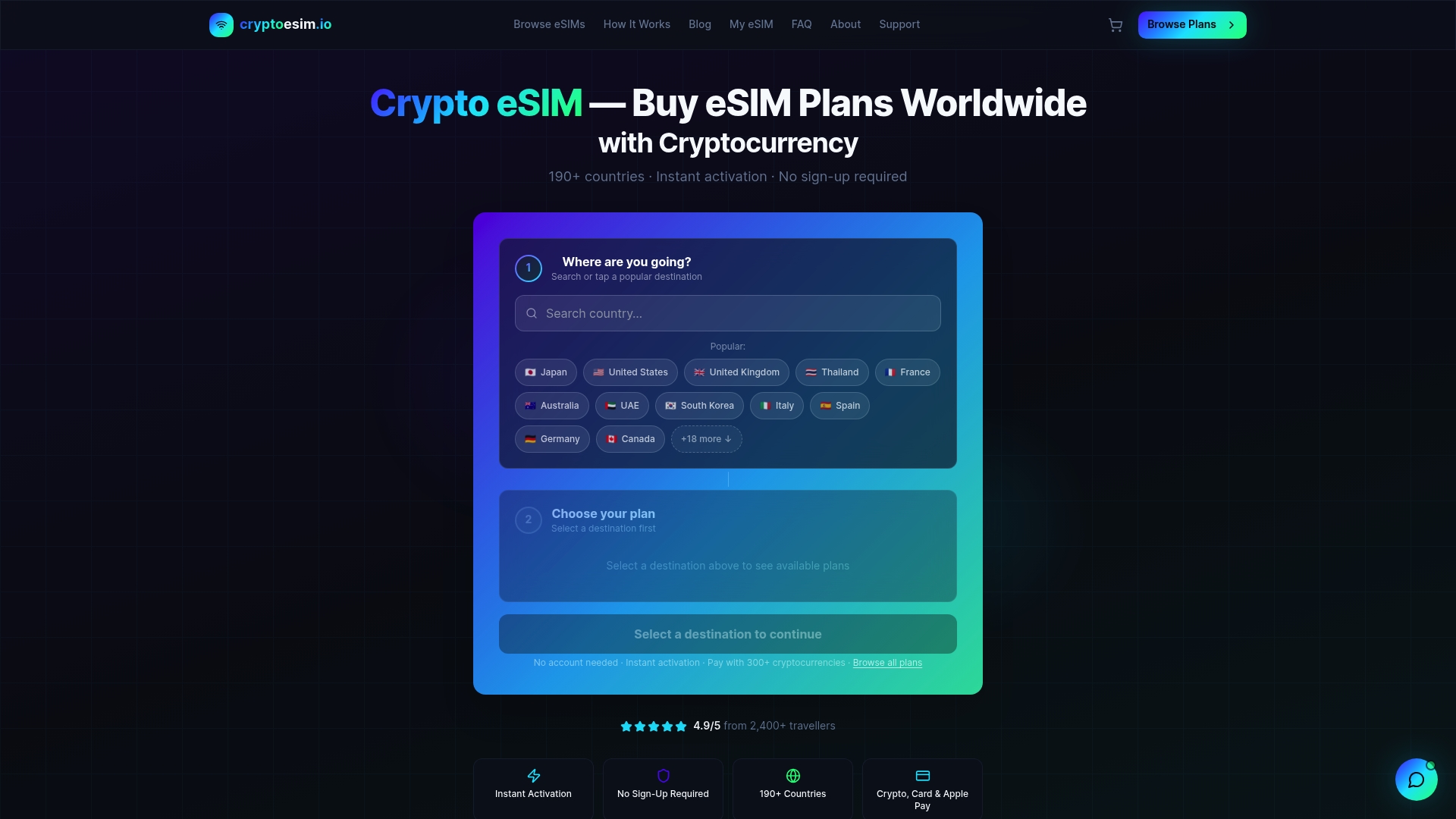
The platform accepts Bitcoin, Ethereum, and 300+ other tokens, plus traditional payment methods like credit cards and Apple Pay. No account creation required. Purchase a plan, receive your QR code, scan and activate. Digital nomads and international travelers choose CryptoeSIM.io for hassle-free global coverage that respects your privacy and eliminates banking restrictions.
Pro Tip: Signing up is quick and lets you activate an eSIM within minutes, with no physical SIM needed. Browse regional plans before your trip to find the best coverage for your route.
Frequently asked questions about eSIM
What devices support eSIM in 2026?
Most flagship smartphones released after 2020 include eSIM capability, including iPhone XS and newer, Samsung Galaxy S20 and newer, and Google Pixel 3 and newer models. Many tablets, smartwatches, and laptops now support eSIM as well. Check your device specifications or cellular settings to confirm compatibility before purchasing a plan.
Can I switch carriers anytime with eSIM?
Yes, you can switch carriers by downloading a new profile, though your device must be unlocked. Carrier-locked phones restrict which profiles you can activate. Once unlocked, switching takes minutes by scanning a new QR code. You can maintain multiple carrier profiles simultaneously and toggle between them as needed.
Is it safe to buy eSIM plans with cryptocurrency?
Cryptocurrency transactions are secure when using reputable providers with established track records. Blockchain technology ensures payment verification without exposing sensitive banking information. The main risks involve sending funds to wrong addresses or using unverified providers. Stick with established eSIM platforms that have customer reviews and clear refund policies.
How does dual SIM function work with eSIM devices?
Dual SIM lets you maintain two active phone numbers on one device, typically combining a physical SIM card with an eSIM profile. You designate which line handles voice calls, texts, and data independently. This setup is perfect for separating work and personal numbers or keeping a home number active while using local data plans abroad.
Do I need internet to activate an eSIM?
Yes, you need an internet connection to download and activate your initial eSIM profile. Use WiFi at the airport, hotel, or cafe to scan the QR code and complete activation. Once activated, the eSIM provides its own data connection. Some devices allow pre-loading profiles before travel, letting you activate them offline by switching in settings.
Can I use the same eSIM profile on multiple devices?
No, eSIM profiles are typically device-specific and tied to your phone’s unique identifier. However, many providers let you purchase multiple profiles under one account or transfer a profile from an old device to a new one. Check your provider’s terms regarding profile transfers and multi-device support before assuming portability.