Why digital SIM cards are essential for global travelers

Most travelers still believe swapping physical SIM cards in every new country is unavoidable. That outdated practice costs you money, time, and peace of mind. Digital SIM cards eliminate these headaches entirely, offering instant connectivity across borders without fumbling with tiny plastic chips at airport kiosks. For tech-savvy international travelers and digital nomads, eSIMs are embedded SIM chips programmable over the air, replacing physical SIM cards in many modern devices. This shift transforms how you stay connected globally, especially when paired with crypto-friendly payment options that prioritize privacy and speed.
Table of Contents
- Key takeaways
- What are digital SIM cards and how do they work
- Advantages of digital SIM cards for international travelers and digital nomads
- Integrating crypto-friendly payments with digital SIM services
- Choosing and managing digital SIM providers for seamless travel
- Explore crypto-enabled digital SIMs at CryptoeSIM.io
- Frequently asked questions about digital SIM cards and crypto payments
Key Takeaways
| Point | Details |
|---|---|
| No physical SIM swaps | Digital SIMs eliminate the need to physically swap SIM cards when traveling and enable immediate cross border connectivity. |
| Instant cross border switching | Profiles stored on the eSIM allow switching between regional carriers in minutes without swapping any hardware. |
| Multiple profiles on device | An eSIM can hold several carrier profiles so you can run personal and work or local plans on one device. |
| Crypto payment privacy | Crypto friendly payment options simplify topping up data plans while prioritizing user privacy and fast setup. |
What are digital SIM cards and how do they work
A digital SIM card is software-based connectivity that lives inside your device rather than a removable plastic chip. The most common form is the eSIM, an embedded chip soldered directly into smartphones, tablets, and laptops during manufacturing. Unlike traditional SIMs that require physical insertion, eSIMs use over-the-air provisioning to download carrier profiles directly to your device.
When you purchase a data plan, the provider sends a QR code or activation link. Scanning this code installs the carrier profile onto your eSIM chip within seconds. Your device can store multiple profiles simultaneously, letting you switch between carriers without ejecting anything. This technology relies on the GSMA standard, ensuring compatibility across networks worldwide.
Most flagship smartphones released after 2018 support eSIM technology. Apple iPhones from XS onward, Samsung Galaxy models from S20 forward, and Google Pixel phones from Pixel 3 upward all include embedded SIM chips. Many iPads and cellular-enabled laptops now ship with eSIM capability as standard equipment. You can verify compatibility in your device settings under cellular or mobile network options.
The technical process works through remote SIM provisioning. Your device contacts the carrier’s subscription manager server, authenticates your purchase, and downloads the encrypted profile. This happens entirely through your existing internet connection, whether WiFi or mobile data. The profile contains all necessary credentials to connect to the carrier’s network, including authentication keys and network access rules.
Key advantages of this digital approach include:
- Manufacturers can design slimmer, more water-resistant devices without SIM card trays
- Users avoid the risk of losing or damaging tiny physical cards during travel
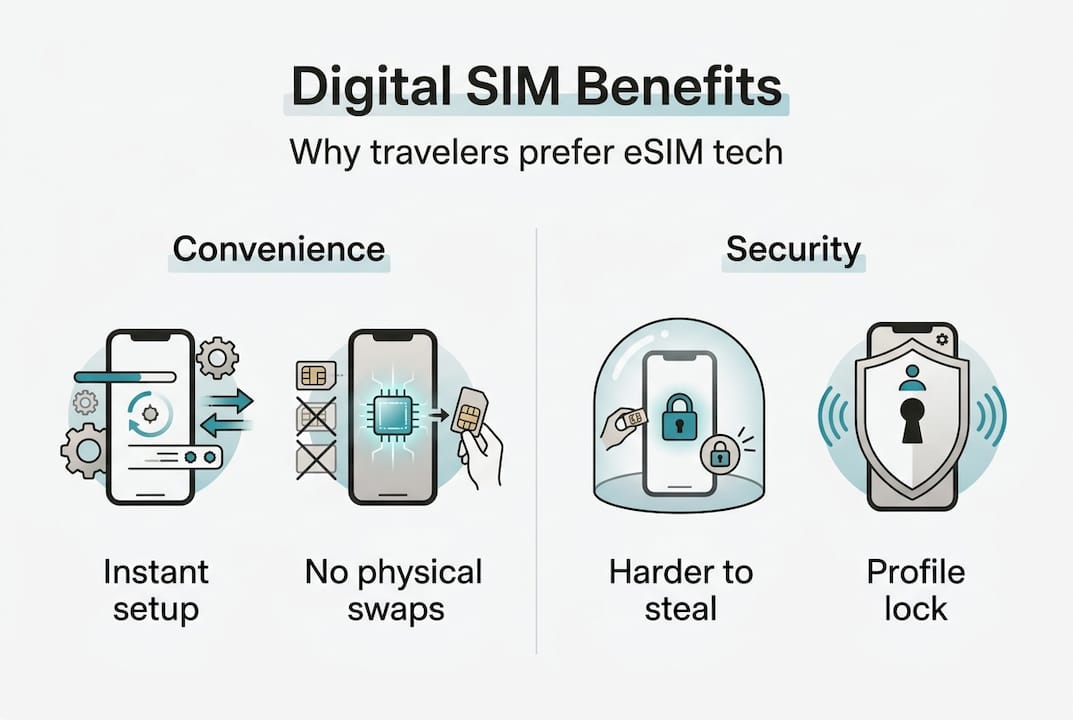
- Switching carriers takes minutes instead of visiting stores or waiting for mail delivery
- Multiple profiles enable simultaneous use of personal and work numbers on one device
Understanding crypto eSIM versus regular eSIM options helps you choose providers that match your privacy preferences and payment methods. The underlying technology remains identical, but payment flexibility varies significantly between providers.
Advantages of digital SIM cards for international travelers and digital nomads
Traditional roaming charges can exceed $10 per megabyte in some regions, turning a simple map lookup into a $50 mistake. Digital SIM cards let you activate local carrier rates instantly without physically visiting stores or negotiating with staff who may not speak your language. You compare plans, purchase data, and connect within minutes of landing.
Managing multiple country profiles becomes effortless when everything lives in your device settings. A digital nomad working across Southeast Asia can maintain active profiles for Thailand, Vietnam, and Indonesia simultaneously. When crossing borders, you simply toggle to the appropriate profile in your phone’s settings. No more juggling physical SIM cards in tiny plastic cases or worrying about losing them in transit.

| Feature | Physical SIM | Digital SIM |
|---|---|---|
| Activation time | 30-90 minutes (store visit) | 2-5 minutes (scan QR code) |
| Switching carriers | Requires new card purchase | Instant profile switch |
| Risk of loss/damage | High (tiny removable chip) | Zero (embedded in device) |
| Multiple profiles | Requires dual SIM phone | Stores 5-10+ profiles digitally |
| Emergency backup | Need spare physical card | Download new profile anywhere |
The ability to maintain multiple active data plans transforms how you handle connectivity. You might keep a global roaming profile for emergencies while using cheaper local profiles for daily browsing. Some travelers maintain profiles in their three most-visited countries, ready to activate the moment they land. This flexibility proves invaluable when plans change unexpectedly or you need backup connectivity.
Security improvements extend beyond convenience. Physical SIM cards can be removed from stolen phones, potentially compromising your number and associated accounts. Embedded digital SIMs require device-level authentication to modify, adding a layer of theft protection. If someone steals your phone, they cannot simply pop out the SIM to use in another device.
Pro Tip: Before traveling, download carrier profiles for your destination countries while still connected to reliable WiFi. This ensures you can activate service immediately upon arrival, even if airport WiFi is congested or unreliable. Store backup QR codes in your email or cloud storage for emergency reactivation.
Cost comparisons reveal dramatic savings. A week in Japan might cost $80 in roaming fees with your home carrier, while a local digital SIM plan provides the same data for $15. Multiply this across multiple countries and frequent travel, and annual savings easily reach hundreds of dollars. The math becomes even more compelling for digital nomads who change locations monthly.
Privacy-conscious travelers appreciate reduced data sharing requirements. Many digital SIM providers, especially those accepting cryptocurrency, require minimal personal information compared to traditional carriers demanding passport copies, proof of address, and banking details. This lighter documentation footprint appeals to those who value digital privacy.
Integrating crypto-friendly payments with digital SIM services
Cryptocurrency transforms digital SIM purchases from a banking transaction into a borderless value transfer. When you use crypto for mobile data payments, you bypass currency conversion fees that typically add 3-5% to international purchases. Bitcoin, Ethereum, and stablecoins move at the same cost whether you’re buying from Thailand, Argentina, or Norway.
Traditional payment methods create friction for international travelers. Your bank might flag purchases from unfamiliar countries as suspicious, freezing your card at the worst possible moment. Credit card networks charge merchants higher fees for cross-border transactions, costs often passed to consumers through inflated prices. Cryptocurrency eliminates these intermediaries entirely, enabling direct peer-to-peer value transfer.
Privacy advantages extend beyond simple anonymity. Many crypto-accepting digital SIM providers operate without mandatory know-your-customer requirements. You can purchase eSIM plans with Bitcoin using only an email address, avoiding the passport scans and address verification demanded by traditional carriers. This approach particularly appeals to journalists, activists, and privacy advocates working in sensitive regions.
Crypto payments enable seamless, secure, and private mobile data top-ups globally, avoiding traditional banking restrictions.
Transaction speed matters when you need connectivity immediately. Cryptocurrency payments confirm within minutes to hours depending on network congestion, compared to 2-5 business days for international bank transfers. This immediacy means you can purchase a data plan, receive your activation code, and start browsing before your flight even boards.
Key benefits of crypto integration include:
- No chargebacks, protecting providers from fraud and enabling lower prices
- Irreversible transactions that settle faster than credit card authorizations
- Access for the unbanked or travelers from countries with restricted banking systems
- Protection against currency devaluation when traveling in economically unstable regions
- Simplified accounting for digital nomads managing income and expenses across borders
Security considerations favor cryptocurrency for digital purchases. When you pay with a credit card, you share your card number, expiration date, CVV code, and billing address with the merchant. Each transaction creates another potential breach point if the merchant’s database gets compromised. Cryptocurrency transactions reveal only your wallet address, a pseudonymous identifier that cannot be used to drain your funds or steal your identity.
Pro Tip: Use stablecoins like USDC or USDT for digital SIM purchases to avoid Bitcoin’s price volatility. You maintain crypto’s privacy and speed benefits while eliminating the risk that your $20 data plan costs $25 by the time the transaction confirms due to exchange rate fluctuations.
The global accessibility of cryptocurrency proves essential in countries with capital controls or restricted banking systems. Travelers in Argentina, Turkey, or Venezuela face strict limits on foreign currency purchases and international transactions. Cryptocurrency bypasses these restrictions entirely, ensuring you can purchase connectivity regardless of local banking regulations.
Choosing and managing digital SIM providers for seamless travel
Selecting the right digital SIM provider requires evaluating several critical factors beyond advertised prices. Coverage breadth, transparent pricing, and crypto payment options form the foundation of a quality provider. A cheap plan means nothing if the carrier lacks coverage in your destination or hides activation fees in fine print.
Start by verifying country-specific coverage for your travel itinerary. Providers claiming global coverage may only partner with one carrier per country, potentially offering weak signals in rural areas. Research which local networks each provider uses and cross-reference with coverage maps. A provider partnering with the dominant carrier in each country delivers better reliability than one using budget networks.
Evaluating providers systematically:
- Check supported countries against your travel plans for the next 6-12 months
- Compare data allowances and validity periods across providers for identical destinations
- Verify accepted payment methods include your preferred cryptocurrency or payment card
- Read privacy policies to understand data collection and sharing practices
- Test customer support responsiveness before purchasing by asking pre-sales questions
- Review refund policies for unused data or service issues
Setting up multiple SIM profiles varies slightly by device manufacturer but follows a similar pattern. On iPhones, navigate to Settings, then Cellular, and tap Add eSIM. Android devices typically use Settings, then Network & Internet, then Mobile Network, and select the plus icon to add a carrier. Scan the QR code provided by your digital SIM provider, assign a label like “Japan Travel” or “Work Line,” and choose whether to use it for data, calls, or both.
| Provider Feature | What to Check | Red Flags |
|---|---|---|
| Coverage | Partner networks in destination countries | Vague claims like “global coverage” without specifics |
| Pricing | Total cost including taxes and activation | Hidden fees revealed only at checkout |
| Data policies | Fair use limits and throttling thresholds | Unlimited claims with buried speed restrictions |
| Payment options | Cryptocurrency, cards, or both accepted | Crypto payments requiring KYC verification |
| Support | Live chat or email response times | Only FAQ pages with no human contact option |
Monitoring data usage prevents unexpected overages or service interruptions. Most devices display cellular data consumption in settings, broken down by app. Set usage alerts at 75% and 90% of your plan limit to avoid running out at critical moments. Many digital SIM providers offer apps that show real-time usage and enable instant top-ups.
Common pitfalls include purchasing plans for the wrong region (buying a Europe plan when you need Asia coverage), failing to activate before your existing service expires, or not verifying device compatibility before purchase. Always download and test your digital SIM profile while still connected to reliable internet, confirming it appears in your device settings and shows the correct carrier name.
Comparing eSIM plans for Europe and Asia travel reveals significant price variations for identical data amounts. A 10GB plan might cost $25 from one provider and $45 from another, with the only difference being brand recognition. Lesser-known providers often deliver identical service through the same underlying carrier networks at lower prices.
Privacy-focused travelers should prioritize providers offering crypto eSIM options without KYC requirements. These services typically request only an email address for delivering activation codes, avoiding the extensive personal data collection standard among traditional carriers. This minimal data approach reduces your digital footprint and limits exposure in potential data breaches.
Explore crypto-enabled digital SIMs at CryptoeSIM.io
Navigating the digital SIM landscape becomes simpler when you choose providers designed specifically for crypto-savvy travelers. CryptoeSIM.io delivers instant connectivity across 190+ countries with straightforward Bitcoin and cryptocurrency payments. You skip account creation entirely, receiving your eSIM activation code via email within minutes of payment confirmation.
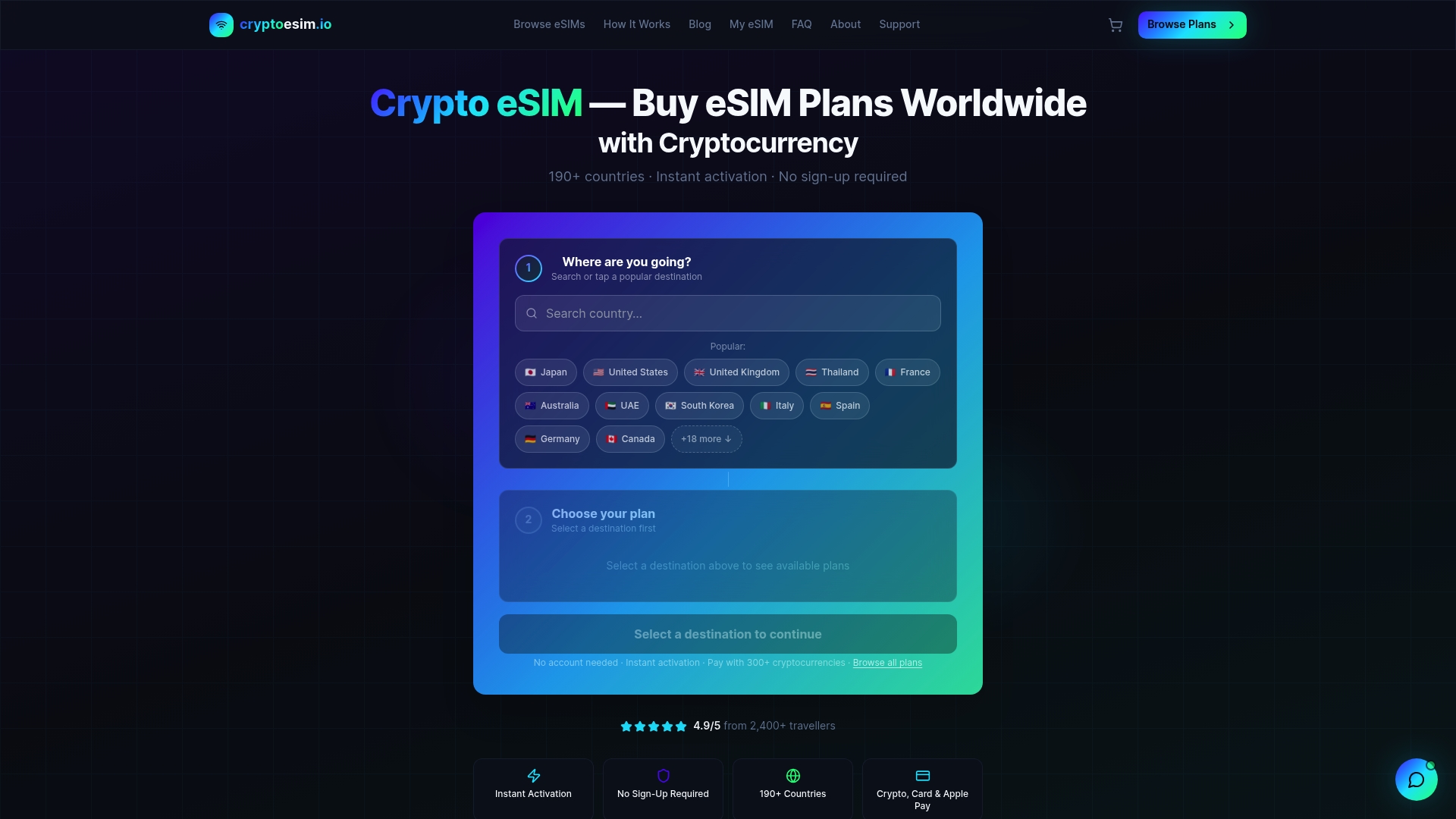
The platform eliminates common frustrations like hidden fees, complex verification processes, and limited payment options. Whether you need data for a weekend trip or extended digital nomad stays, competitive pricing and transparent terms let you budget accurately. The combination of broad coverage, instant activation, and privacy-focused purchasing makes staying connected abroad as simple as scanning a QR code. Explore current plans and coverage at CryptoeSIM.io or dive deeper into connectivity strategies through the CryptoeSIM.io blog.
Frequently asked questions about digital SIM cards and crypto payments
What devices support digital SIM cards?
Most smartphones released after 2018 include eSIM capability, including iPhone XS and newer, Samsung Galaxy S20 and later, and Google Pixel 3 onward. Many iPads, cellular-enabled laptops, and smartwatches also support digital SIM technology. Check your device specifications or settings menu under cellular options to confirm compatibility before purchasing.
Is it safe to use crypto for mobile data payments?
Cryptocurrency payments for digital SIM services offer enhanced security compared to credit cards because you never share banking credentials or personal financial information with merchants. Transactions are irreversible and pseudonymous, reducing fraud risk. Choose reputable providers with established track records and use secure wallet software to protect your funds during transactions.
How do I switch between carrier profiles on a digital SIM?
Switching profiles takes seconds through your device settings. On iPhone, go to Settings, then Cellular, and tap the profile you want to use. On Android, navigate to Settings, then Network & Internet, select Mobile Network, and choose your preferred profile. You can toggle between profiles unlimited times without affecting stored data or credentials.
Are there any hidden fees with digital SIM services?
Reputable providers display total costs upfront, including data allowances, validity periods, and any activation fees. Watch for vague terms like “fair use policies” that might throttle speeds after certain thresholds. Always review the complete pricing breakdown before purchase and avoid providers that only reveal full costs at checkout.
Can digital SIM cards replace physical SIMs completely for travelers?
For most international travelers, digital SIMs provide complete replacement functionality with added convenience. However, some countries have limited eSIM provider options, and certain budget phone models still lack embedded SIM chips. Carrying one physical SIM as emergency backup remains wise until eSIM adoption reaches universal coverage. Review the ultimate crypto eSIM guide for comprehensive setup and troubleshooting strategies.