How crypto enables mobile payments for travelers in 2026

You can now buy a working eSIM data plan for 200+ countries in under two minutes, pay with Bitcoin or a stablecoin, skip the ID check entirely, and receive a scannable QR code before your coffee cools. No bank approval. No foreign exchange desk. No waiting. Crypto-native eSIM providers like Airhub, Cryptorefills, SIMPM, and Uquid have quietly made this the new normal for digital nomads and frequent flyers who refuse to let a declined card strand them without data in a foreign airport.
Table of Contents
- Why mobile payments matter for global connectivity
- How cryptocurrency enables instant, borderless mobile payments
- Crypto vs traditional payments: Fees, speed, and flexibility
- Risks, challenges, and best practices for crypto-powered connectivity
- The real-world impact and future outlook for crypto mobile payments
- The overlooked truth: Why privacy and no-KYC matter more than fees
- Unlock crypto-powered connectivity today
- Frequently asked questions
Key Takeaways
| Point | Details |
|---|---|
| Cryptocurrency unlocks global connectivity | International travelers can pay for eSIM data plans instantly from anywhere, without bank or passport restrictions. |
| Fees are significantly lower | Crypto payments average less than 1.5% in fees compared to traditional 4–7% rates for cross-border services. |
| Privacy and borderless payments matter | No-KYC crypto payments allow international nomads to avoid ID checks and keep their travel anonymous. |
| Stablecoins provide stability | Stablecoin payments mitigate volatility, making them the best choice for larger eSIM purchases and frequent remittances. |
| Challenges can be managed | Volatility risks and regulatory variations exist, but travelers can minimize issues by following expert practices. |
Why mobile payments matter for global connectivity
Reliable data is the backbone of modern travel. Whether you are closing a client deal from a café in Lisbon or navigating a transit hub in Bangkok, a dropped connection costs real money and real stress. Yet the traditional path to mobile data abroad is riddled with friction.
Here is what most travelers run into:
- Carrier roaming fees that can reach $10 or more per day, billed without warning
- Local SIM purchases that require a passport, a local address, or a minimum stay
- Credit card declines triggered by foreign transaction flags or issuer restrictions
- Bank wire delays that take 1 to 5 business days, useless when you land in 3 hours
- Currency conversion fees stacked on top of every card swipe abroad
The eSIM vs. physical SIM comparison already shows that digital SIMs remove the hardware problem. But the payment layer is where most travelers still get stuck. Traditional payment rails were built for domestic, verified, single-currency transactions. They were not designed for someone buying a 10-day data plan in Thailand while sitting in a departure lounge in Germany.
“Crypto fills the gap for privacy-focused, borderless mobile data payments, ideal for nomads avoiding KYC and foreign exchange friction. Stablecoins further mitigate volatility concerns.” — crypto-native eSIM store lessons
The result is a payment mismatch that crypto solves elegantly. Blockchain transactions have no concept of borders, business hours, or issuer approval queues. That is not a feature. That is the entire point.
How cryptocurrency enables instant, borderless mobile payments
The mechanics are simpler than most people expect. When you choose a crypto payment option on an eSIM platform, the process follows a clean sequence:
- Select your destination country and data plan
- Choose your preferred cryptocurrency at checkout
- Send the exact amount to the generated wallet address or scan the payment QR
- Wait for one blockchain confirmation (typically 10 to 60 seconds for most networks)
- Receive your eSIM QR code instantly via email or on-screen
That fifth step is the key differentiator. Instant QR code delivery after blockchain confirmation means you are connected within minutes, not hours. No-KYC purchases mean you never hand over a passport scan or a utility bill just to buy mobile data.
Coverage is not a concern either. Major crypto-friendly eSIM providers support between 160 and 200+ countries, covering virtually every destination a traveler or remote worker would visit. Accepted coins typically include BTC, ETH, USDT, USDC, SOL, and hundreds of additional tokens depending on the platform.
| Feature | Crypto payment | Card payment |
|---|---|---|
| ID required | No | Sometimes |
| Processing time | Under 1 minute | Instant to 24 hrs |
| Decline risk | Very low | Moderate to high |
| Cross-border fees | Minimal | 1.5% to 3% |
| Privacy level | High | Low |
Our crypto payment guide walks through the full process step by step, and the privacy benefits of crypto eSIMs go deeper on why no-KYC matters for frequent travelers.
Pro Tip: Use a network with low gas fees, like Polygon or Solana, when buying smaller data plans. You will avoid paying more in transaction fees than the plan itself costs.
Crypto vs traditional payments: Fees, speed, and flexibility
Fees are where crypto makes its strongest case. Crypto payment fees average just 0.2% to 1.5%, compared to the 4% to 7% that traditional bank transfers and card networks charge. The World Bank pegs the average cost of a $200 cross-border transfer at 6.49%. That gap is not trivial when you are buying data plans regularly across multiple countries.
Speed matters just as much. A bank wire to a foreign provider can take 1 to 5 business days. A crypto transaction settles in seconds to minutes depending on the network. For a traveler who just landed and needs data now, that difference is everything.
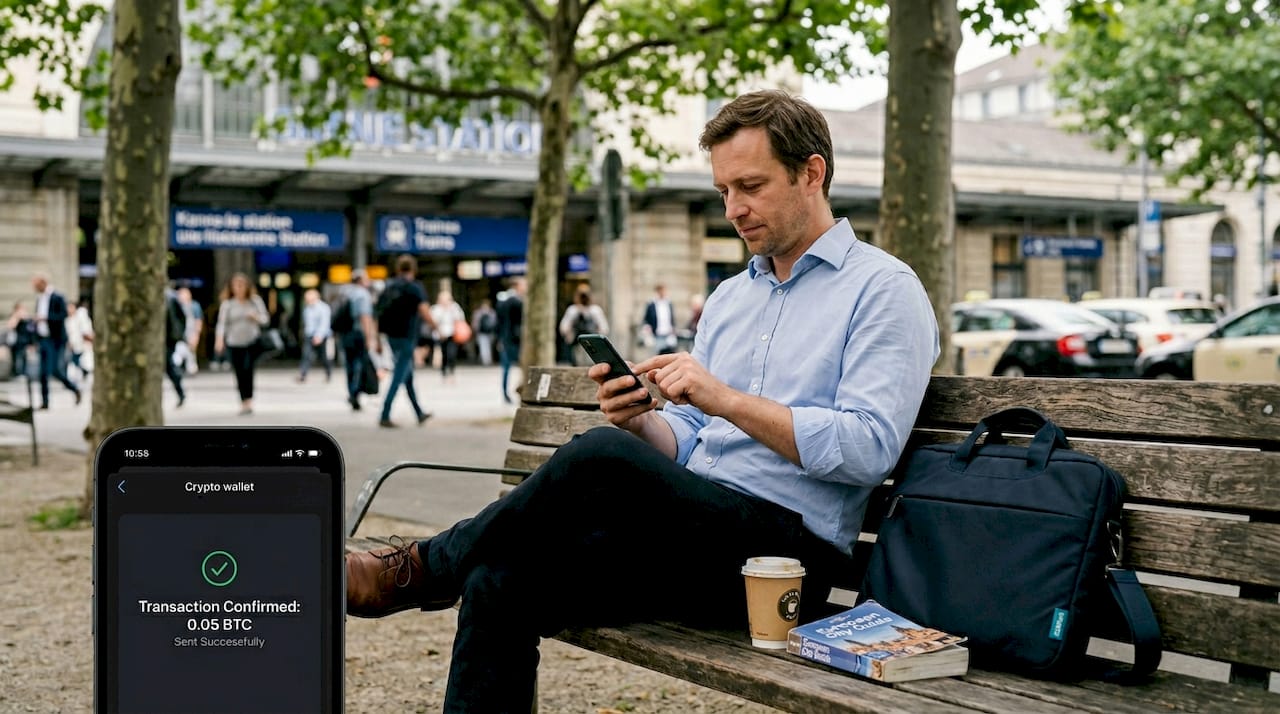
Stablecoins have emerged as the practical sweet spot. Stablecoin cross-border volumes hit $390 to $400 billion in 2025, driven by freelancers, remote workers, and travelers who want crypto’s speed without the price swings. USDT and USDC are pegged to the US dollar, so the amount you send is the amount that arrives, no surprises.
Key fee comparison:
- Bitcoin or Ethereum: 0.5% to 1.5% network fees, slight volatility window during confirmation
- Stablecoins (USDT, USDC): 0.1% to 0.5% on low-fee networks, price-stable
- Credit cards: 1.5% to 3% processing plus potential foreign transaction fees
- Bank transfers: 3% to 7% total cost including FX spread and wire fees
Understanding how a blockchain payment system actually settles transactions helps explain why costs are so much lower. There is no correspondent bank chain, no currency conversion desk, and no intermediary taking a cut at each step.
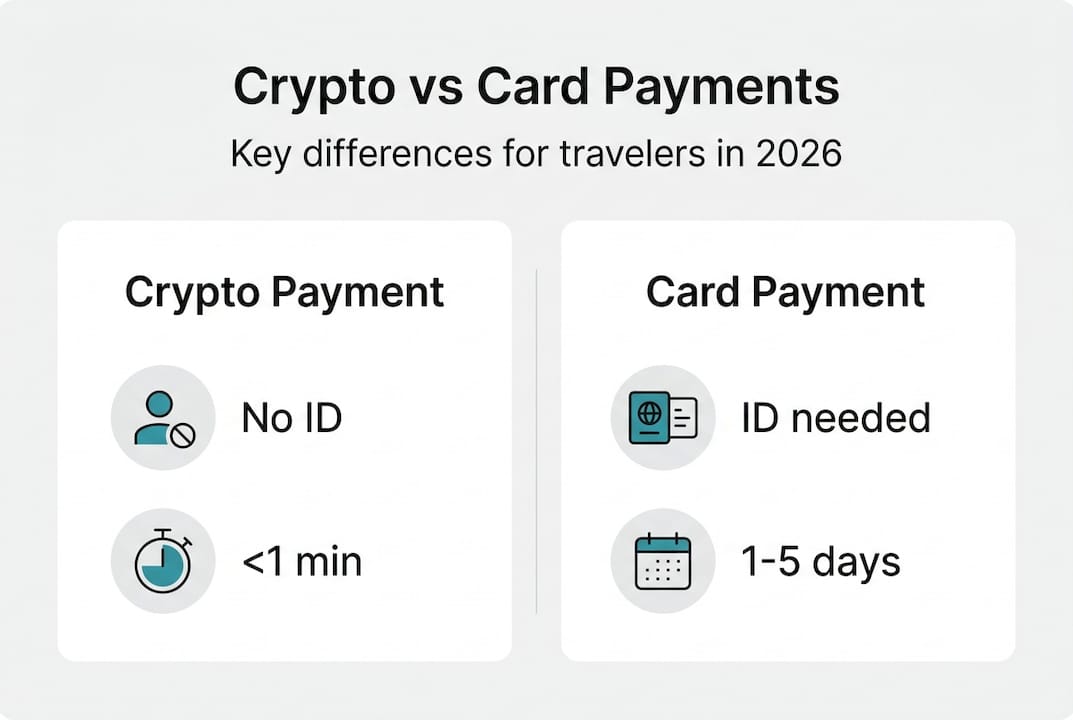
For very small transactions under $5, traditional card payments can occasionally be more practical since some blockchain networks charge flat fees that eat into tiny amounts. Stablecoins on layer-2 networks largely solve this, but it is worth checking before you pay. Our multi-currency payments for eSIM guide covers which coins work best for which plan sizes.
Risks, challenges, and best practices for crypto-powered connectivity
Crypto payments are not without friction. Volatility, multi-chain complexity, and regulatory variance are the three challenges that come up most often. Here is how to handle each one.
Volatility: BTC and ETH prices can shift 2% to 5% in minutes. If you are paying with a volatile coin, the window between initiating and confirming a transaction can change your effective cost. The fix is simple: use stablecoins for payments whenever possible.
Multi-chain complexity: Not every provider accepts every coin on every network. Sending USDT on the wrong chain can result in lost funds. Always confirm the network (ERC-20, TRC-20, BEP-20) before sending.
Regulatory variance: Crypto regulations differ significantly by country. Some nations restrict crypto transactions entirely, while others have no rules at all. Cross-border payment risks are real, and cards still offer chargeback protections that crypto does not.
Best practices for a smooth crypto eSIM purchase:
- Choose a provider that supports stablecoins on low-fee networks
- Confirm the exact wallet address and network before sending
- Keep a small amount of ETH or SOL for gas fees in your wallet
- Save the eSIM QR code and confirmation email immediately after delivery
- Check local crypto regulations if traveling to regions with known restrictions
“Cards convert to fiat at the point of sale and are not natively borderless. Stablecoins are best for payments where speed, privacy, and cost matter most.” — cross-border payments 2025
Pro Tip: Before a big trip, pre-load a non-custodial wallet with USDC on a low-fee network. You will have instant, stable purchasing power for eSIM plans without touching a bank or card. See our crypto eSIM usage tips for a full wallet setup walkthrough, and explore seamless crypto payments for the latest provider options. The blockchain development landscape also explains why multi-chain support is still maturing.
The real-world impact and future outlook for crypto mobile payments
The shift is already happening. Growing crypto adoption for purchasing mobile services among travelers and remote workers is accelerating as more people hold digital assets and more providers accept them. This is not a niche trend anymore.
What is driving it:
- Privacy demand: More travelers want to buy services without handing over personal data to foreign companies
- Global coverage: Crypto works the same in 200 countries. Your card does not.
- Speed expectations: Instant delivery has become the baseline expectation for digital services
- Remote work growth: Distributed teams need reliable, fast, globally consistent connectivity solutions
- Stablecoin maturity: The volatility objection is largely solved for payments, removing the last major barrier
Looking ahead, the next wave of innovation points toward embedded crypto payments inside travel apps, automatic eSIM top-ups triggered by wallet balances, and regulatory frameworks that legitimize crypto payments in more markets. The 2026 crypto adoption trends suggest that mainstream acceptance is accelerating, not slowing.
For travelers and remote workers, the practical implication is clear. Secure global data access through crypto payments is no longer experimental. It is a reliable, cost-effective, and increasingly standard way to stay connected anywhere on the planet.
The overlooked truth: Why privacy and no-KYC matter more than fees
Most guides focus on fees. We think that misses the bigger point.
When you buy an eSIM with crypto, you are not just saving 3% on transaction costs. You are opting out of a data collection system that most travelers never think about. Every card swipe, every SIM registration, every carrier account creates a record tied to your identity, your location, and your travel patterns.
Crypto fills the gap for privacy-focused, borderless mobile data payments in a way that no card or bank transfer can replicate. For digital nomads, journalists, researchers, or anyone traveling through regions with surveillance concerns, that is not a minor convenience. It is a meaningful layer of protection.
The no-KYC travel solutions available today are not workarounds. They are the intended design of decentralized payment systems applied to a real, everyday need. True frictionless mobility means not just fast data, but data access that does not require you to prove who you are to a foreign telecom company first.
Unlock crypto-powered connectivity today
You now have a clear picture of why crypto payments are reshaping how travelers and remote workers access mobile data. Faster transactions, lower fees, genuine privacy, and coverage across 190+ countries are not promises. They are the current reality for anyone willing to use the right tools.
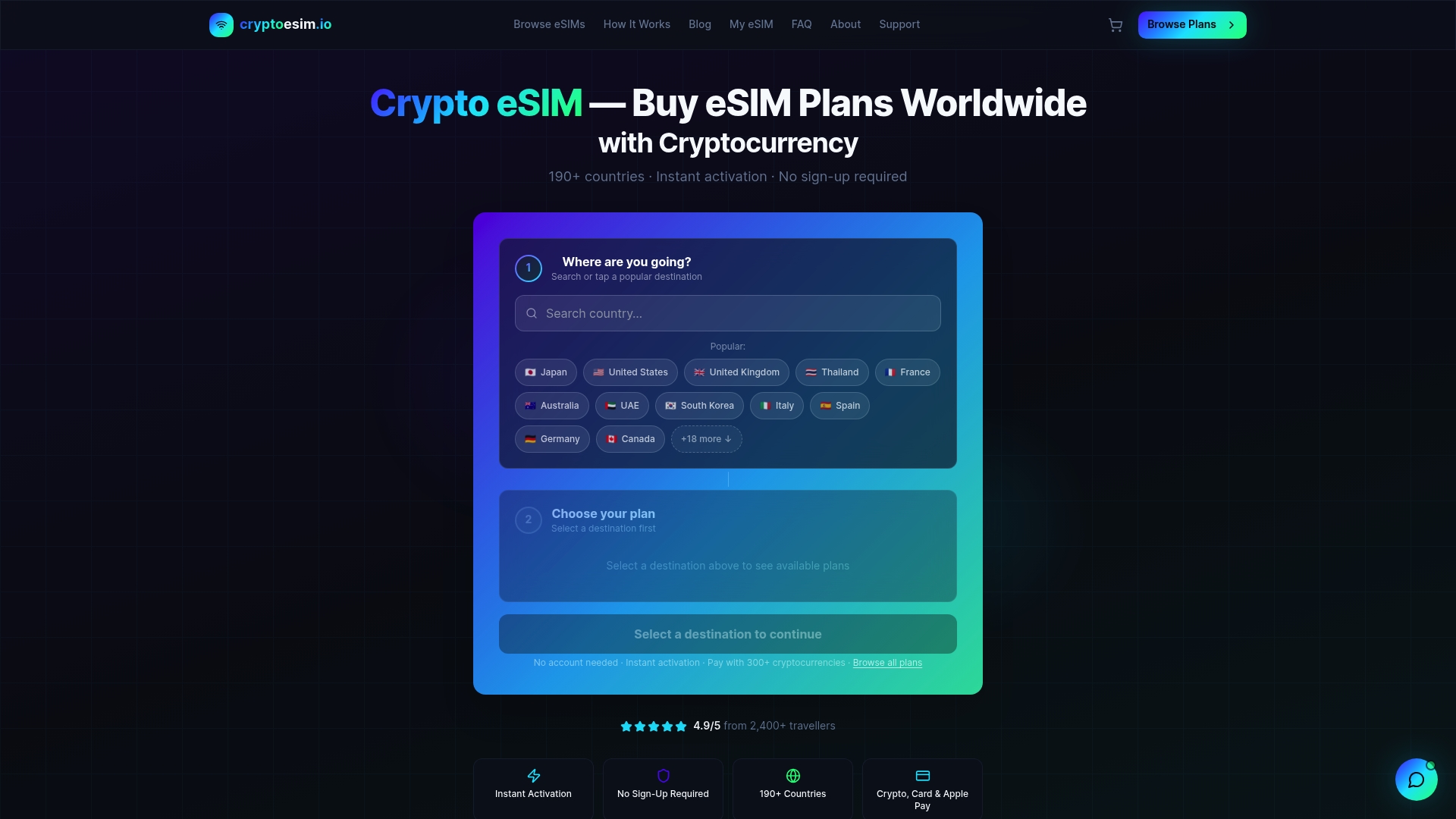
At CryptoEsim.io, you can buy eSIMs with crypto using Bitcoin, Ethereum, or over 300 other tokens, with no account required and instant QR code delivery. Plans cover 190+ countries, and the entire checkout takes under two minutes. Whether you are a digital nomad planning your next move or a business traveler who needs reliable data on short notice, crypto-powered eSIM connectivity is ready when you are.
Frequently asked questions
Which cryptocurrencies are accepted for eSIM data plan payments?
Most providers support BTC, ETH, USDT, USDC, and SOL, covering both native coins and popular stablecoins. Some platforms extend this to 300 or more tokens.
Do I need to verify my identity to buy eSIMs with crypto?
No ID is required for most crypto eSIM purchases. You do not need to submit a passport, address, or any personal documents.
How do crypto payment fees compare to card or bank transfer?
Crypto fees average 0.2–1.5%, significantly lower than the 4–7% typical of card or bank transfer methods for cross-border transactions.
Can I use crypto to buy eSIM data in any country?
Crypto payments are supported for eSIM plans covering 160 to 200+ countries, with instant delivery after payment confirmation.
Are stablecoins safer for mobile payments than BTC or ETH?
Yes. Stablecoins dominate cross-border utility because they eliminate price volatility, making USDT and USDC the preferred choice for predictable payment amounts.
Recommended
- CryptoeSIM.io — Buy eSIMs with Crypto | 190+ Countries
- CryptoeSIM.io — Buy eSIMs with Crypto | 190+ Countries
- CryptoeSIM.io — Buy eSIMs with Crypto | 190+ Countries
- CryptoeSIM.io — Buy eSIMs with Crypto | 190+ Countries
- Blockchain-based payment system | Blockchain software development company | Bitecode