Why Crypto for Subscription Services: 2026 Guide

TL;DR:
- Crypto subscription payments offer lower fees, faster settlement, and global reach compared to traditional card methods. They eliminate chargeback risk and serve underbanked and international customers more effectively. Implementing on-chain billing with smart contracts enables automated, reliable recurring payments for targeted segments.
Cryptocurrency is the most cost-effective and globally accessible payment method for subscription services today. The core reason why crypto for subscription services makes financial sense is simple: crypto processing fees range from 0.23% to 1%, compared to 1.5%–3.5% for traditional card networks. That fee gap compounds fast for any business billing thousands of customers monthly. On-chain billing, the technical term for blockchain-based recurring payments, removes bank intermediaries entirely. Stablecoins like USDC and USDT add price stability to the equation, making crypto subscriptions practical for both merchants and customers. Crypto payment adoption grew 82% from 2024 to 2026, driven by exactly these cost and speed advantages.
What are the main advantages of crypto payments for subscription services?
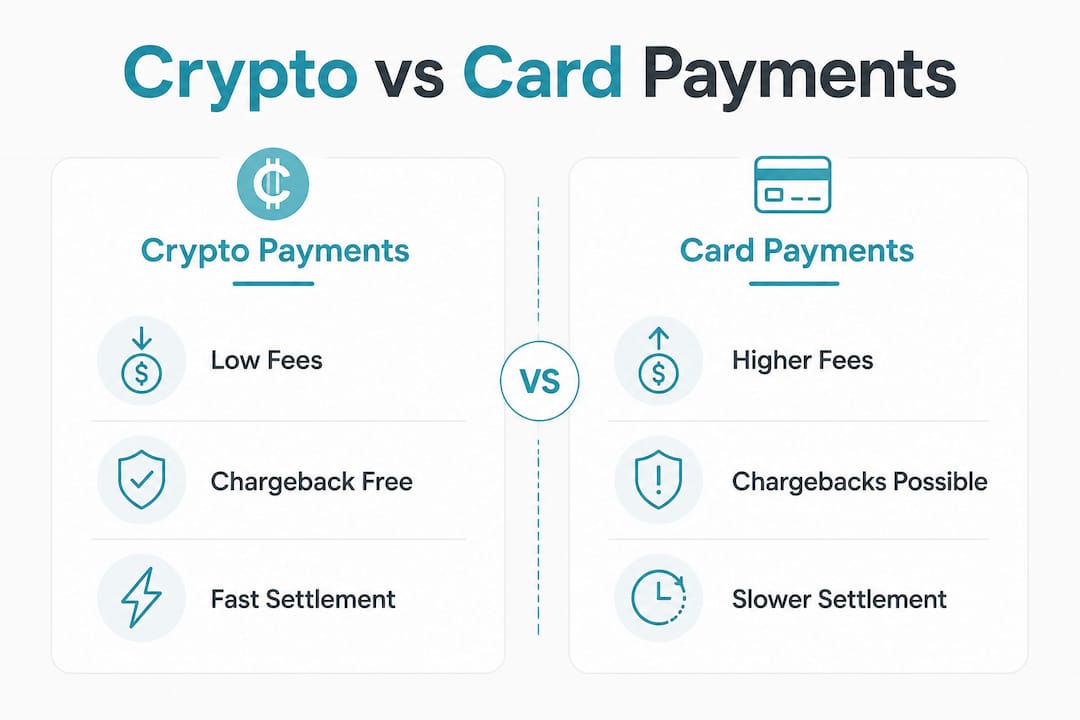
The single biggest advantage is cost. Card networks charge merchants between 1.5% and 3.5% per transaction. Crypto payment fees sit at 0.23%–1%. For a subscription business processing $500,000 per month, that difference saves tens of thousands of dollars annually.
The second major advantage is chargeback elimination. Blockchain transactions are final once confirmed, meaning no customer can reverse a payment after the fact. Chargeback fraud costs subscription businesses significant administrative time and money. Crypto removes that risk entirely because the blockchain ledger is immutable.

Settlement speed is the third advantage most businesses underestimate. Traditional card payments take 3–5 business days to settle. 75% of crypto gateways offered instant settlement by 2025. Faster settlement means better cash flow visibility and less working capital tied up in transit.
Global reach is the fourth advantage. Card networks block transactions in dozens of countries, and many potential subscribers simply lack bank accounts. Stablecoin cross-border payment volumes grew 32% year over year in 2025, and 76% of Southeast Asian users prefer crypto for its speed and reliability. Crypto subscriptions reach customers that fiat systems cannot.
Pro Tip: Use stablecoins like USDC or USDT for subscription billing rather than volatile assets like Bitcoin. Price stability protects both your revenue forecasts and your customers’ budgets.
Here is a quick comparison of the two payment models:
| Feature | Crypto payments | Traditional card payments |
|---|---|---|
| Processing fee | 0.23%–1% | 1.5%–3.5% |
| Settlement time | Instant to same day | 3–5 business days |
| Chargeback risk | None (blockchain finality) | High (reversible transactions) |
| Geographic reach | Global, permissionless | Restricted by card network rules |
| Refund process | Manual, merchant-initiated | Automated via card network |
How does crypto subscription billing technically work on-chain?
The core technical challenge with crypto subscriptions is that standard crypto wallets are push-only. The customer initiates every transaction manually. Card billing works the opposite way: the merchant pulls funds automatically each cycle. That pull model is what makes recurring billing work without customer friction.
Smart contract spending caps solve this problem. The customer authorizes a smart contract once, setting a maximum amount the merchant can pull per billing period. After that, the merchant’s system triggers the payment automatically within those authorized limits. No repeated customer action is required.
The process works in four steps:
- Customer authorizes a spending cap. The customer connects their wallet and signs a smart contract that sets the maximum billing amount and frequency. This is a one-time action.
- Merchant system triggers the payment. At each billing cycle, the merchant’s backend calls the smart contract to pull the authorized amount from the customer’s wallet.
- Blockchain confirms the transaction. The payment settles on-chain, typically within seconds to minutes depending on the network.
- Webhook updates the subscription status. The merchant’s system receives a real-time confirmation and updates the customer’s account access automatically.
Most recurring crypto payments fail without spending-cap smart contracts. Manual invoicing and token streaming are workable alternatives, but neither matches the reliability or user experience of the spending-cap model.
Token compatibility matters too. The smart contract must support the specific token the customer wants to pay with. A contract built for USDC will not automatically accept Ethereum or Bitcoin. Businesses need to define which tokens they accept before deployment.
Pro Tip: Build your subscription system to support at least one major stablecoin and one native token like ETH or BNB. This covers the majority of crypto-paying customers without overcomplicating your infrastructure.
What are the operational and financial considerations for adopting crypto subscriptions?
Crypto subscriptions are not a universal replacement for fiat billing. They are a strong addition for specific customer segments. Understanding where crypto wins and where it adds friction is the difference between a smooth rollout and a costly one.
Wallet setup creates onboarding friction. A customer who has never used a crypto wallet faces a steeper learning curve than clicking “pay with card.” Conversion rates drop when the checkout experience is unfamiliar. Businesses targeting crypto-native audiences, underbanked populations, or high-value cross-border customers will see the best results. Businesses with primarily card-comfortable domestic customers should treat crypto as an optional payment method, not a replacement.
Crypto refunds are more manual and operationally heavy than card refunds. There is no card network to process the reversal automatically. The merchant must initiate a new outbound transaction to the customer’s wallet. This requires clear internal policies, wallet address verification, and dedicated support workflows.
Finance team reconciliation is another real challenge. Fiat billing produces clean, currency-denominated records that feed directly into standard accounting software. Crypto billing requires tracking wallet addresses, token types, network fees, and asset conversion rates. Crypto billing shifts the compliance and record-keeping burden onto the merchant, requiring detailed audit trails for every transaction.
The customer segments that benefit most from crypto subscriptions are:
- Crypto-native users who already hold digital assets and prefer spending them directly.
- Underbanked customers in regions where card access is limited or unreliable.
- High-value cross-border subscribers who face card network blocks or high foreign transaction fees.
- Privacy-focused users who prefer transactions that do not require sharing card details.
Reducing subscription churn from card failures is another measurable benefit. Expired cards and institutional payment blocks cause involuntary cancellations that crypto eliminates entirely.
Pro Tip: Run crypto billing as a parallel payment option alongside fiat for the first six months. This lets you measure conversion rates and support volume before committing to a full integration.
How can businesses implement crypto subscription payments today?
Implementation does not require building a blockchain system from scratch. Several payment infrastructure providers offer plug-and-play crypto subscription tools that connect to existing business systems. The key is choosing the right architecture before writing a single line of code.
Start by defining your subscription parameters clearly. Decide the billing frequency, the accepted tokens, and the maximum spending cap per cycle. Stablecoins are the right default for most businesses because they eliminate price volatility from revenue forecasting. Native tokens like ETH or SOL make sense if your audience is deeply crypto-native and prefers holding those assets.
Webhook integration is non-negotiable for a reliable system. Webhook listeners automate invoice updating and user access control, linking each blockchain confirmation to the subscriber’s account status in real time. Without webhooks, your team manually checks the blockchain for payment confirmations, which does not scale.
Operational policies reduce involuntary churn. Key practices include:
- Sending wallet balance reminders 48–72 hours before each billing cycle.
- Building retry logic for failed transactions due to insufficient balance.
- Automating access suspension and reactivation based on payment status.
- Logging every transaction with wallet address, token type, amount, and network fee for finance reconciliation.
In-app crypto payments reduce involuntary churn caused by rejected cards and complex checkouts. Automated renewal reminders and real-time reporting improve payment success rates across global subscriber bases. For businesses with international audiences, this alone justifies the integration effort.
For a broader look at how crypto payments work for travelers and mobile-first users, the same principles apply: lower friction, faster access, and no geographic restrictions.
Key Takeaways
Crypto subscription payments deliver the strongest results when businesses combine on-chain billing infrastructure, stablecoin pricing, and automated webhook systems to serve global, crypto-native, and underbanked customer segments.
| Point | Details |
|---|---|
| Lower transaction costs | Crypto fees of 0.23%–1% beat card fees of 1.5%–3.5%, saving significant money at scale. |
| Chargeback elimination | Blockchain finality removes chargeback fraud risk, cutting administrative overhead. |
| Smart contract billing | Spending-cap authorizations enable automated recurring pulls without repeated customer approval. |
| Operational complexity | Crypto refunds and finance reconciliation require dedicated policies and audit-ready record-keeping. |
| Best-fit customer segments | Crypto-native, underbanked, and high-value cross-border subscribers see the greatest benefit. |
The honest case for crypto subscriptions in 2026
I have watched the on-chain billing space mature considerably since 2024, and the progress is real. Two years ago, recurring crypto payments were mostly theoretical. Today, spending-cap smart contracts and stablecoin rails make them genuinely viable for production subscription businesses.
What I find underappreciated is the churn reduction angle. Most subscription businesses obsess over acquisition costs and ignore the quiet revenue leak from failed card payments. Expired cards, institutional blocks, and cross-border declines silently cancel subscribers every month. Crypto eliminates that category of failure entirely. For any business with a meaningful international subscriber base, that alone is worth the integration effort.
The part I want to be direct about: crypto is not a replacement for fiat billing in 2026. It is a powerful addition for the right segments. Businesses that treat it as a universal solution will frustrate their mainstream customers. Businesses that deploy it as a parallel option for crypto-native and cross-border users will see measurable revenue gains with manageable operational overhead.
The future of crypto in subscription services points toward on-chain billing becoming a standard feature of payment infrastructure, not a niche experiment. The businesses that build the capability now will have a structural advantage when adoption reaches the mainstream. The ones that wait will spend twice as much catching up.
— Mohammed
Cryptoesim and crypto-powered global subscriptions
Cryptoesim sits at the intersection of crypto payments and global connectivity, making it a natural fit for anyone exploring subscription services that run on digital assets.
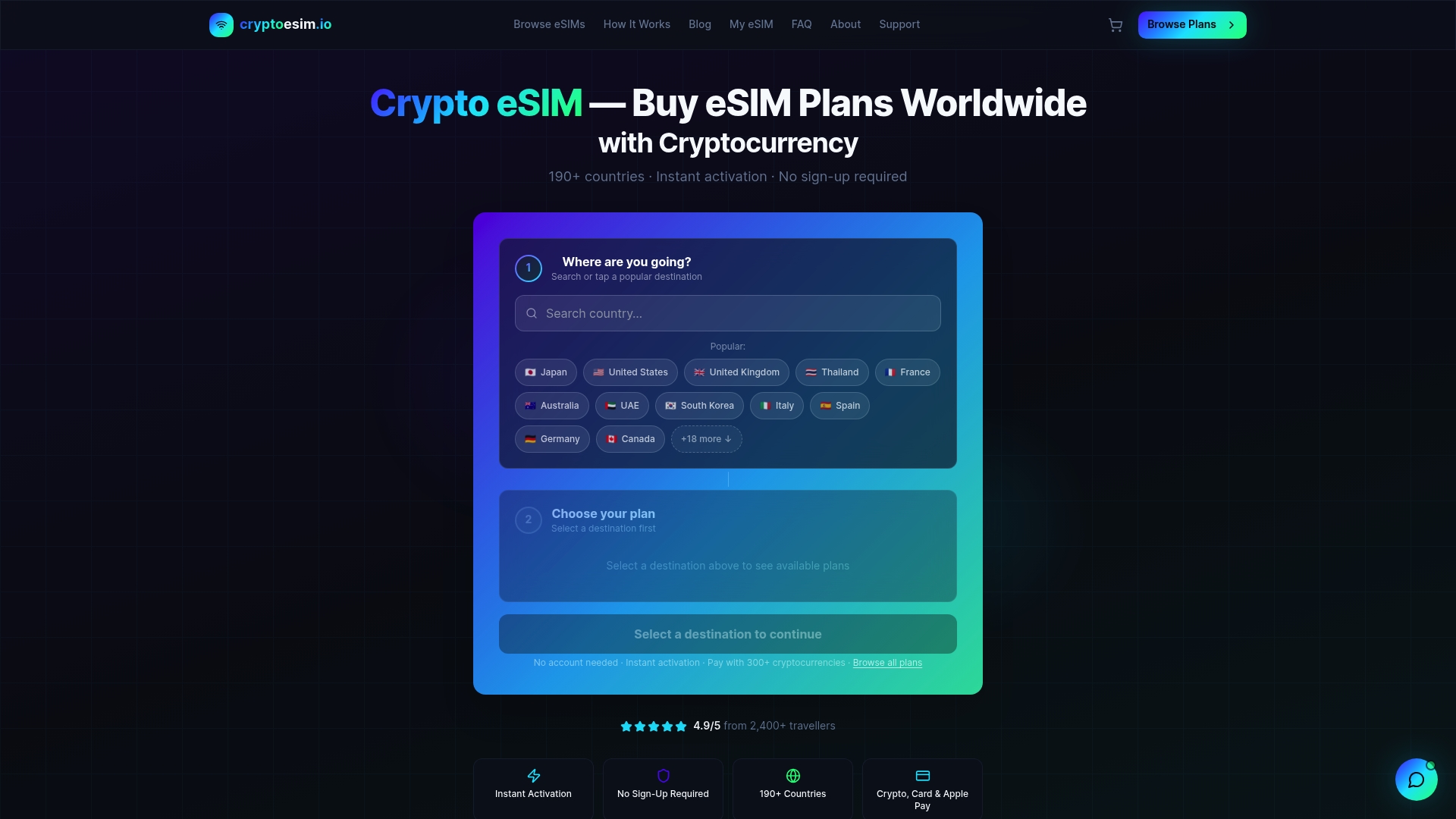
Cryptoesim accepts Bitcoin, Ethereum, and over 300 other tokens for eSIM data plan purchases across more than 190 countries. No account creation is required. Payments confirm instantly, and data access activates within minutes. For travelers, remote workers, and digital nomads who already hold crypto, this is the most direct path to mobile connectivity without touching a card or a bank. Cryptoesim also supports multi-currency crypto payments for international data plans, removing the foreign transaction fees and currency conversion friction that traditional payment methods add. Visit Cryptoesim to activate a plan today.
FAQ
What is on-chain billing for subscription services?
On-chain billing is a recurring payment model where transactions settle directly on a blockchain using smart contracts. It removes bank intermediaries, reduces fees, and enables instant settlement for subscription businesses.
Why use cryptocurrency for payments instead of cards?
Crypto processing fees range from 0.23% to 1%, compared to 1.5%–3.5% for card networks. Crypto also eliminates chargeback fraud because blockchain transactions are final once confirmed.
How do crypto subscriptions handle automatic renewals?
Smart contract spending caps authorize the merchant to pull a set amount from the customer’s wallet each billing cycle without requiring repeated customer approval. This mirrors the pull-payment model of traditional card billing.
Which businesses benefit most from crypto subscription payments?
Businesses serving crypto-native users, underbanked populations, and high-value cross-border customers see the strongest results. These segments face the most friction with traditional card networks.
Are crypto subscription refunds difficult to process?
Crypto refunds require the merchant to initiate a new outbound transaction manually, unlike card refunds processed automatically through the card network. Clear internal policies and wallet verification workflows are necessary to handle them efficiently.