Secure crypto payments guide: travel safely in 2026

Imagine landing in Bangkok, connecting to the airport Wi-Fi, and opening your crypto wallet to pay for a hotel. Within minutes, a clipboard malware attack silently swaps your recipient address, and your funds vanish into a stranger’s wallet forever. This is not a hypothetical. Travelers lose crypto to preventable attacks every day because they treat digital payments like cash, forgetting that blockchain transactions are irreversible and that unsecured networks are hunting grounds for sophisticated attackers. This guide walks you through the exact risks, tools, and step-by-step methods you need to pay with crypto abroad without losing sleep or funds.
Table of Contents
- Understanding crypto payment risks on the road
- Tools and preparations: What you need before you pay
- Step-by-step: Making secure crypto payments while traveling
- Troubleshooting and verifying crypto payments
- Our perspective: What most crypto security guides miss for travelers
- Get started with secure crypto-enabled travel
- Frequently asked questions
Key Takeaways
| Point | Details |
|---|---|
| Always use a VPN | Protect your wallet and payments by encrypting all public Wi-Fi connections. |
| Double-check addresses | Verify sender and recipient addresses every time—test sends help prevent unrecoverable losses. |
| Pick the right wallet | Use hardware wallets for storage and reliable, updated mobile wallets for daily spending. |
| Verify every transaction | Track and confirm payment status, and keep secure records of all transactions during travel. |
Understanding crypto payment risks on the road
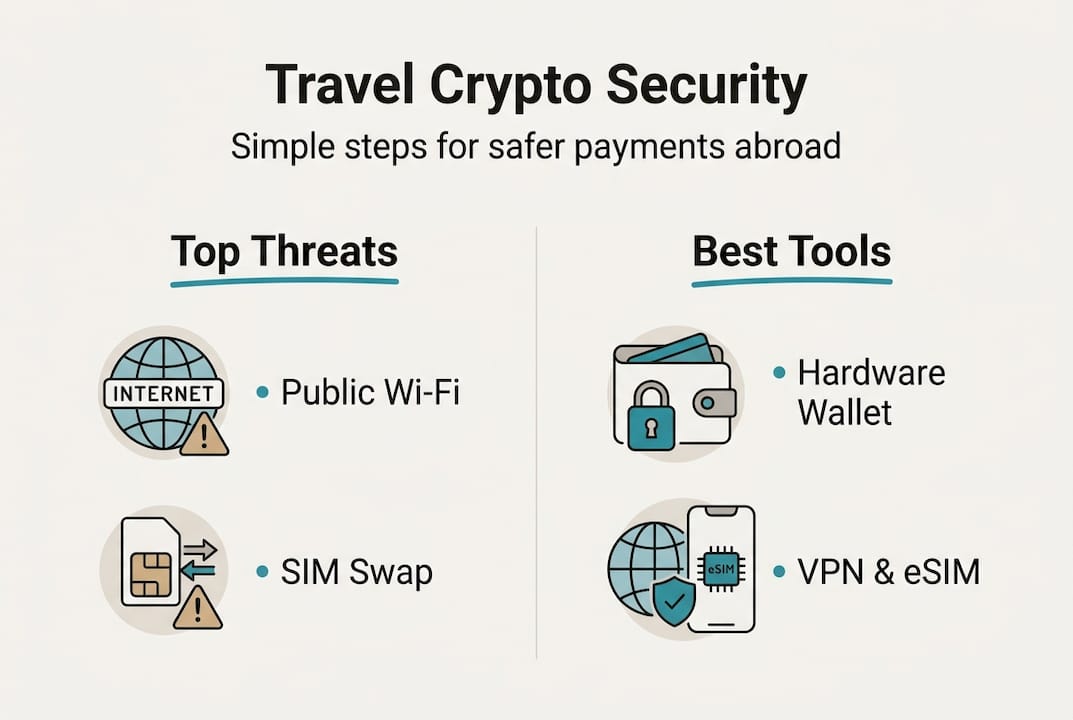
Public Wi-Fi is the single biggest threat most travelers underestimate. Coffee shops, airports, and hotel lobbies broadcast open networks that anyone nearby can monitor. On these networks, man-in-the-middle attacks let a bad actor intercept your traffic, capture session tokens, and even inject malicious scripts into unencrypted pages. Always use a VPN on public Wi-Fi to encrypt your connection and block interception before it starts.
Beyond Wi-Fi, three threats specifically target crypto users on the move. SIM swap fraud lets attackers convince your carrier to transfer your phone number to their device, bypassing SMS-based two-factor authentication. Clipboard malware, common on Android and Windows, monitors your clipboard and replaces copied wallet addresses with the attacker’s address the moment you paste. And because blockchain transactions are final, there is no chargeback, no dispute process, and no customer support line to call.
The scale of the crypto payment ecosystem makes these risks worth taking seriously. Over 15,000 merchants accept crypto globally, and crypto ATMs operate in more than 70 countries, meaning you will encounter real payment opportunities everywhere you travel. Understanding crypto payment basics before you leave home is not optional anymore.
DeFi vulnerabilities also matter even if you never touch a protocol directly. 2025 saw major DeFi hacks totaling hundreds of millions of dollars, exposing how arithmetic edge cases and reentrancy bugs can drain funds in seconds. The lesson for everyday travelers: the same carelessness that leaves smart contracts exposed leaves your mobile wallet exposed too.
Here are the major crypto payment risks you face on the road:
- Clipboard malware silently replaces wallet addresses when you paste
- SIM swap attacks bypass SMS-based authentication
- Man-in-the-middle attacks on public Wi-Fi intercept transactions
- Phishing sites mimic legitimate wallets or exchanges
- Physical theft of unlocked devices with open wallet apps
- Irreversible transactions mean mistakes are permanent
“The weakest link in mobile crypto security is almost always the device itself, not the blockchain.” Endpoint security, including app permissions, OS updates, and screen lock settings, determines whether your wallet stays yours.
Paying attention to mobile phone cyber attacks and how they target travelers specifically gives you a realistic picture of what you are up against. Combine that awareness with the right tools, and you shift the odds dramatically in your favor. Protecting privacy with crypto eSIMs is one layer of that defense, keeping your data connection off shared networks entirely.
Tools and preparations: What you need before you pay
Your security posture starts before you board the plane. The wallet you choose, the device you carry, and the apps you install all determine how exposed you are when you actually need to pay.
Wallet types and their travel trade-offs:
| Wallet type | Security level | Ideal use case | Portability |
|---|---|---|---|
| Hardware wallet | Very high | Large holdings, cold storage | Low (physical device) |
| Mobile wallet | Medium | Daily spending, small amounts | Very high |
| Multisig wallet | Very high | Shared accounts, large sums | Medium |
| Paper wallet | High (if stored safely) | Long-term backup only | High but fragile |
For most travelers, the smart approach is a two-wallet strategy. Keep the bulk of your crypto in a hardware wallet that never connects to public networks. Load a mobile wallet with only what you plan to spend in the next few days, treating it like cash in your pocket.

Verify wallet addresses fully before sending anything, and consider multisig setups for holdings above a few hundred dollars. Multisig requires multiple approvals before a transaction goes through, which means a single compromised device cannot drain your funds.
Before you travel, run through this preparation checklist:
- Update everything: OS, wallet apps, VPN clients, and authenticator apps
- Enable full-disk encryption on your phone and laptop
- Install a reputable VPN and test it before departure
- Set up an authenticator app (not SMS) for 2FA on all accounts
- Write down your seed phrase on paper and store it separately from your device
- Remove unused apps that request unnecessary permissions
Learn more about securing crypto data in transit to understand how encryption protects your wallet communications at the network level.
Pro Tip: Before any international trip, send a small test transaction of a few dollars to confirm your wallet, network, and recipient details all work correctly. Catching a configuration error at home costs nothing. Catching it abroad after a large send costs everything.
For travelers who want to combine secure data access with crypto payments, using crypto securely with eSIMs removes the public Wi-Fi problem entirely by giving you a private mobile data connection. Pair that with multi-currency crypto payments and you have a flexible, secure setup for almost any country.
Step-by-step: Making secure crypto payments while traveling
Knowing the risks and having the right tools only matters if you execute payments correctly. Here is a reliable sequence for every transaction abroad.
- Connect securely first. Use your eSIM data or activate your VPN before opening your wallet. Never initiate a transaction on public Wi-Fi without encryption active.
- Verify the recipient address manually. Copy the address, then check the first four and last four characters against the original source. Do not rely on visual scanning alone.
- Send a test transaction. For any new recipient or large payment, send a small amount first. Confirm it arrives before sending the full sum.
- Set appropriate network fees. Low fees cause delayed or stuck transactions, especially on congested networks like Ethereum mainnet. Check current gas prices before sending.
- Confirm the transaction details one final time. Amount, address, network, and fee. Then approve.
- Screenshot the transaction ID immediately. This is your proof of payment and your tool for tracking.
Address clipboard malware by pasting addresses and then manually retyping the last few characters to force yourself to look. Irreversible transactions demand this level of care.
Pro Tip: Always double-check the first two and last four characters of a wallet address before confirming. Clipboard malware typically changes only the middle section, banking on you not checking the ends.
Here is how common mobile payment approaches compare for travelers:
| Method | Speed | Security | Best for |
|---|---|---|---|
| QR code scan (in-person) | Fast | Medium (verify address) | Retail, restaurants |
| eSIM-enabled data payment | Fast | High (private network) | Online purchases |
| Payment processor (BitPay, etc.) | Medium | High | Established merchants |
| Crypto ATM | Slow | Low to medium | Cash conversion |
For mobile crypto payment security that scales across countries, the eSIM-plus-VPN combination consistently outperforms relying on local networks. When a transaction fails or gets stuck, check the block explorer for your network, confirm the fee was sufficient, and wait. Most stuck transactions resolve within a few hours. For managing crypto risks during volatile market periods, avoid large payments when prices are swinging hard, since the dollar value of your send can shift significantly between initiation and confirmation.
Troubleshooting and verifying crypto payments
Sending a transaction is only half the job. Confirming it arrived correctly, and knowing what to do when it does not, is what separates confident crypto travelers from stressed ones.
Every blockchain transaction has a unique ID called a transaction hash or TXID. Paste it into a block explorer (Etherscan for Ethereum, Mempool.space for Bitcoin) to see real-time confirmation status, fee paid, and receiving address. This takes 30 seconds and eliminates guesswork.
Common mistakes that cause payment problems:
- Wrong network selection: Sending ETH on the Polygon network to an exchange that only supports mainnet
- Insufficient fees: Transactions stuck in the mempool waiting for miners to pick them up
- Incorrect address: Sending to a valid but wrong address, which is irreversible
- Expired payment requests: Some merchants generate time-limited payment addresses
Crypto ATMs in 70+ countries offer a fallback option, but fees often run 5 to 15 percent, and some machines have known security issues. Use them only when necessary and always in well-lit, public locations.
Pro Tip: Always take a screenshot of the completed transaction screen and the recipient’s confirmation page. If a dispute arises, this is your evidence, and on-chain data backs it up permanently.
Best practices for post-transaction verification:
- Check block explorer within 5 minutes of sending
- Wait for at least 3 confirmations before considering a payment final
- Save the TXID in a notes app or email it to yourself
- Request a receipt or confirmation from the merchant where possible
- Enable wallet push notifications so you know when funds leave or arrive
If your phone is lost or stolen mid-trip, your seed phrase is your lifeline. Access your wallet on any device using that phrase. This is why storing it separately from your phone matters so much. For building stronger habits around digital security, security awareness training resources designed for fintech users translate directly to travel scenarios. Combine that with secure online purchases best practices, and you have a complete verification framework.
Our perspective: What most crypto security guides miss for travelers
Most crypto security content focuses on technical complexity: hardware wallets, multisig setups, air-gapped devices. That advice is solid in theory but often impractical when you are jet-lagged in a foreign city trying to pay for accommodation at midnight.
What actually causes crypto losses on the road is simpler and more human. Fatigue lowers your attention. Language barriers slow you down. Rushing to catch a train makes you skip the address verification step you know you should do. These are not technical failures. They are human ones.
The travelers who consistently avoid losses are not the ones with the most sophisticated setups. They are the ones who build simple, repeatable habits: always test send, always verify the last four characters, always use VPN before opening the wallet. Simple multi-step verifications outperform elaborate systems that you abandon under pressure.
For seamless crypto payments that hold up in real travel conditions, the goal is maximum security with minimum friction. If your security process is too complicated to follow when you are tired, it will fail exactly when you need it most.
Get started with secure crypto-enabled travel
You now have a complete framework for paying with crypto abroad, from understanding threats to verifying transactions and recovering from mistakes. The next step is making sure your data connection is as secure as your wallet.
CryptoEsim.io lets you buy eSIM data plans for over 190 countries using Bitcoin, Ethereum, and more than 300 other tokens, with no account required and no KYC friction. A private eSIM connection eliminates the public Wi-Fi risk at the source, giving you a secure channel for every payment you make on the road. Browse crypto travel tips and eSIM options to build a travel setup that keeps your funds and your data protected from the moment you land.
Frequently asked questions
Is it safe to use public Wi-Fi for crypto payments while traveling?
Using a VPN makes public Wi-Fi significantly safer, but the safest option is always a private eSIM data connection that bypasses shared networks entirely.
What should I do if my crypto transaction doesn’t go through?
Paste your TXID into a block explorer to check status, verify the address was correct, and confirm your network fee was sufficient before attempting any retry.
How do I securely store my crypto while on a long trip?
Use a hardware wallet for large holdings and a mobile wallet with multisig or 2FA enabled for daily spending, keeping only what you need accessible at any time.
Which countries have the most crypto-friendly payment options?
The US, most of Europe, Japan, and Singapore lead in crypto-accepting merchants, while crypto ATMs in 70+ countries give travelers a cash conversion fallback almost everywhere.